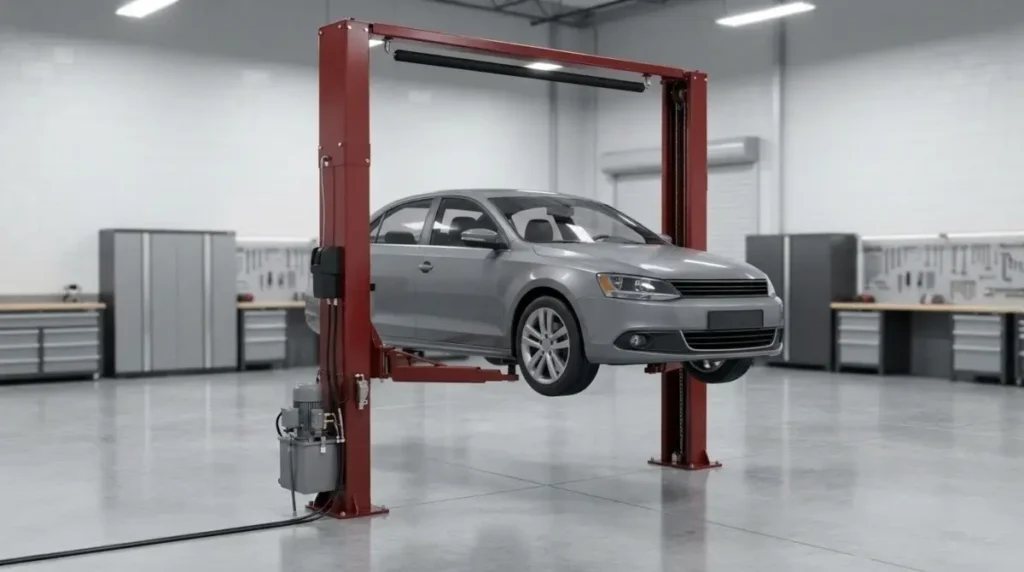
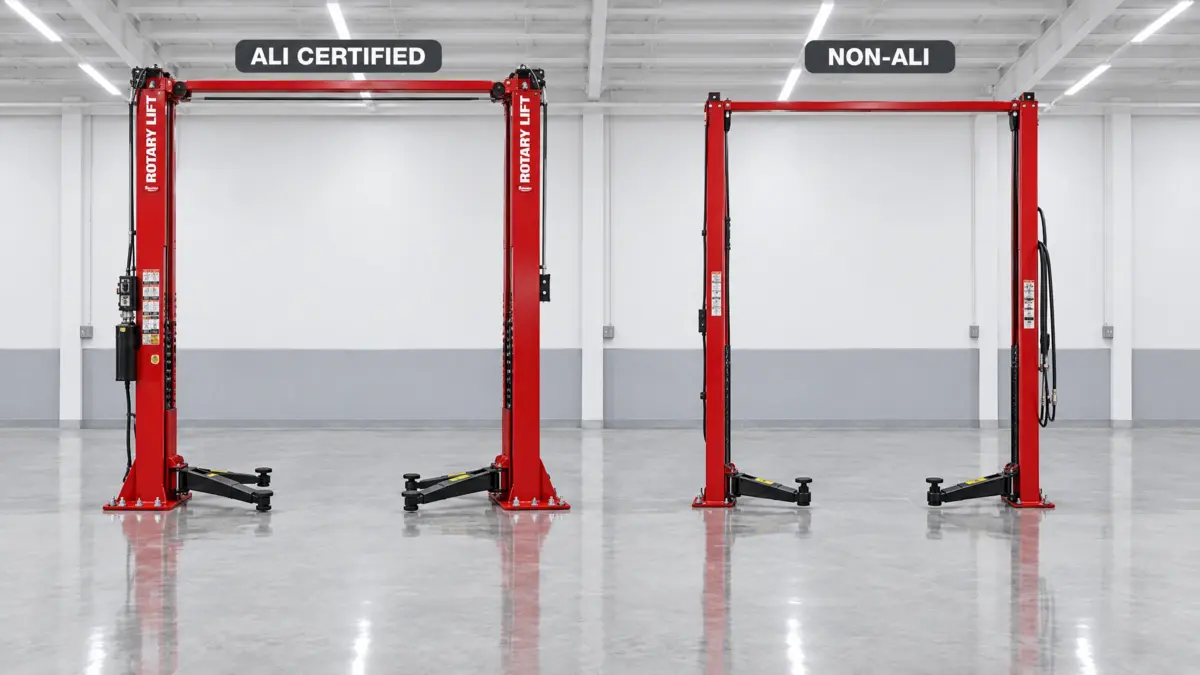
An ALI certified car lift is independently tested by a third-party laboratory to ANSI/ALI ALCTV to verify structural strength, hydraulic safety and electrical compliance, earning the official gold ALI Certified label. If you run a commercial repair shop, dealership, fleet bay or training facility in Canada or the United States where ministry inspectors, workplace safety officers, building officials or insurers check your bays, choose our ALI Certified 10,000 lb (4,536 kg) Daytona BR10-2OH-33.
If you are outfitting a private home garage, collector bay or solo shop where your local Authority Having Jurisdiction (AHJ) does not require a third-party certification sticker, a standard lift with automatic mechanical locks and aircraft-quality cables like the 10,000 lb (4,536 kg) Daytona LTPA10, the 9,000 lb (4,082 kg) Daytona LTPF9 or the 9,000 lb (4,082 kg) Daytona LFPP9 delivers dependable capability at a lower equipment cost.
One detail many buyers miss: under ANSI/ALI ALOIM, every commercial lift or hoist should be inspected at least once a year by a qualified lift inspector, whether or not the lift carries a certification label.
Buying the wrong lift for your building can stall a municipal permit sign-off, hold up an insurance audit or force you to overspend on third-party laboratory fees your bay does not need. Picking between an ALI certified car lift and a standard model comes down to who works under the hoist and which inspector walks through your door.
We manufacture both options across our 2-post lifts and 4-post lifts lineup so shop owners and home mechanics in Canada and the US can match their exact local code, ceiling height and budget. If you are still narrowing down lift categories, start with our guide to the different types of car lifts.
Key takeaways
- Sole ALI Certified model. The 10,000 lb (4,536 kg) BR10-2OH-33 is Daytona’s only ALI Certified lift (confirmed September 2026).
- Third-party validation. Gold-label certification requires independent structural overload testing, complete electrical system listing and unannounced factory inspections under ANSI/ALI ALCTV.
- Commercial bays. Shops with employees, dealerships, fleets and schools generally need an ALI Certified model to satisfy insurers, workplace safety officers and the local Authority Having Jurisdiction (AHJ).
- Home garages. Private residential bays are normally outside workplace safety rules, making standard models like the LTPA10, LTPF9 and LFPP9 practical choices.
- Identical 5-2-1 warranty. Both certified and standard Daytona lifts carry 5 years structural, 2 years power units and 1 year parts coverage for indoor use, with warranty parts freight covered in Canada and the continental US.
- No fake credentials. Terms like “ANSI certified” or “OSHA certified” are invalid; ANSI and OSHA do not certify products or inspectors.
- Planning ranges. Across North America, 2-post lift equipment typically runs $2,800 to $8,000, with total installed projects ranging from $3,000 to $13,000 depending on site prep.
What makes an ALI certified car lift different?
An ALI certified car lift has been independently tested and listed by an accredited third-party laboratory under the sponsorship of the Automotive Lift Institute (ALI) to confirm it meets ANSI/ALI ALCTV. A lift manufacturer cannot self-certify a hoist or claim compliance on its own paperwork. To earn the gold ALI Certified label, a lift model must clear three mandatory steps:
- Third-party structural overload testing. Independent laboratory engineers load-test the steel columns, carriages, swing arms, arm restraints and hydraulic cylinders under extreme conditions to confirm the hoist holds its rated capacity safely.
- Complete electrical safety listing. The entire electro-hydraulic lift assembly, not just the electric motor in isolation, is tested and listed to applicable US and Canadian electrical safety standards.
- Unannounced factory inspections. The manufacturing facility undergoes ongoing quality audits after initial testing to confirm that production units match the steel thickness, weld quality and mechanical safety locks of the tested sample.
Watch out for invalid certification claims
When comparing equipment or inspection services, watch for phrases that sound official but do not exist. According to ALI, nobody can sell an “ANSI certified” or “OSHA certified” car lift, and there is no such credential as an “OSHA certified lift inspector.” ANSI accredits standards developers and OSHA enforces workplace safety under the General Duty Clause, but neither agency tests or certifies products. Look for models certified to ANSI/ALI ALCTV by an accredited third party, and use an ALI Certified Lift Inspector for annual inspections under ANSI/ALI ALOIM.
Understanding how certification testing works sets up the practical question for your bay: how does our certified model compare side by side against our standard 2-post lineup?
How does the ALI Certified BR10-2OH-33 compare to standard Daytona lifts?
The Daytona BR10-2OH-33 and Daytona LTPA10 share a 10,000 lb (4,536 kg) capacity, dual direct-drive hydraulic cylinders, automatic mechanical locks with single-point release and our 5-2-1 warranty, while the BR10-2OH-33 adds third-party ANSI/ALI ALCTV certification, 3-stage arms and standard height extensions. Those 3-stage arms and included stackable extensions (1½ in., 3 in. and 6 in.) give technicians extra reach flexibility when positioning pads on short-wheelbase cars, unibody crossovers, electric vehicles (EVs) and full-size trucks.
| Feature or specification | BR10-2OH-33 (ALI Certified) | LTPA10 (Standard overhead) | LTPF9 (Standard floorplate) | LFPP9 (Standard 4-post) |
|---|---|---|---|---|
| Official gold ALI Certified label | Yes (Daytona’s sole ALI Certified model, confirmed September 2026) | No (Standard) | No (Standard) | No (Standard) |
| Rated lifting capacity | 10,000 lb (4,536 kg) | 10,000 lb (4,536 kg) | 9,000 lb (4,082 kg) | 9,000 lb (4,082 kg) |
| Lift configuration | Clear-floor overhead 2-post with 3 width settings | Adjustable-width overhead 2-post (88.6" / 94.5" / 100.4") | Open-top floorplate 2-post for low ceilings (110" overall height) | 4-post drive-on parking lift (70.9" max clearance) |
| Drive system & arms | Dual direct-drive cylinders · 3-stage arms | Dual direct-drive cylinders · Adjustable width | Chain-over hydraulic cylinders · Floorplate equalization | Hydraulic cylinder with aircraft-quality lifting cables |
| Mechanical safety locks | Automatic locks with single-point release & overhead limit switch | Automatic locks with single-point release & overhead limit switch | Automatic mechanical safety locks & height limit switch | Primary and secondary mechanical lock systems |
| Included accessories | Drop-in pads plus 1½ in., 3 in. and 6 in. height extensions included (BR10-2OH-33-EXT compatible) | Optional 2 ft height extension kit (LTPA10-EXT) | Standard frame contact pads | Drip trays, tool tray and removable aluminum ramps included |
| Electrical power spec | 240V / 3HP / 12A / 1PH / 60Hz | 240V / 3HP / 13A / 1PH / 60Hz | 240V / 3HP / 13A / 1PH / 60Hz | 120V / 1.5HP / 1PH / 60Hz |
| Daytona 5-2-1 warranty | 5 Yr Structural / 2 Yr Power Units / 1 Yr Parts (Indoor use only) | 5 Yr Structural / 2 Yr Power Units / 1 Yr Parts (Indoor use only) | 5 Yr Structural / 2 Yr Power Units / 1 Yr Parts (Indoor use only) | 5 Yr Structural / 2 Yr Power Units / 1 Yr Parts (Indoor use only) |
| Best fit | Commercial repair shops, dealerships, municipal fleets & inspected bays | Home garages, private shops & non-inspected full-height bays | Low-ceiling residential garages & private service bays | Collector storage, home parking bays & wheel-engaged service |
If your shop services heavier commercial trucks and does not require a gold label, you can also step up to the 12,000 lb (5,443 kg) LTPA12, the 12,000 lb (5,443 kg) low-ceiling LTPF12 or the 15,000 lb (6,804 kg) LTPO15 (which ships with a 2 ft height extension kit and must be assembled with it). For a complete comparison across every 2-post capacity band, read our best 2-post car lift buyer’s guide and our guide to 2-post lift dimensions.
When do you need an ALI certified 2-post lift in Canada or the USA?
You need an ALI certified lift whenever your local Authority Having Jurisdiction (AHJ), provincial workplace safety ministry, OSHA compliance officer or commercial insurance underwriter requires third-party listing to ANSI/ALI ALCTV. Code and listing rules vary by province, state and municipality, so the safest move for any employer bay is confirming requirements with your local building department and insurer before ordering.
| Facility or bay type | Who typically inspects or audits | Is an ALI Certified lift typically required? | Recommended Daytona model |
|---|---|---|---|
| Commercial repair shop or dealership (with employees) | Provincial Ministry of Labour / WorkSafe, OSHA, municipal AHJ & garage liability insurer | Yes, normally required by workplace regulators, adopted building codes and insurers | BR10-2OH-33 (10,000 lb ALI Certified) |
| Municipal, utility or government fleet bay | Public-sector safety officers, procurement specs & municipal code officials | Yes, public fleet tenders almost always specify ANSI/ALI ALCTV certification | BR10-2OH-33 (10,000 lb ALI Certified) |
| High school, college or trade training shop | School board risk managers, provincial/state safety inspectors & municipal AHJ | Yes, institutional bays require third-party certification and annual inspections | BR10-2OH-33 (10,000 lb ALI Certified) |
| Solo owner-operated commercial bay (no employees) | Commercial building landlord, municipal permit office (AHJ) & shop insurance underwriter | Depends on local AHJ permit rules, lease terms and commercial insurer policy | BR10-2OH-33 or LTPA10 (confirm with AHJ & insurer) |
| Private residential home garage or hobby shop | Local municipal building department only if a building or electrical permit is pulled | Rarely required unless the municipality enforces 2024 IRC R317.7 where adopted | LTPA10, LTPF9 or LFPP9 |
Canadian provinces vs. US states: how hoist inspections work
In Ontario and across Canada, mechanics and inspectors frequently refer to a vehicle lift as an automotive hoist. Provincial workplace safety regulators (including the Ontario Ministry of Labour, Immigration, Training and Skills Development, WorkSafeBC, CNESST in Quebec and Alberta OHS) require commercial shop hoists used by workers to comply with recognized safety standards such as CSA B167 / ANSI/ALI ALCTV and undergo an annual inspection by a qualified lift inspector under ANSI/ALI ALOIM.
In the United States, federal and state OSHA offices enforce workplace lift safety through the General Duty Clause by referencing ANSI/ALI ALCTV and ANSI/ALI ALOIM as the recognized national consensus standards, while municipal building departments enforce adopted editions of the International Building Code (IBC). Installing the Daytona BR10-2OH-33 gives commercial managers on both sides of the border the gold ALI Certified label that inspectors, permit offices and commercial insurance underwriters look for during bay audits. Once installed, ALI recommends a Check360 inspection at commissioning and requires documented operator training before the hoist enters service.
Outfitting a commercial shop or private garage? Take your ceiling height, bay width and the vehicles you work on to a local Daytona distributor. They quote, deliver and install, including single home-garage orders. Have a question first? Talk to our team.
Get a Quote From Your Local DistributorRunning a home garage or private bay? Here is what changes
Workplace safety agencies govern commercial employers with staff, though some municipalities adopt residential building code provisions such as 2024 IRC Section R317.7 where adopted by the local AHJ. Always check with your local municipal building department before installing a residential hoist, especially if your project requires a building or electrical permit.
When your local AHJ does not require a third-party certification sticker for a private residential garage, farm shop or collector storage building, our standard automotive lifts give you built-in mechanical safety without the third-party laboratory cost premium:
- Full-height home bays. The 10,000 lb (4,536 kg) LTPA10 offers three adjustable width settings (88.6 in., 94.5 in. and 100.4 in., or 2,250 mm, 2,400 mm and 2,550 mm) to fit tight residential bays. Check our guide on 2-post lift placement and distance from a wall before marking your floor.
- Low-ceiling garages. If an overhead beam will not clear your garage door tracks or roof trusses, the 9,000 lb (4,082 kg) LTPF9 (110 in. or 2,794 mm overall height) or 6,000 lb (2,722 kg) LMS6 mid-rise scissor lift solve vertical clearance constraints. See our full breakdown on fitting a 2-post car lift for an 8-foot ceiling.
- Vehicle storage and detailing. The 9,000 lb (4,082 kg) LFPP9 4-post parking lift runs on 120V / 1.5HP / 1PH / 60Hz power and pairs with our air-powered RAJ5 5,000 lb rolling jack or RAJ6 6,000 lb rolling jack (rolling jacks are designed for Daytona lifts and may not fit other brands). If you are weighing runway storage against frame-engaging service, read 2-post lift vs 4-post lift.
What 3 things should you check before buying a non-certified car lift?
Before purchasing a standard non-certified lift, verify that it includes automatic mechanical safety locks, a multi-year structural warranty that covers replacement parts freight and local distributor installation support. Not all non-certified lifts are built the same, and verifying these three details protects your bay from unbacked imports:
- Built-in mechanical safety locks (never hold a vehicle on hydraulics alone). Every Daytona lift, certified or standard, uses automatic mechanical safety locks that engage as the lift rises, backed by high-polymer polyethylene wear-resistant slide blocks and rubber door guards. Overhead 2-post models include single-point lock release and a padded overhead shutoff bar that stops the motor if a tall roof approaches the top beam. Review our how to use a car lift safely checklist for daily lock habits.
- A real 5-2-1 warranty with freight included. Many online sellers advertise a 1-year warranty that leaves you paying hundreds of dollars in shipping for a heavy replacement part. Daytona’s 5-2-1 limited warranty covers structural components for 5 years, power units (motors, pumps, cylinders and seal kits) for 2 years and non-wearing parts for 1 year from the purchase invoice date, with warranty parts freight covered across Canada and the continental US. All Daytona equipment is for indoor use only; outdoor use, overloading or improper installation voids the warranty, and electronic or wearing parts (cables, hoses, slider blocks, rubber pads) are excluded.
- Local distributor installation, concrete verification and parts support. A 2-post lift relies on a sound concrete slab and proper electrical feed. Your local Daytona distributor can inspect your bay, supply the lift and handle professional installation. Before installation, review our car lift installation guide, how thick of concrete for a 2-post lift and 2-post lift power requirements.
Concrete and electrical safety reminder
Always follow the installation manual for your specific lift model and consult a qualified professional before drilling, especially if your building has a post-tension slab, radiant floor heat, cracks or a suspended slab. For electrical hookups, a dedicated circuit and a licensed electrician are required under the NEC in the US and CEC CSA C22.1 in Canada (ESA in Ontario). Your licensed electrician sizes the breaker and wire from the lift’s data plate, the manual and local code.
How much does certification affect car lift cost and project budgeting?
Third-party laboratory testing and ongoing plant inspection fees place an ALI certified lift toward the upper end of the $2,800 to $8,000 North American 2-post lift equipment range, while total installed projects typically run $3,000 to $13,000 across all lift types. Because Daytona sells through authorized regional distributors on a quote basis, your local dealer builds an exact quote around five price drivers: capacity, configuration (overhead vs floorplate vs adjustable-width), certification (BR10-2OH-33 vs standard), included equipment (such as standard drop-in pads and extensions) and warranty support.
When planning your budget using the Five F’s (Fixture, Freight, Floor, Feed and Fitting), use these representative North American planning ranges (surveyed September 2026):
- Fixture (lift equipment only). Two-post lifts (9,000 to 15,000 lb, all configurations) typically run $2,800 to $8,000; four-post parking lifts (9,000 to 10,000 lb) run $3,200 to $7,500; mid-rise scissor lifts (6,000 lb) run $2,000 to $4,500; high-rise scissor lifts (6,600 lb like the LHS7) run $3,500 to $6,500; motorcycle/ATV lifts (2,200 lb like the LMATV) run $1,500 to $3,000.
- Freight. Delivery typically runs $300 to $900, with liftgate or residential delivery surcharges extra.
- Floor (concrete work). Ranges from $0 on an existing qualifying slab up to $3,000 for major work, with localized pad pours or slab thickening typically running $600 to $1,500.
- Feed (electrical circuit). Having a licensed electrician install a new dedicated circuit near the panel typically runs $300 to $900 (longer conduit runs or panel upgrades cost more).
- Fitting (installation labor). Professional installation typically runs $400 to $1,500 overall ($700 to $1,500 for a 2-post lift, $400 to $900 for a 4-post parking lift and $300 to $700 for a scissor lift).
For a full breakdown of equipment and site-prep budgeting, see our car lift cost guide, home garage car lift cost breakdown and car lift installation cost guide. Commercial shops calculating bay payback can review car lift ROI, and buyers looking to spread out capital costs can explore car lift financing (third-party financing may be available through NewLane Finance in the US or Active Growth Financial in Canada; approval is not guaranteed).
Built for your shop. Ready for your bay.
Tell your local Daytona distributor whether your bay requires an ALI Certified hoist for commercial inspections or a standard lift for a private garage, along with your ceiling height and slab thickness. They will recommend the right model, quote it and install it. Have a question first? Talk to our team.
- BR10-2OH-33 (ALI Certified). 10,000 lb (4,536 kg) overhead 2-post, dual direct-drive, 3-stage arms, drop-in pads and 1½ in., 3 in. and 6 in. extensions included.
- LTPA10 & LTPF9 (Standard). 10,000 lb (4,536 kg) adjustable overhead and 9,000 lb (4,082 kg) low-ceiling floorplate 2-post lifts with automatic mechanical locks.
- 5-2-1 warranty. 5 years structural, 2 years on power units, 1 year on parts, with warranty parts freight covered in Canada and the continental US. Indoor use only.
- Since 1999. Canadian-owned manufacturer serving the US and Canada through authorized local distributors.
About the author
The Daytona Team
Written by the team at Daytona Automotive Equipment, a Canadian-owned manufacturer of automotive lifts, tire changers and wheel balancers since 1999.
- Specializations. 2-post and 4-post lift specification, bay layout planning, ANSI/ALI certification guidance and distributor technical support across Canada and the United States.
- Standards. Guidance aligned to ANSI/ALI ALCTV construction and testing standards, ANSI/ALI ALIS installation practice and ANSI/ALI ALOIM operation, inspection and maintenance practice.
- Reviewed by. Daytona product and technical support staff, November 2026.
Daytona Automotive Equipment Inc. · Brighton, ON, Canada · Automotive lifts, tire changers and wheel service equipment since 1999.
References and sources
- Automotive Lift Institute (ALI). ALI Lift Certification Program & ANSI/ALI ALCTV Overview. Automotive Lift Institute, current edition.
- Automotive Lift Institute (ALI). ANSI/ALI ALOIM: Standard for Automotive Lifts: Safety Requirements for Operation, Inspection and Maintenance. Automotive Lift Institute, current edition.
- Automotive Lift Institute (ALI). ALI Certified Lift Inspector Program & Check360 Inspection Guide. Automotive Lift Institute, current edition.
- Automotive Lift Institute (ALI). Vehicle Lifting Points for Frame-Engaging Lifts. Automotive Lift Institute, current edition.
Figures in this article are representative for planning and are not quotations. Code and certification requirements depend on your local Authority Having Jurisdiction (AHJ). Confirm concrete, electrical and clearance requirements against the installation manual for your specific lift before purchase or installation. Daytona Automotive Equipment is not affiliated with Harbor Freight’s Daytona tool brand.