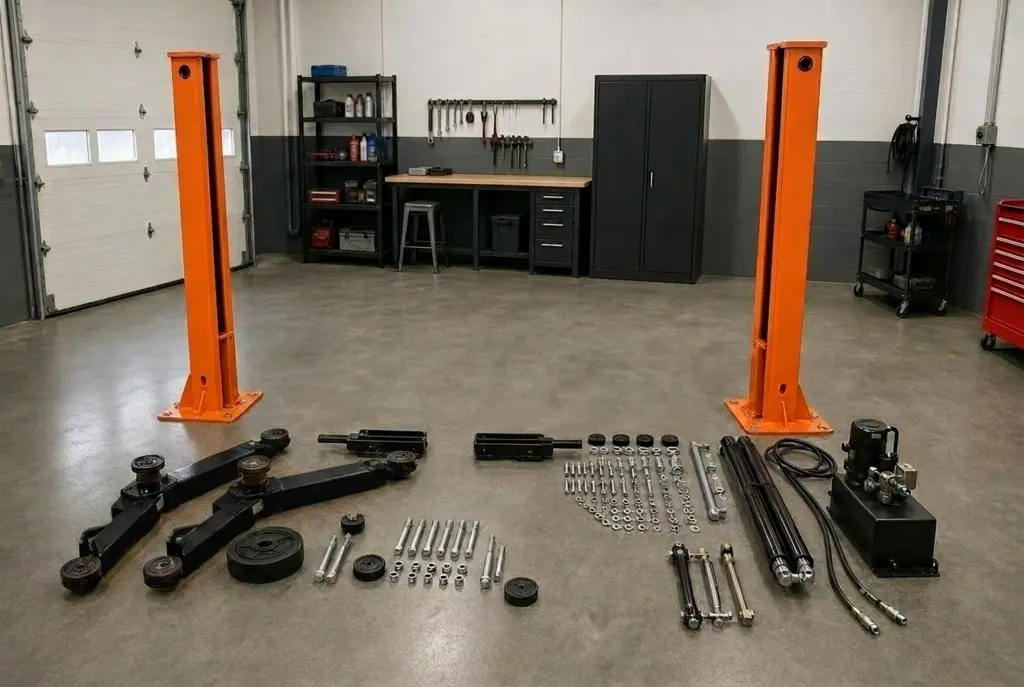
Car lift installation has four stages. You confirm the slab, ceiling, power and bay layout meet your lift manual. You stand and anchor the columns or runways. You connect the cables, hydraulics and power. Then you run no-load test cycles before any vehicle goes up.
Two capable people usually need four to six hours for the mechanical work on a 2 post lift, once the site is ready. A licensed electrician handles the circuit separately.
A home garage with a verified slab and the right tools can be a realistic DIY job. A commercial bay, an unknown slab or an overhead model with no second helper is a job for a qualified installer or your local Daytona distributor.
The lift is sitting in your bay on a freight pallet, the power unit strapped on top. Now the real question arrives: do you set it up yourself, or call someone?
It is a fair question. A car lift holds thousands of pounds of vehicle over your head, and the difference between a clean car lift installation and a dangerous one usually comes down to details most people never think about until they are drilling.
This guide covers what the job takes, who should do it, and the order to do it in. It focuses on 2 post lifts, the most common install, and explains how 4 post, scissor, parking and motorcycle lifts differ. Daytona has supplied shops and home garages across the US and Canada since 1999, and the approach below reflects that experience.
Read this first
This is a general reference. Every lift ships with an installation manual containing the exact specifications for that model. If anything here differs from your manual, the manual wins. When in doubt, stop and follow it.
Key takeaways
- Plan first. Slab, ceiling, power and layout must all pass before install day. Most failed installs are failed plans.
- Concrete. Many 9,000 to 10,000 lb (4,082 to 4,536 kg) 2 post lifts need at least 4 to 4¼ in. (102 to 108 mm) of cured 3,000 PSI (20.7 MPa) concrete. Your manual sets the real figure.
- Anchors. Anchor size, depth and torque are specified in your model’s manual. Use a calibrated torque wrench, not an impact gun.
- Power. Have a licensed electrician run the circuit; see the manual. Daytona 2 post lifts run on 240V single phase.
- Code. Requirements vary by jurisdiction and are set by your local building department. Call before you order.
- Who installs. A qualified installer or your local Daytona distributor. ALI certifies lift inspectors, not installers.
- Testing. Run at least three no-load cycles before the first vehicle, and record the results.
What does car lift installation involve?
Car lift installation is a site job first and an assembly job second. The bolting and routing are straightforward with a manual and a helper. Most of the risk sits in the floor under the lift and the decisions made before delivery.
Every lift type follows the same broad pattern: verify the site, position, anchor, plumb, connect, test. On a 2 post lift, those steps carry the most consequence, because two columns transfer the full vehicle load and its tipping force into a handful of anchors.
| Phase | What happens | Typical time |
|---|---|---|
| 1. Verify the site | Slab, ceiling, power, code and bay layout confirmed against the manual | Before install day |
| 2. Lay out the columns | Chalk line, column spacing, orientation and square check | 45–60 minutes |
| 3. Drill and anchor | Drill, clean, set anchors, shim plumb, torque to the manual value | 60–90 minutes |
| 4. Assemble and connect | Overhead beam or floorplate, cables, hydraulic lines and fluid | 90–150 minutes |
| 5. Commission | Arms and restraints, bleeding, no-load cycles and a written record | 45–60 minutes |
Should you install a car lift yourself or hire a professional?
A hands-on owner with a verified slab, the right tools and a capable helper can install a 2 post lift in a home garage. A commercial bay should use a qualified installer. Be honest about the job before you commit.
In North America, the ANSI/ALI ALIS standard covers lift installation and service, including installer training and the documents an owner should keep. Professional installers work to it, and it exists because installation errors are a leading cause of lift problems.
| Your situation | Recommended path |
|---|---|
| Commercial shop, dealership or any workplace bay | Qualified installer, with installation records kept on file |
| Slab thickness, strength or age unknown | Verify the slab first, then use a qualified installer |
| Post-tension, repaired or suspect slab | Structural engineer review before anyone drills |
| Home garage, verified slab, two capable people | Self-install is realistic if you follow the manual exactly |
| No rotary hammer or calibrated torque wrench | Rent the tools first, or hand the job to a qualified installer |
| Overhead model and no second helper | Qualified installer |
There is a warranty side too. Daytona’s 5-2-1 warranty becomes invalid if equipment is improperly installed or the installation instructions are not followed. That is not a trap. A badly anchored lift damages itself in ways a well anchored one never does.
There is no prize for doing it the hard way. If you would rather hand it off, your local Daytona distributor can quote, deliver and install, including single home-garage orders.
Four site checks before you install a car lift in your garage
Treat these as hard stops. If any one fails, fix it before the lift arrives. Each is cheap to solve in advance and expensive to solve after you have drilled holes in a slab.
| Check | What to confirm | Stop if |
|---|---|---|
| 1. Slab | Thickness, strength and cure age at both column positions, with no cracks or joints in the footprint | Anything is below the manual minimum, or unknown |
| 2. Ceiling | Overall lift height plus a buffer, and the roof of your tallest vehicle at working height | Clear height to the lowest obstruction is too low |
| 3. Power | A dedicated circuit matching the spec plate, within reach of the power column | No dedicated circuit exists yet |
| 4. Layout | Bay width and length, column spacing, walking room and nothing in the footprint | Ducts, beams, lights or drains sit where the lift goes |
Check 1: the concrete slab
This is the only check that fails catastrophically. The anchors do not hold the lift. The concrete around them does. Use the figures below for planning, then confirm against your manual.
| Lift capacity | Common minimum | Better for a new pour | Concrete strength |
|---|---|---|---|
| 9,000–10,000 lb (4,082–4,536 kg) | 4–4¼ in. (102–108 mm) | 6 in. (152 mm) reinforced | 3,000 PSI (20.7 MPa) or more |
| 12,000 lb (5,443 kg) | 6 in. (152 mm) | 6–8 in. (152–203 mm) reinforced | 3,500–4,000 PSI (24–27.6 MPa) |
| 15,000 lb (6,804 kg) | 6–8 in. (152–203 mm) | 8 in. (203 mm) reinforced | 4,000 PSI (27.6 MPa) preferred |
New concrete needs at least 28 days of cure before anchoring. Keep anchors clear of expansion joints, control joints, slab edges and cracks. Never drill a post-tension slab until a qualified professional has scanned and verified the cable locations. Our concrete thickness guide for 2 post lifts covers test holes, core samples and what to do if the slab is too thin.
Check 2: ceiling height and clearance
Measure to the lowest obstruction with the garage door open, not to the drywall. Door tracks, opener rails and light fixtures all count. Then check two things: the lift itself plus a 6 in. (152 mm) buffer, and the roof of your tallest vehicle at the lock height you will use.
Most overhead 2 post lifts need about 12 ft (3.66 m) or more. If your ceiling is tight, the LTPF9 at 110 in. (2.79 m) and the LTPF12 at 114 in. (2.90 m) have no overhead crossbar. For the tightest garages, read our guide to a 2 post car lift for an 8 foot ceiling.
Check 3: electrical supply
Daytona 2 post lifts run on 240V single phase, 60Hz, drawing roughly 12 to 13 amps depending on the model. Many 4 post parking lifts and some mid-rise scissor lifts run on 120V. The exact figures are on the spec plate.
Have a licensed electrician run the circuit; see the manual. Position the receptacle or disconnect so the supplied cord reaches the power column without an extension. New circuits usually need a permit and inspection. Our 2 post lift power requirements guide lists what to ask your electrician.
Check 4: bay layout
Plan roughly 12 ft (3.66 m) wide by 24 ft (7.32 m) long for a passenger vehicle on a 2 post lift, with about 3 ft (0.91 m) of walking room past each column. Confirm the center-to-center column spacing in your manual before marking anything.
Adjustable models help in awkward bays. The LTPA10 and LTPA12 each offer three width settings. For model-by-model widths and footprints, see our 2 post lift dimensions guide.
Indoor use only
All Daytona equipment must be installed and used indoors. Equipment installed outdoors is not covered by warranty.
Building code, permits and ALI certification
Code and listing requirements for car lifts vary by jurisdiction and are set by your local building department, the Authority Having Jurisdiction (AHJ). It decides whether the lift, the electrical work or both need a permit, and which code edition and standards apply where you live.
The 2024 International Residential Code and International Building Code include provisions for automotive lifts, covering listing and labeling and where a lift may be installed in a home. The Automotive Lift Institute publishes a plain-language summary of the 2024 IRC lift requirements. Whether your jurisdiction has adopted that edition, and how it applies it, is a question for your AHJ.
Lift certification is granted per model, not per brand. You can check any model in the ALI Directory of Certified Lifts. Daytona’s BR10-2OH-33 10,000 lb overhead 2 post lift is ALI Certified, which makes it the straightforward choice if your jurisdiction requires a certified lift. It is the only ALI Certified model in the Daytona range.
Call before you order
Ask your building department three questions: does the lift need a permit, does the electrical circuit need a permit, and are there listing or certification requirements for lifts. Then ask your distributor what local installs usually require.
Tools, people and time for vehicle lift installation
Gather everything before you start. Stopping halfway through an anchor set to hunt for a socket is how columns end up out of plumb.
You will need a rotary hammer with the bit size your manual specifies, a shop vacuum and hole brush, a calibrated click-type torque wrench, a 4 ft (1.22 m) level, a chalk line, a tape measure, a full socket set, a pry bar and steel shims. Add safety glasses, gloves, hearing protection and a dust mask.
A lift typically arrives on a freight truck at well over 1,000 lb (454 kg). Plan for a forklift or engine hoist to unload and uncrate it, and to lift the overhead beam safely.
Two people is the minimum. The columns are heavy, the overhead beam is awkward, and several steps need one person holding while the other measures. Book a full working day and do not set a deadline you will be tempted to rush.
Automotive lift installation step by step: a 2 post lift
The 2 post is the most common shop and home lift, so it is the example here. Your manual sets the sequence, spacing and values for your model. Use these steps to understand the job, not to replace it. For a deeper walkthrough, see our 2 post lift installation guide.
Step 1: unpack and pre-thread
Unpack everything and check it against the packing list. While the columns are still lying flat, thread the equalizer cables through them. Doing it on the floor is far easier than fighting cables once the columns are standing.
Step 2: lay out and stand the columns
Snap a chalk line and measure the center-to-center column spacing from your manual. Confirm whether your lift is set up symmetric or asymmetric. Asymmetric columns are rotated slightly so car doors open wider, and getting it backwards means drilling twice.
Stand each column with your helper, align the base plates to the line and check square by measuring both diagonals. When the diagonals match, the layout is square. Mark the drill points through the base plate holes.
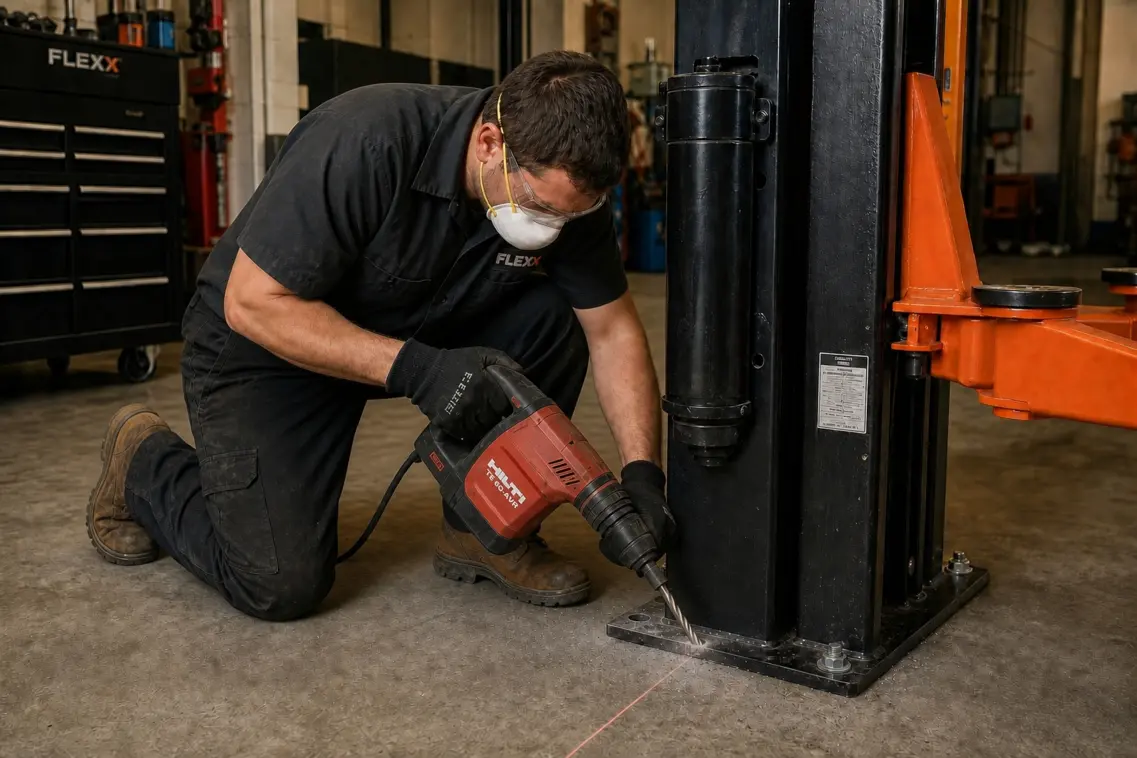
Step 3: drill, clean and anchor
Drill each hole straight down, keeping the drill perpendicular to the floor. Vacuum, brush and vacuum again. Set the anchors, then shim under the base plate until the column reads plumb in both directions, staying within the maximum shim thickness in your manual.
Anchor size, depth and torque are specified in your model’s manual. Torque figures found online vary widely because anchor diameter, embedment depth and concrete strength all change the answer, so never borrow a number from another lift. Apply torque with a calibrated torque wrench, not an impact gun, and write the values down.
Safety stop: an anchor that spins
If an anchor spins and will not come up to torque, stop turning it. It usually means an oversized hole, a hole that was not cleaned, or weak concrete at that spot. Follow the repair or relocation procedure in your manual, and never put a vehicle on a lift with a suspect anchor.
Step 4: fit the overhead beam or floorplate
On an overhead model, raise the top beam into place, bolt it to both columns and fit the overhead shutoff bar. This is the heaviest step, and a third pair of hands helps. On a floorplate model, there is no beam. The hoses and cables run through a low channel across the floor between the columns.
Follow your manual on sequence. Some overhead lifts call for the beam before the second column is anchored. Either way, a plumb column matters more than hitting the spacing figure to the last fraction.
One build note: the LTPO15 ships with its 2 ft (0.61 m) height extension kit and must be assembled with that kit fitted.
Step 5: mount the power unit and connect hydraulics
Hang the power unit on its column bracket, ideally with two people. Connect the hydraulic lines and tighten the fittings to the manual’s specification. Some fittings seal without thread sealant, and adding tape can cause leaks, so follow the manual. Fill the reservoir with the fluid type and quantity your manual specifies.
Have a licensed electrician run the circuit; see the manual. Tie up spare hydraulic line so the carriage cannot snag it.
Step 6: route and adjust the equalizer cables
Route the cables over their sheaves exactly as the manual diagram shows. Equalizer cables do not lift the vehicle. They keep both carriages rising at the same rate, so a misrouted or unevenly tensioned cable shows up as one side climbing faster than the other.
Raise the carriages a short distance and adjust tension until both sit on the same lock position. Cables and hoses are wearing parts and are excluded from warranty coverage, so route them carefully.
Step 7: install the arms and restraints
Hang each arm on its carriage pin, confirming front and rear positions. Fit the arm restraints and test all four individually. Each restraint must engage cleanly when set and release when you want to move the arm.
Rather have it done for you? A local Daytona distributor can check your slab, ceiling and power, then quote, deliver and install the right lift. Have a question first? Talk to our team.
Find a Daytona DistributorThe first test cycle checklist
Before any vehicle goes on the lift, bleed the hydraulics per the manual and run at least three complete no-load cycles. A cross-threaded fitting or a lock that does not seat costs nothing when the lift is empty.
- Full travel. Raise to full height and listen for grinding, popping or uneven hydraulic sound.
- Even rise. Confirm both carriages rise and lower at the same rate. If one lags, recheck cable routing and tension.
- Leaks. Inspect every fitting, wipe it dry and recheck after the next cycle.
- Locks. Confirm the locks engage at every position and hold when you push down on the carriage by hand.
- Restraints and shutoff. Check all four arm restraints and the limit switch or overhead shutoff bar.
- Record. Write down the model, serial number, install date, anchor torque values and who installed it.
Once it passes empty, raise a light vehicle a few inches, stop, and recheck the anchors and base plates before going higher. Our guide on how to use a car lift safely covers spotting, lifting points and lowering.
How vehicle lift installation differs by lift type
The logic of position, anchor, connect and test carries across every lift type. What changes is how the load reaches the floor and what you assemble.
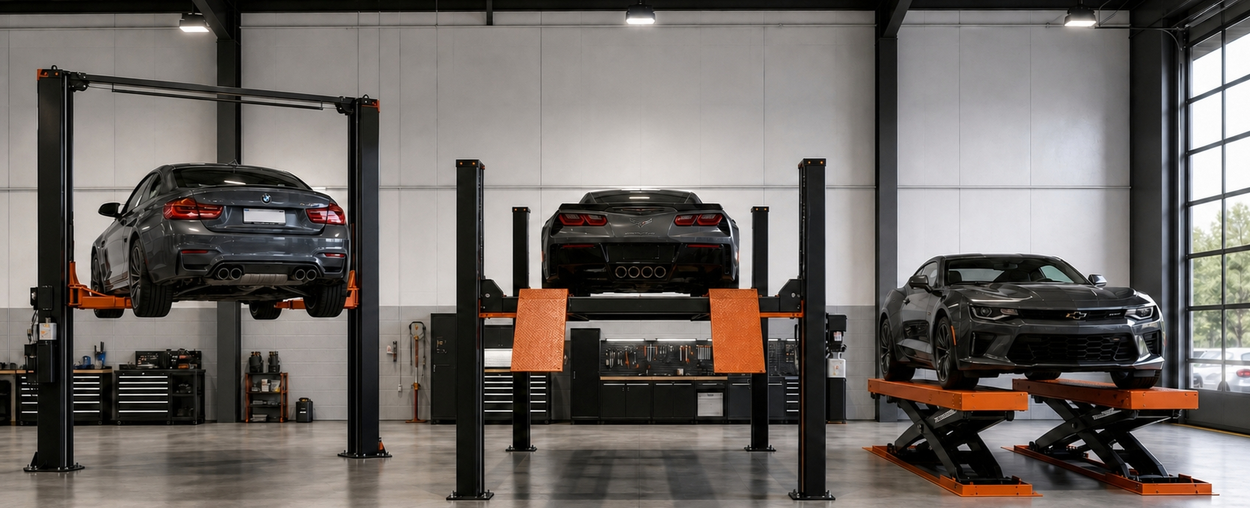
| Lift type | Installation focus | Typical power |
|---|---|---|
| 2 post | Slab depth at both columns, anchoring, plumb, cable equalization | 240V |
| 4 post service | Level runways, lock ladders, cable routing; anchoring recommended for fixed installs | 240V |
| 4 post parking | Ceiling height for stacking, lock ladders, level floor | 120V common |
| Alignment | Level runways, turntables and slip plates, thicker concrete | 240V |
| Scissor | Very level slab, pad anchoring, hose routing | 120V or 240V by model |
| Motorcycle and ATV | Flat, solid surface, wheel chock and ramp setup | Varies |
Rolling jacks and alignment accessories are sold separately, and Daytona’s are engineered to fit Daytona lifts. Check compatibility in the lift accessories listings, or compare every configuration on the automotive lifts page.
Car lift installation mistakes that become service calls
Most problems we hear about later trace back to one rushed step on install day. These are the ones to avoid.
Anchoring into unverified or green concrete
A slab can look perfect and measure 3 in. (76 mm) mid-bay. Anchors set in uncured concrete can pass a torque check on the day, then loosen as the slab keeps moving.
Using an impact gun on anchors
An impact gun cannot tell you what torque it applied. Over-torquing crushes concrete around the anchor, and under-torquing lets the column work loose. Both reduce holding strength.
Shimming past the manual limit
Small floor slopes are normal. Stacking shims beyond the manual’s maximum changes how load transfers into the anchors. If the slope needs more correction, the slab needs correcting first.
Measuring the ceiling with the door closed
The open door and its tracks are often the lowest thing in the garage. Measure with the door fully open, at the opener rail and at any light fixtures, and use the lowest figure.
Skipping the no-load cycles and the paperwork
Skipping test cycles turns a small fault into a loaded failure. Skipping the written record leaves you with nothing to show an inspector, an insurer or the warranty department later.
What does car lift installation cost?
Installation cost depends less on the lift and more on the site. Labor for a straightforward 2 post install is only part of the bill. Delivery, a new 240V circuit, concrete work, permits and door or lighting changes in a low garage can each add more than the install itself.
Our car lift installation cost guide breaks down each line. For a full home-garage budget including the lift, see the home garage car lift cost guide, and for what drives lift pricing, the car lift cost guide.
What happens after install day
Two things belong on your calendar. First, re-torque every anchor after a short break-in period and again on the schedule in your manual, because fresh anchors commonly settle under real loads.
Second, plan an annual inspection. The ANSI/ALI ALOIM standard calls for every lift to be inspected at least once a year by a qualified lift inspector. ALI runs a certification program for inspectors, and you can search its certified lift inspector directory. In Ontario, workplace lifting devices fall under Regulation 851, and other provinces and states have their own rules.
Between inspections, a short daily, weekly and monthly routine catches problems early. Our 2 post lift maintenance checklist lays it out by interval.
Get your lift installed right: find your local distributor
Tell your local Daytona distributor your slab details, ceiling height, bay size and the vehicles you work on. They will recommend a model, quote it and install it, including single home-garage orders. Have a question first? Talk to our team.
- 5-2-1 warranty. 5 years structural, 2 years power units, 1 year parts. Indoor use only.
- Warranty freight. Freight on warranty parts covered within Canada and the continental US.
- ALI Certified option. The BR10-2OH-33 10,000 lb overhead 2 post lift.
- Low-ceiling options. LTPF9 at 110 in. (2.79 m) and LTPF12 at 114 in. (2.90 m) overall.
- Since 1999. Canadian owned, serving the US and Canada.
Third-party financing may be available. Approval not guaranteed. See financing options or read our car lift financing guide.
Get a Local QuoteAbout the author

The Daytona Team
Written by the team at Daytona Automotive Equipment, a Canadian-owned manufacturer of automotive lifts, tire changers and wheel service equipment since 1999.
We work daily with shop owners, home-garage builders, distributors and installers, and the guidance here reflects the installation questions we field most often, from slab checks to first test cycles.
- Specializations. Lift installation planning, slab and anchoring requirements, bay layout, 2 post, 4 post and scissor lifts.
- Standards. Guidance aligned to ANSI/ALI ALIS installation practice and ANSI/ALI ALOIM operation, inspection and maintenance practice.
- Reviewed by. Daytona product and technical support staff, October 2026.
Daytona Automotive Equipment Inc. · Brighton, ON, Canada · Automotive lifts, tire changers and wheel service equipment since 1999.
References and sources
- Automotive Lift Institute. 2024 IRC Chapter 3 Automotive Lift Requirements. ALI, accessed October 2026.
- Automotive Lift Institute. ALI Directory of Certified Lifts. ALI, accessed October 2026.
- Automotive Lift Institute. ANSI/ALI ALIS, Safety Requirements for Installation and Service of Automotive Lifts. ANSI/ALI, current edition.
- Automotive Lift Institute. ANSI/ALI ALOIM, Safety Requirements for Operation, Inspection and Maintenance. ANSI/ALI, current edition.
- Automotive Lift Institute. Find a Certified Auto Lift Inspector. ALI, accessed October 2026.
- Government of Ontario. O. Reg. 851, Industrial Establishments. Ontario e-Laws, accessed October 2026.
Figures in this article are for planning only and are not quotations or specifications. Slab, anchor, power and clearance requirements vary by lift model and site. Always follow the installation manual for your specific lift, and consult your local building department and a qualified installer before purchase or installation. Daytona Automotive Equipment is not affiliated with Harbor Freight’s Daytona tool brand.