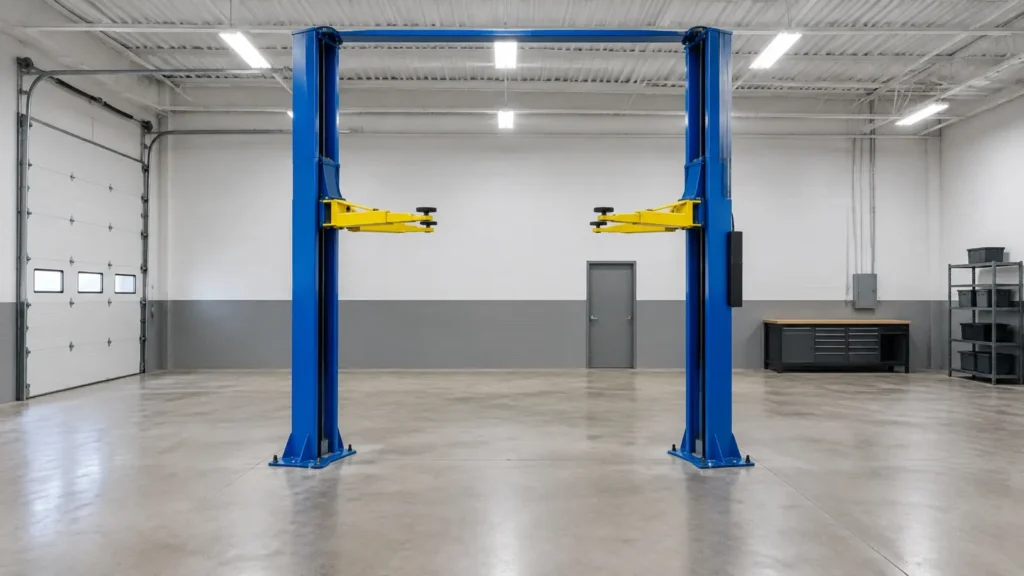
The majority of 2 post lift dimensions are between a predictable range with the overall width around 11 to 12 ft (132 to 145 in.), the ceiling clearance of 10 to 12 ft for standard-capacity models, and a floor footprint that requires a bay roughly 12 ft wide by 24 ft long to work efficiently.
The exact number depends on the model, and the arm type you pick, not just the weight capacity.
Buyers get tripped up when they confuse "overall width" with "width between columns," where the latter is the number that actually determines how a wide vehicle fits.
With the model of your lift confirmed through knowing what type of vehicle you are lifting with it, the next step it to take measurement. Afterwards you will know if a 2 post lift actually fit your space, or are you about to order something that clips the ceiling by three inches?
2 post lift dimensions aren't one number. They're five numbers working together: width, height, footprint, bay size and power. Miss one and the other four don't matter. This guide walks through each one using real spec data from five current Daytona models, so you can measure your space once and shop with confidence, not guesswork.
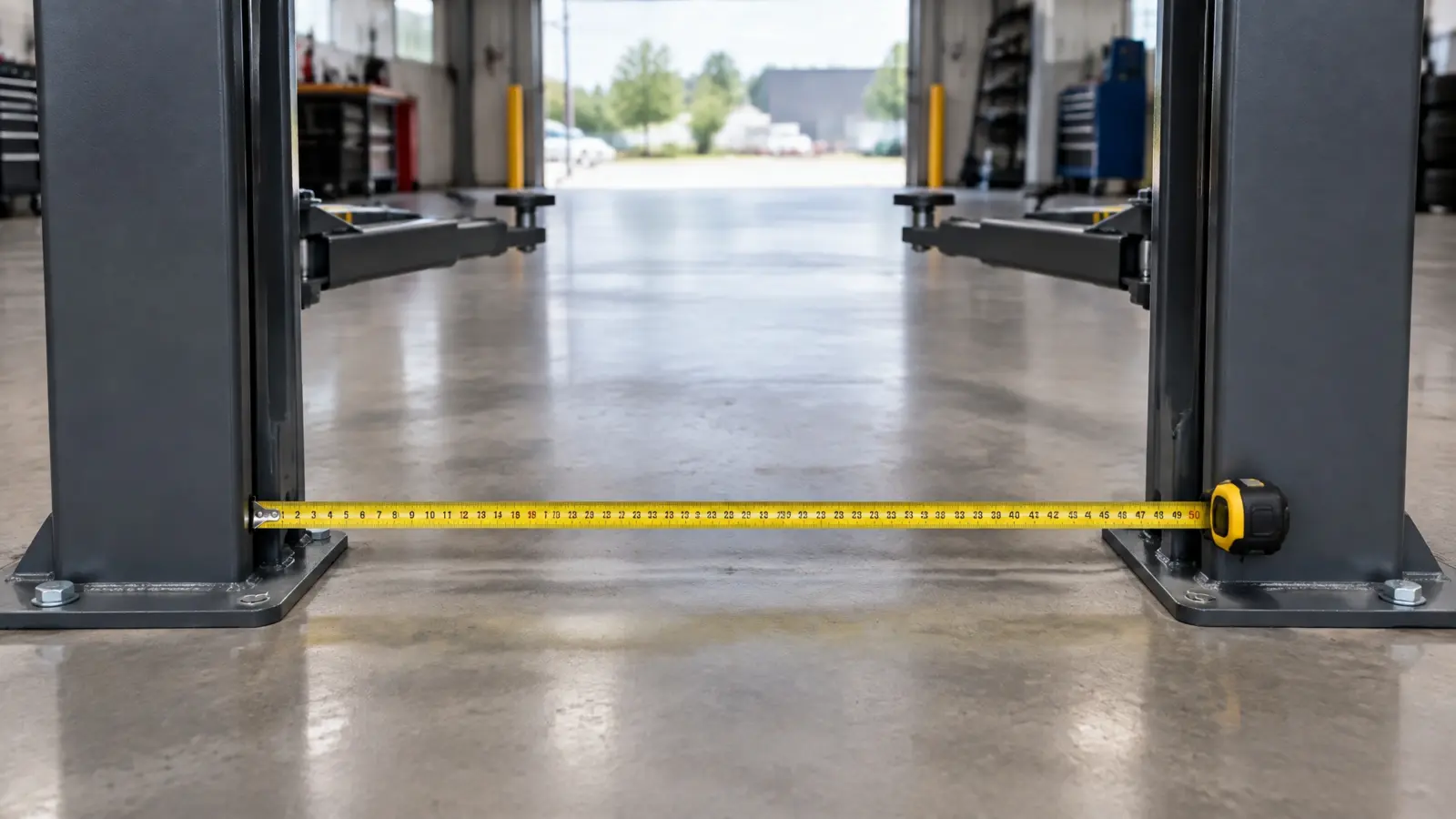
Key takeaways: the five numbers you need before you buy
- Width. Both the overall footprint width and the narrower width between the columns matter, and they're not the same number.
- Height. Overall lift height plus the vehicle's height plus a buffer, not just the raw ceiling measurement.
- Footprint. How much floor the lift itself occupies, base to base.
- Bay size. The working space around the lift for the vehicle, the technician and the tools.
- Power. Voltage, amperage and phase, confirmed before the electrician quotes the job.
2 post Lift Width and Column Spacing, Explained
Do not mistake overall width and column spacing as being the same thing, if you do its going to be a world of trouble. Overall width is the measurement from the outside edge of one column to the outside edge of its counterpart. Whereas, Column spacing (or drive-thru clearance) is the gap in between the columns.
Overall Width vs. Width Between Columns
On an adjustable-width lift like the LTPA10, you actually choose your column spacing from three settings: 88.6 in., 94.5 in. or 100.4 in. A wider setting handles bigger trucks and vans; a narrower one saves floor space in a tighter bay. The LTPA12 works the same way, with settings of 107 in., 113 in. or 119 in.
Fixed-configuration lifts like the floorplate and overhead models don't give you that choice, so you're matching the vehicle to the spec sheet instead of adjusting the lift to the vehicle. Either way, use the column spacing number, not the "overall width" number in the marketing photo, to check whether your widest vehicle will pass between the posts.
What "Drive-Thru Clearance" Actually Means
Drive-thru clearance describes the gap you actually drive a vehicle's wheels through, measured at the arms' lowered position. It matters most if you plan to park a second vehicle behind the lift, or if you regularly service dual-rear-wheel trucks where only the front wheels need to clear the arms. According to the Automotive Lift Institute, the trade association that certifies lift models in North America, this kind of clearance measurement should always be checked against the specific model's listing, not estimated from a photo (ALI Directory of Certified Lifts).
Common mistake: assuming wider is automatically better
A wider column setting eats more floor space and pushes your minimum bay width up. If you mostly service sedans and light SUVs, the narrowest available setting on an adjustable model usually leaves more usable floor space without sacrificing capability.
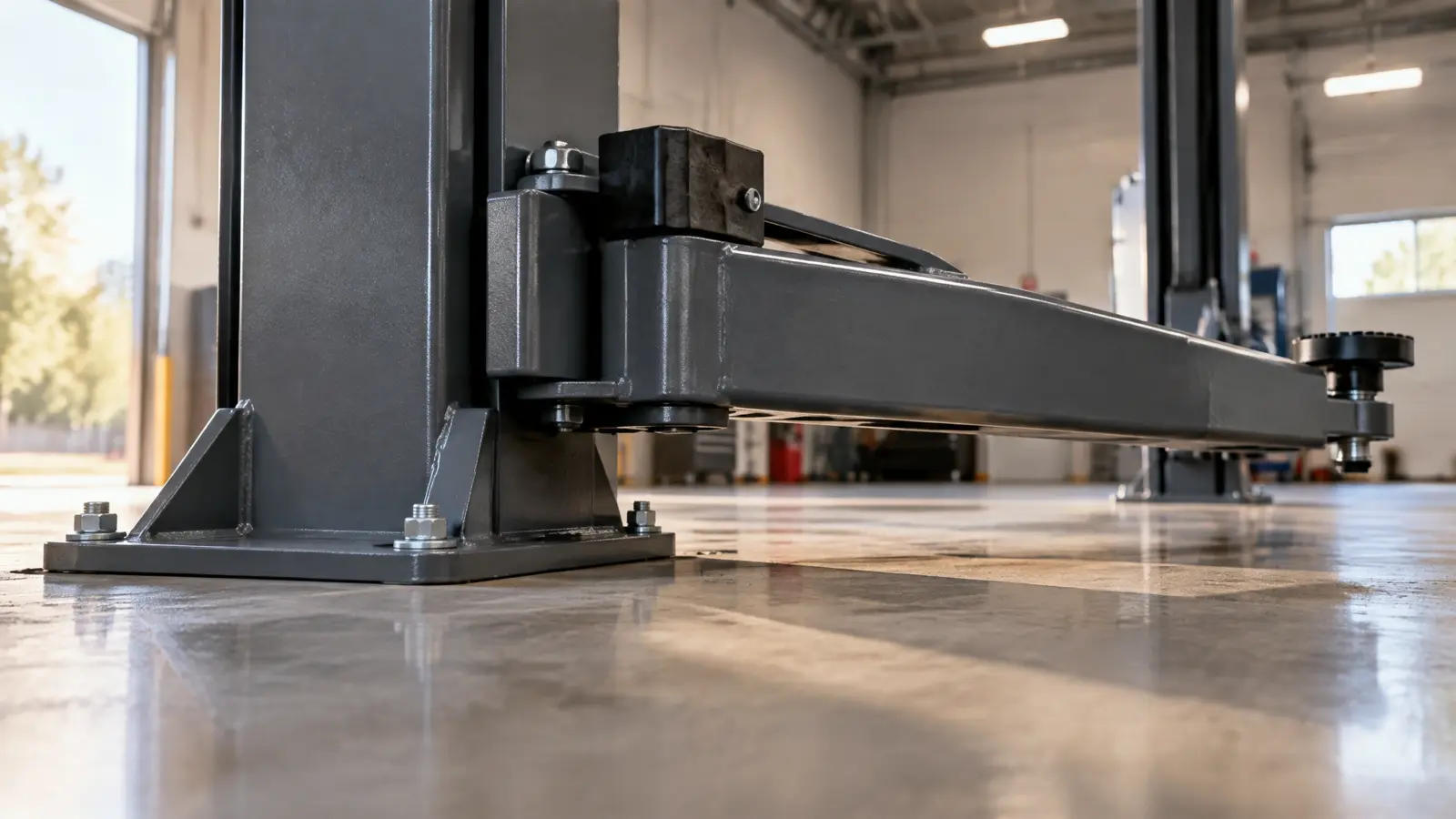
2 post Lift Dimensions by Model: A Side-by-Side Comparison
Here's how five current Daytona 2 post models compare on the dimensions that decide fit. Where a figure isn't published for a model, we've marked it rather than guess, because a wrong number here is worse than no number.
| Model | Capacity | Type | Column Spacing / Width Settings | Overall Height |
|---|---|---|---|---|
| BR10-2OH-33 | 10,000 lb | Overhead, ALI Certified | 3 width settings available; confirm exact figures on the spec sheet | Confirm on spec sheet |
| LTPO15 | 15,000 lb | Overhead | Fixed configuration; 2 ft height extension kit included and must be installed | Confirm on spec sheet |
| LTPA12 | 12,000 lb | Adjustable | 107 in., 113 in. or 119 in. | Confirm on spec sheet |
| LTPA10 | 10,000 lb | Adjustable | 88.6 in., 94.5 in. or 100.4 in. | Confirm on spec sheet |
| LTPF12 | 12,000 lb | Floorplate (no overhead bar) | Fixed configuration; check with your distributor for column spacing | 114 in. |
| LTPF9 | 9,000 lb | Floorplate (no overhead bar) | Fixed configuration; check with your distributor for column spacing | 110 in. |
Two things stand out here. First, the two adjustable models give you three width settings each, which is the closest thing to a custom fit you'll get without a custom order. Second, the floorplate models publish overall height but not a column-spacing figure, which is normal for a design that skips the overhead crossbar entirely. If a specific number in this table isn't listed, your local distributor can pull it from the current manual before you order.
How Tall Does Your Ceiling Need to Be?
As a general planning range, standard-capacity 2 post lifts typically need 10 to 12 ft of clear ceiling height, and higher-capacity heavy-duty lifts can need 14 ft or more. These are industry-typical planning figures, not a guarantee for any specific model, and you should treat them as a starting point for measuring, not a final answer.
| Vehicle Type | Typical Vehicle Height | Suggested Ceiling Clearance |
|---|---|---|
| Compact and small cars | 4.5 to 5.2 ft | 10 to 11 ft |
| Sedans | 4.5 to 5 ft | 12 ft |
| SUVs and light trucks | 5.2 to 6.2 ft | 12 ft |
| Full-size trucks and vans | 6 to 6.5 ft | 14 to 16 ft |
If your ceiling sits closer to 8 or 9 ft, you're not automatically out of options. A floorplate design, like the LTPF9 or LTPF12, removes the overhead crossbar entirely, which changes this math. We've built a dedicated low ceiling car lift guide that goes deep on exactly which lifts fit under 8, 9 and 10 ft, so we won't repeat all of it here.
Bay Size: How Much Floor Space Around the Lift?
Plan for a minimum bay of about 12 ft wide by 24 ft long for a standard passenger vehicle, and closer to 12 to 16 ft wide by 24 to 36 ft long if you regularly lift full-size trucks. The lift's own footprint is only part of that number. The rest is room to actually work.
Minimum Bay Width and Length
Length matters more than most first-time buyers expect. A standard sedan runs about 16 ft long; a full-size pickup can stretch past 22 ft. Your bay needs to swallow the vehicle plus a few feet of clearance at each end, or you'll be backing out through a door you can barely close.
| Setup | Minimum Bay Width | Minimum Bay Length |
|---|---|---|
| Home garage, sedans and light SUVs | 12 ft | 24 ft |
| Small shop, mixed passenger vehicles | 12 to 14 ft | 24 to 28 ft |
| Commercial shop, trucks and vans | 14 to 16 ft | 28 to 36 ft |
Distance From Walls and Other Lifts
Leave at least 2 ft between the vehicle and the nearest wall or piece of equipment so a technician can move around comfortably. If you're running two lifts in one shop, that spacing multiplies fast, and column placement relative to the wall changes depending on whether your arms are symmetric or asymmetric. We cover exact wall-distance numbers by arm type in our dedicated 2 post lift placement guide.
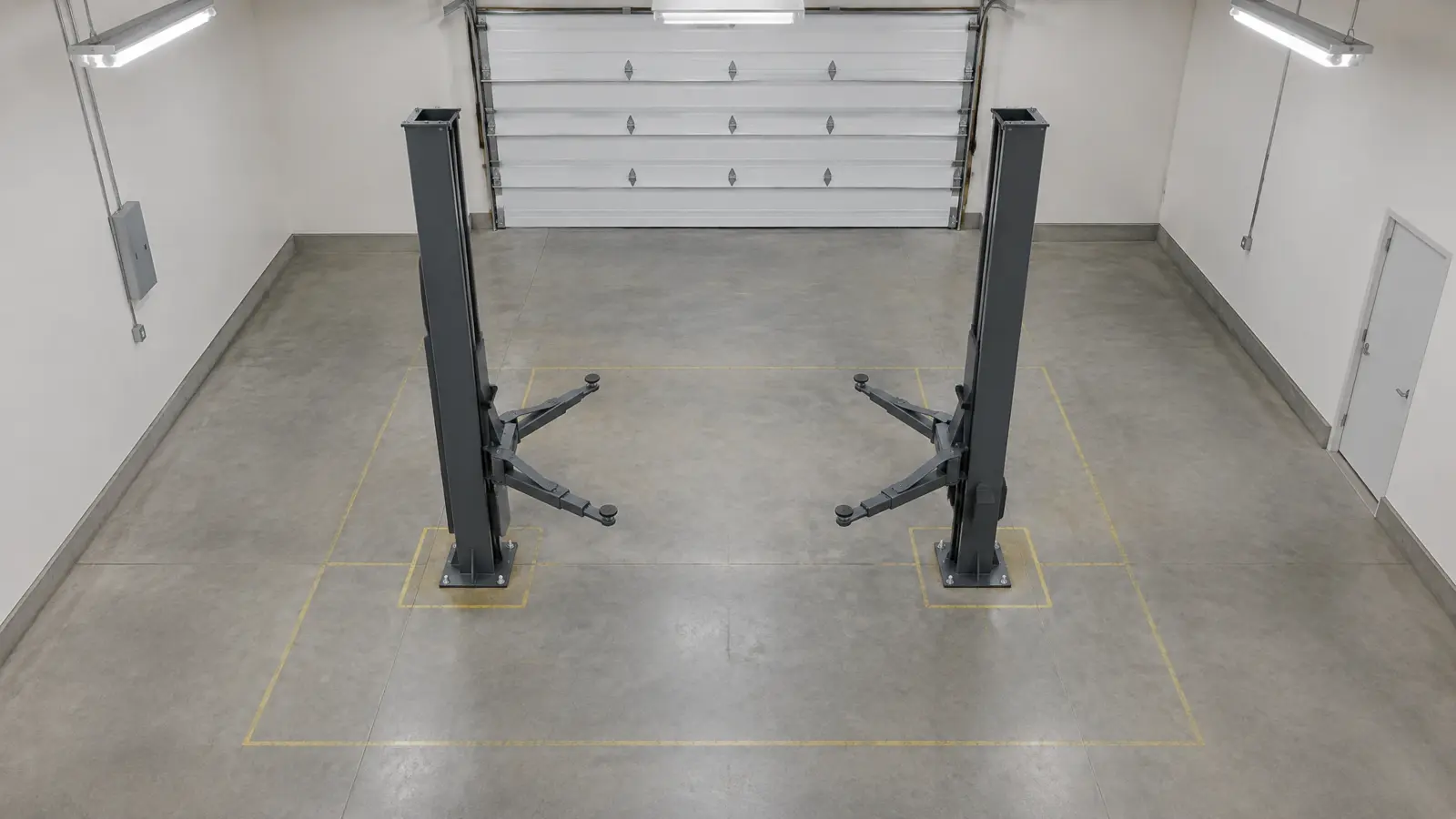
Symmetric vs. Asymmetric Arms: Why Footprint Isn't the Whole Story
Why this matters for your layout
Symmetric arms split the vehicle roughly 50/50 between the front and rear columns. Asymmetric arms shift more of the vehicle's length behind the rear column, freeing up space in front for door swing and technician movement. Two lifts with identical footprints can need noticeably different clearance in front of the columns depending on which arm style they use, so check this before you finalize where the lift sits relative to a door or wall.
This is one of those specs that doesn't show up in a headline capacity number, but it changes your layout more than an extra thousand pounds of capacity ever will. If you're choosing between models, ask your distributor which arm style each option uses before you commit to a floor plan.
Overhead vs. Floorplate vs. Adjustable-Width: The Space Tradeoff
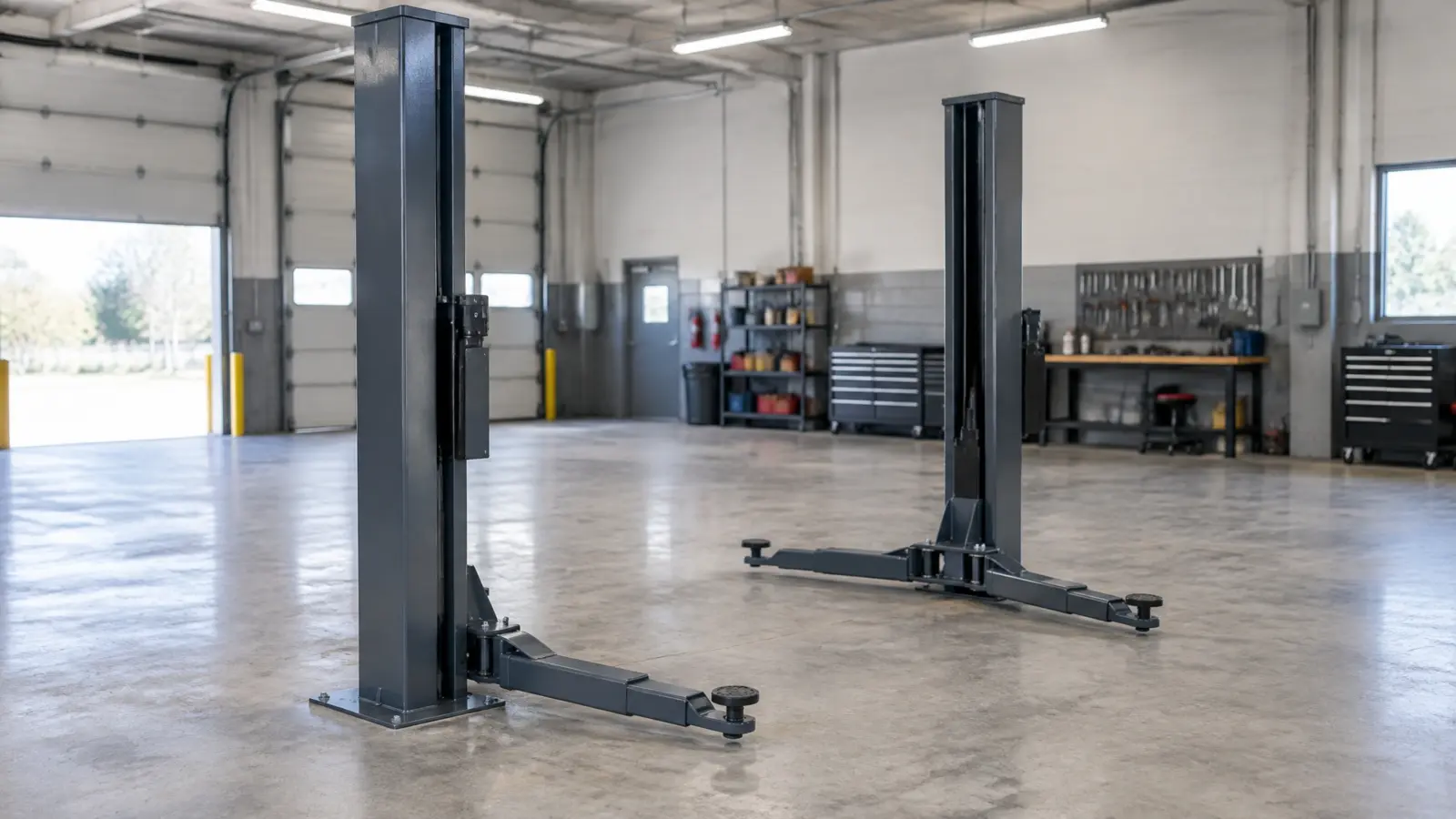
Overhead lifts use the least floor-level footprint but need the most ceiling height; floorplate lifts flip that trade, giving up nothing overhead but adding a low-profile crossmember at floor level. Neither is objectively better. The right one depends on which measurement you're short on: ceiling or floor.
The BR10-2OH-33 is Daytona's ALI Certified overhead model and a good default when ceiling height isn't a constraint. The LTPO15 steps up to 15,000 lb capacity in the same overhead family, though it ships with a 2 ft height extension kit that must be assembled before use, which adds to the overall height you need to plan for.
On the other end, the LTPF9 and LTPF12 skip the overhead bar entirely, running the connecting structure across the floor instead. That's the design to reach for in a garage with an 8 or 9 ft ceiling, at the cost of a slightly higher trip hazard at ground level and a base you'll want to mark clearly.
The adjustable-width LTPA10 and LTPA12 sit in between: standard overhead-style clearance needs, but with the flexibility to narrow or widen the column spacing to match your actual vehicle mix, which matters more for shops that service everything from compacts to work trucks in the same bay.
Power and Electrical Space Planning
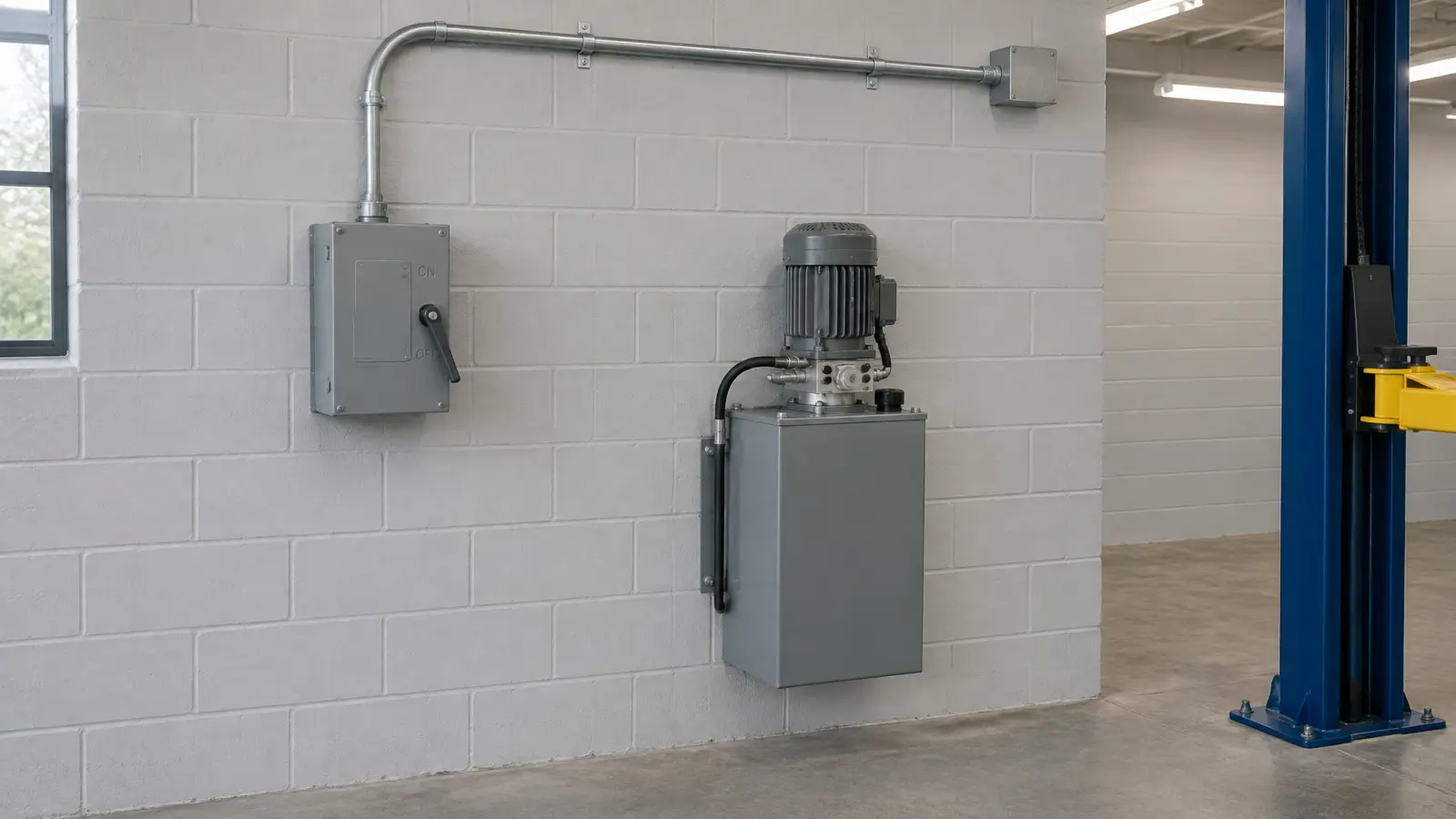
Every model in Daytona's 2 post lineup runs on 240V, single-phase, 60Hz power, with amperage and horsepower varying slightly by model. That's a fixed requirement in your space plan, not a flexible one, so confirm it early with whoever is running your electrical.
The BR10-2OH-33 and LTPO15 both draw 3HP; the BR10-2OH-33 pulls 12A while the LTPO15, LTPA12 and LTPA10 each pull 13A, all on a single 240V, single-phase circuit. That's a modest ask for most shop or garage electrical panels, but it's not something you want to discover mid-installation. We always recommend having a licensed electrician confirm your panel capacity before the lift arrives, rather than after.
Concrete and Floor Requirements, in Brief
Dimensions and concrete are two different questions, and it's tempting to lump them together. In short: your slab needs enough thickness and cured strength to anchor the columns safely, and that number depends on the model's capacity, not just its footprint. We've written a full breakdown covering exact thickness by capacity, cure time and anchor spacing in our concrete requirements guide, and we'd rather point you there than repeat a partial version of it here.
One rule always applies regardless of model: never substitute a different anchor type than the one specified in your lift's manual, and always have a qualified professional evaluate a post-tension slab before drilling.
Not sure what fits? Take your ceiling height, bay width and the vehicles you work on to a local Daytona distributor. They quote, deliver and install. Have a question first? Talk to our team.
Find a Daytona DistributorYour 2 post Lift Space Planning Checklist
Measure these five things before you call anyone
- Ceiling height. Measure to the lowest point in the bay, not the highest, and don't forget lights, ductwork or door tracks.
- Column spacing you need. Measure your widest vehicle's tire-to-tire width, then compare it to the model's narrowest available setting.
- Bay width and length. Include swing room for doors and at least 2 ft of clearance to the nearest wall or piece of equipment.
- Electrical panel capacity. Confirm your panel can supply 240V, single-phase power at the amperage the model requires.
- Slab condition. Note the age, thickness and any visible cracking before assuming it's ready for anchors.
Distributors tell us the single most common install delay isn't the lift itself. It's a ceiling measurement taken with the garage door closed, which shaves a foot or more off the real clearance once the door track is factored in. Measure with the door fully open.
If you're planning a 2 post lift installation from scratch, our step-by-step guide walks through the process after you've confirmed the space works, from anchoring through the first test lift. And if you're weighing a 4-post model instead for storage or alignment work, our 4-post lift dimensions guide covers that footprint separately, since the numbers don't translate directly.
Get a quote from your local Daytona distributor
Tell your local Daytona distributor your ceiling height, bay width and the vehicles you service. They will recommend a model, quote it and install it. Have a question first? Talk to our team.
- Six 2 post models. From 9,000 to 15,000 lb, in overhead, floorplate and adjustable-width configurations.
- 5-2-1 warranty. 5 years structural, 2 on power units, 1 on parts. Indoor use only.
- Since 1999. Canadian owned, serving the US and Canada.
About the author

The Daytona Team
Written by the team at Daytona Automotive Equipment, a Canadian-owned manufacturer of automotive lifts, tire changers and wheel service equipment since 1999.
- Specializations. 2 post lift sizing, garage and shop layout planning, and lift selection guidance.
- Standards. Guidance aligned to ANSI/ALI ALCTV construction and testing practice and ANSI/ALI ALOIM operation, inspection and maintenance practice.
- Reviewed by. Daytona product and technical support staff, {{PUBLISH_DATE}}.
Daytona Automotive Equipment Inc. · Brighton, ON, Canada · Automotive lifts, tire changers and wheel service equipment since 1999.
References and sources
- Automotive Lift Institute. ALI Directory of Certified Lifts. Automotive Lift Institute, accessed 2026.
- Automotive Lift Institute. ANSI/ALI ALOIM: Safety Requirements for Operation, Inspection and Maintenance. Automotive Lift Institute, current edition.
- Occupational Safety and Health Administration. Standard Interpretation on Automotive Lift Certification. OSHA.gov, 2014.
Figures in this article are representative for planning and are not quotations. Confirm requirements against the installation manual for your specific lift before purchase or installation. Daytona Automotive Equipment is not affiliated with Harbor Freight's Daytona tool brand.