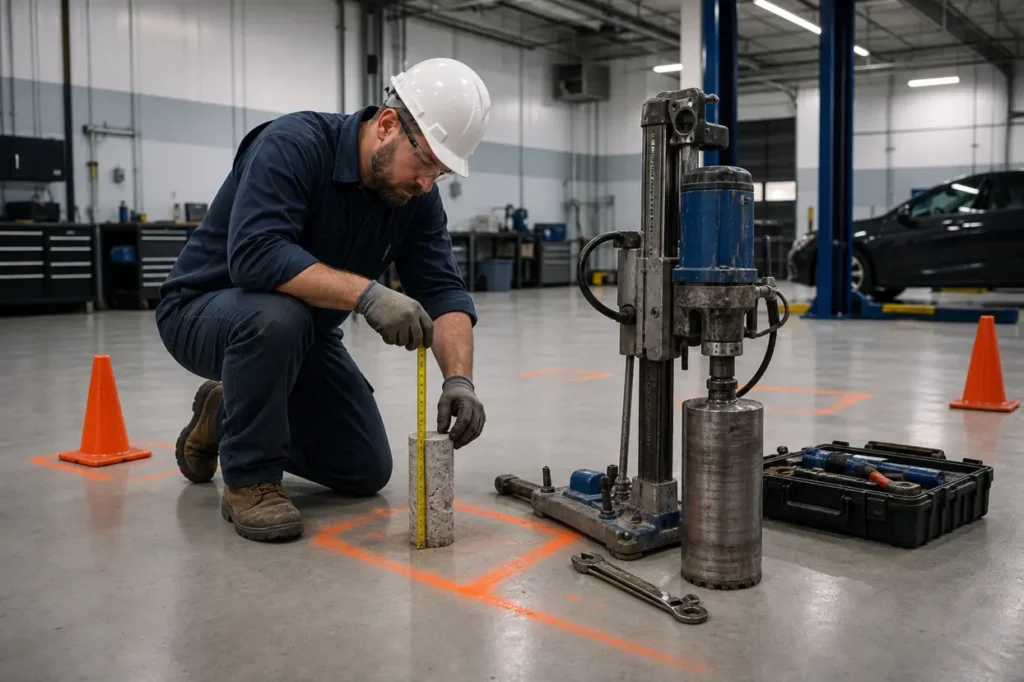
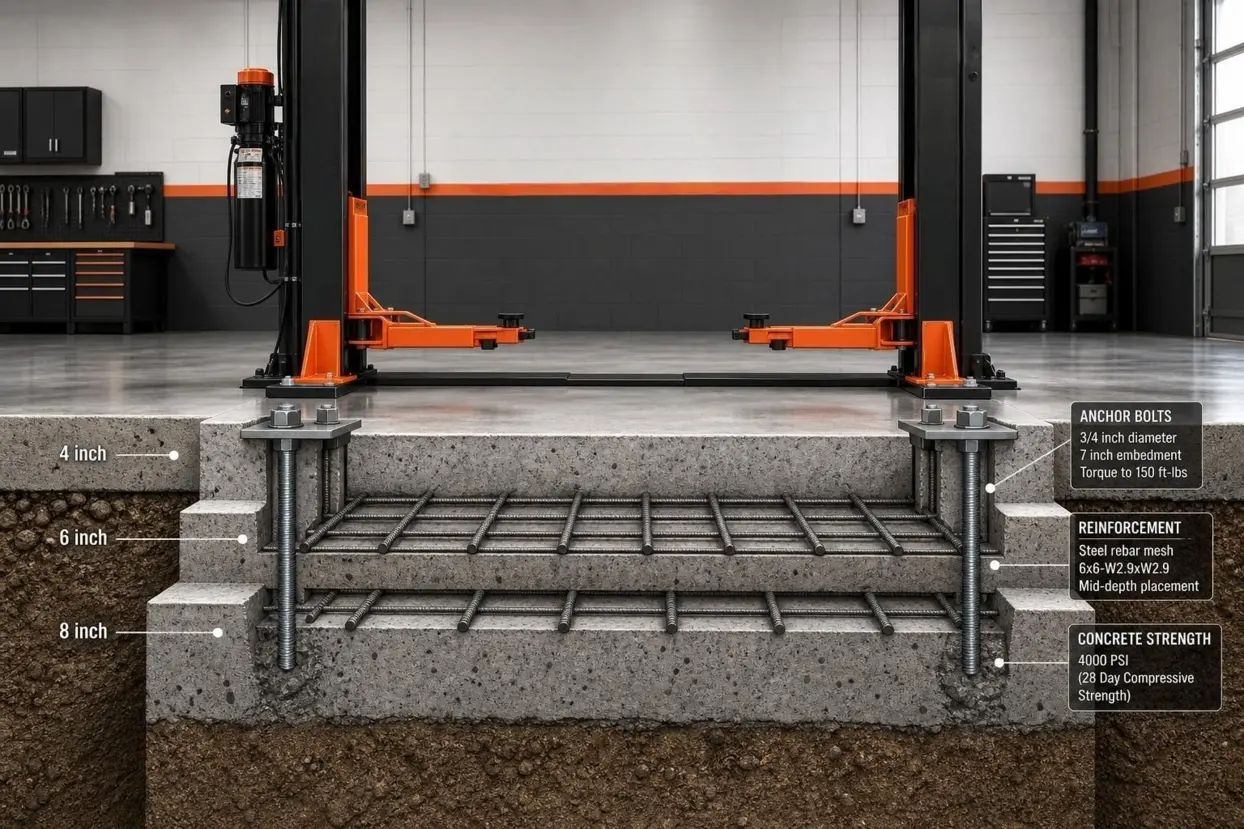
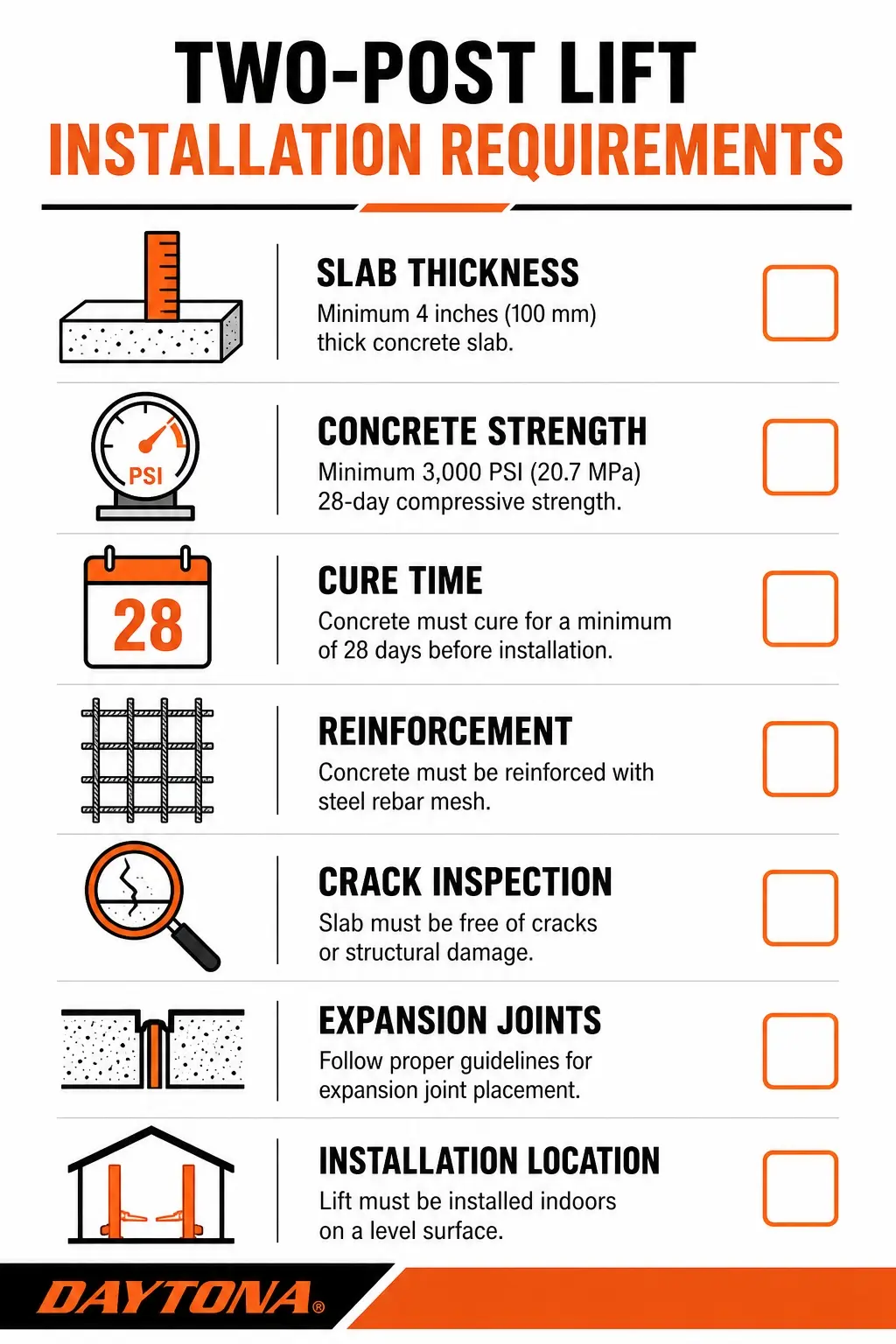
Most 9,000 lb and 10,000 lb two-post lifts require a minimum of 4 to 4¼ inches (102–108 mm) of fully cured concrete rated at 3,000 PSI (about 20.7 MPa) or higher, measured as solid slab depth under every anchor, not the average thickness of the bay.
For a new pour, plan on 6 inches (152 mm) of reinforced concrete at 3,500 to 4,000 PSI. Heavy-duty 12,000 lb and 15,000 lb models commonly call for 6 to 8 inches (152–203 mm), and new concrete needs roughly 28 days of cure time before anchors are drilled.
The mistake that causes most failed installs is assuming an existing garage slab is thick enough. A floor can look perfect and still measure 3 inches over gravel. Measure before you drill, and always follow the installation manual for your exact lift model.
Concrete is the single most common reason a two-post lift install gets delayed, re-quoted or stopped on the day. The lift itself is straightforward. The floor underneath it is the variable.
A two-post lift raises a vehicle by its frame, which means the entire load and the tipping moment of that load travel down two columns into a handful of anchor bolts. Those anchors do not hold the lift. The concrete around them does. That is why the question of how thick of concrete for a 2 post lift comes before almost every other buying decision — the required concrete slab thickness for a 2 post lift is set by the anchor, not by the look of the floor.
This guide gives you the planning numbers by capacity, how to verify an existing slab, and the specific conditions where you should stop and call a professional before a single hole is drilled.
Key takeaways
- 4 to 4¼ inches minimum. Common floor for many 9,000–10,000 lb two-post lifts, at 3,000 PSI or better, fully cured.
- 6 inches is the better target. For any new pour, 6 inches of reinforced concrete at 3,500–4,000 PSI buys you anchor depth and margin for heavier vehicles later.
- 12,000–15,000 lb lifts ask for more. Plan 6 to 8 inches and expect the manual to specify a longer anchor and a deeper embedment.
- 28 days of cure. New concrete gains most of its design strength over 28 days. Drilling early weakens the slab exactly where you need it strongest.
- Depth is local, not average. A slab that is 6 inches at the door can be 3 inches mid-bay. Verify at both column locations.
- Joints and cracks are disqualifiers. Keep anchors clear of expansion joints, control joints, slab edges and any cracked or spalled concrete.
- Post-tension slabs need a professional. Never drill one until cable locations have been scanned and verified.
- Indoor only. All Daytona equipment is for indoor installation. Outdoor installation voids the 5-2-1 warranty.
Is the minimum concrete thickness the same as the right concrete thickness?
No — the minimum in a manual is the lowest condition a lift may be anchored to, while the recommended spec is what keeps the install sound over a decade of daily cycles. A slab can meet the minimum on paper and still be a poor choice if it is old, thin in patches, cracked, or was poured without reinforcement.
Use the table below as your planning baseline for concrete slab thickness for a 2 post lift, then confirm against the manual for your specific model.
| Spec | Common minimum | Better recommendation | Why it matters |
|---|---|---|---|
| Concrete thickness | 4–4¼ in. (102–108 mm) on many 9k–10k lifts | 6 in. (152 mm) reinforced | Thicker concrete gives the anchor more embedment depth and more surrounding mass to resist pull-out and cone failure. |
| Compressive strength | 3,000 PSI (20.7 MPa) | 3,500–4,000 PSI (24–27.6 MPa) | Higher strength concrete resists cracking around base plates and holds anchor torque far better over time. |
| Cure time | 28 days | 28 days, longer if curing was cold, hot or wet | Concrete keeps gaining strength after it feels hard. Drilling a green slab permanently reduces anchor capacity. |
| Reinforcement | Varies by manual | Rebar or welded wire mesh on new pours | Reinforcement controls crack width around the high-load column areas rather than preventing cracks entirely. |
| Slab condition | No major defects | Verified depth, strength and crack map at both columns | A sound-looking surface tells you nothing about depth, sub-base or voids underneath. |
What are the concrete requirements for a 2 post lift by capacity?
Requirements scale with capacity: 9,000–10,000 lb lifts commonly start at 4–4¼ inches of 3,000 PSI concrete, while 12,000 lb models typically need 6 inches and 15,000 lb models 6 to 8 inches. A 9,000 lb lift and a 15,000 lb lift do not place remotely the same demand on the floor or on the anchors.
| Lift capacity | Common minimum thickness | Better shop recommendation | Concrete strength | Planning note |
|---|---|---|---|---|
| 9,000 lb | 4–4¼ in. | 6 in. reinforced | 3,000–4,000 PSI | Workable in many home garages and light service bays provided the slab is verified and uncracked. |
| 10,000 lb | 4–4¼ in. on some models | 6 in. reinforced | 3,000–4,000 PSI | The most common shop capacity, so 10k 2 post lift concrete requirements are the figures most manuals are written around. Verify depth at both columns before drilling rather than trusting one test hole. |
| 12,000 lb | 6 in. | 6–8 in. reinforced | 3,500–4,000 PSI | Sized for heavier trucks, vans and high daily cycle counts, so anchor depth becomes the limiting factor. |
| 15,000 lb | 6–8 in. | 8 in. reinforced | 4,000 PSI preferred on new pours | Heavy-duty installs warrant a purpose-poured slab and professional review of the bay layout. |
If you are still choosing a capacity, the 2 post car lift buyer's guide walks through capacity, arm design and width settings, and the full range is on the 2-post lifts category page.
Why do 2 post lifts need more concrete than 4 post lifts?
Because a two-post lift concentrates the whole vehicle load and its overturning moment into two anchored columns, while a four-post lift distributes it across four columns and two long runways. Same vehicle weight, very different load path into the floor.
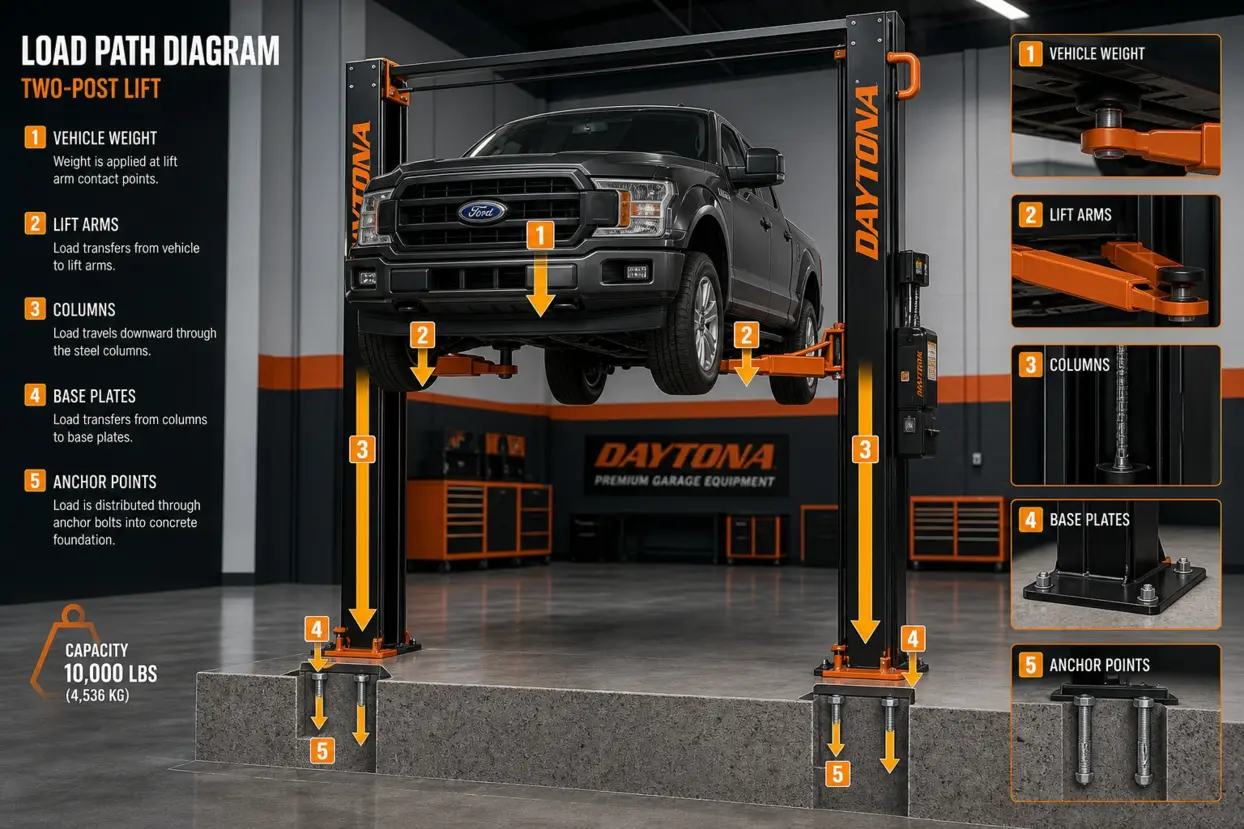
When a slab is too thin or too weak, the failure is rarely dramatic at first. Anchors lose torque, the base plate develops a hairline gap, and cracks radiate from the anchor holes. Caught early it is a repair. Ignored, a 2 post lift concrete failure becomes a stability problem under load.
The ANSI/ALI ALIS:2022 standard from the Automotive Lift Institute sets the safety requirements for lift installation and service, and is the reference professional installers work to. For lift certification specifically, the ALI certification program explains how listed lifts are independently tested. Daytona's BR10-2OH-33 10,000 lb overhead lift is Daytona's ALI Certified two-post model.
If your work is mostly wheels-off — brakes, suspension, exhaust, tyres — a two-post lift is the right tool and the slab work is worth doing properly. If you mainly need storage or parking, compare the load path of a four-post design first in 2-post lift vs 4-post lift.
What PSI concrete do you need for a 2 post lift?
3,000 PSI (roughly 20.7 MPa) is the common published minimum, and 3,500 to 4,000 PSI is the sensible target for any new pour. PSI describes compressive strength: how much pressure a test cylinder of that concrete withstands before it fails.
Strength is not set by the mix alone. Sub-base preparation, drainage, water content on site, weather during placement and curing discipline all move the finished number, sometimes by a wide margin. The American Concrete Institute's ACI CODE-332-20 is the reference your contractor will recognise for residential concrete design and construction.
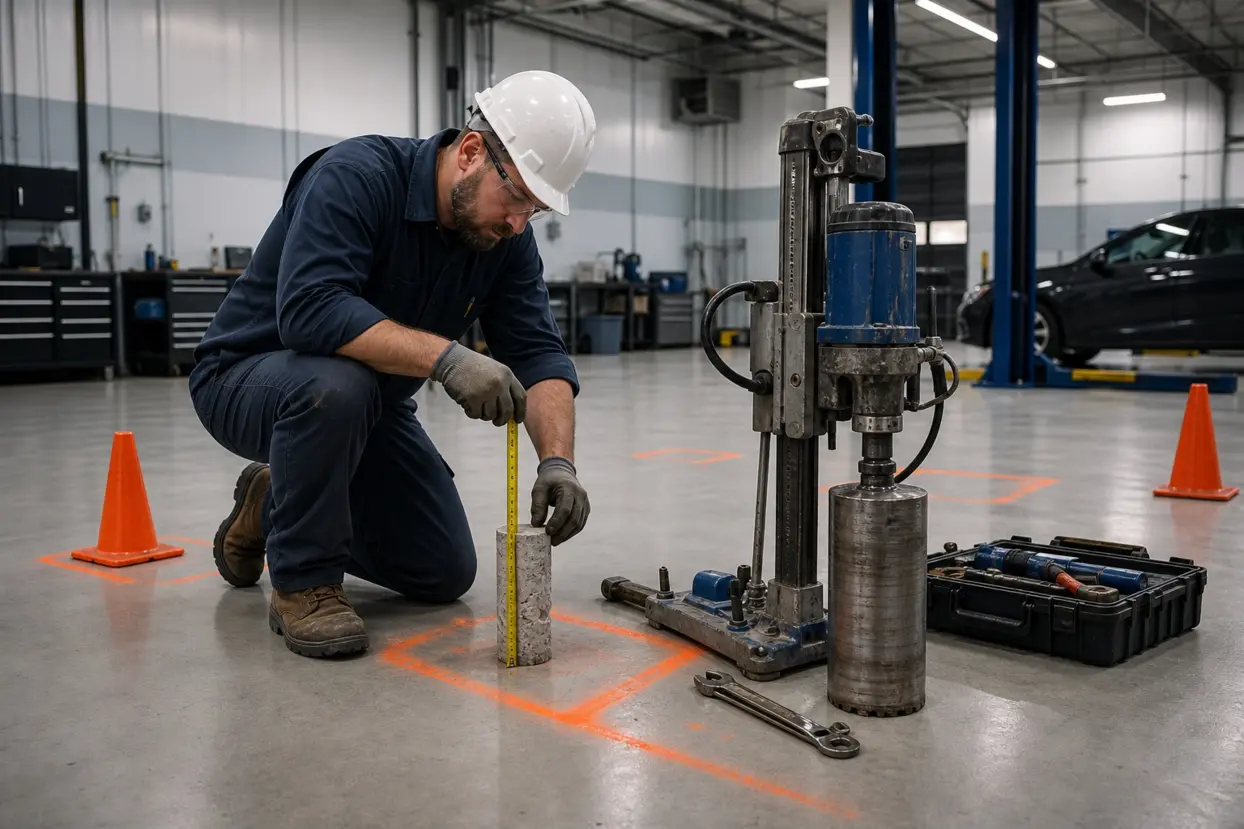
If the slab is existing and undocumented, strength has to be tested rather than guessed. A core sample gives you depth and strength in one operation, which is usually cheaper than the consequences of being wrong.
How long should concrete cure before installing a car lift?
Allow at least 28 days of cure before drilling anchors or loading a lift, and longer if the pour cured in cold, hot or wet conditions. Concrete reaches a large share of its design strength in the first week but keeps gaining meaningfully through day 28.
The temptation is real when a new bay is otherwise finished. Resist it. Anchors set in green concrete can pass a torque check on the day and then lose tension as the slab continues to move. Ask the supplier or the contractor who placed the slab to confirm it is ready for anchor drilling in writing.
Do you need rebar or wire mesh for a 2 post lift?
Rebar or welded wire mesh is strongly recommended for any new slab under a two-post lift, though it is a crack-control measure and not a substitute for depth or strength. Reinforcement keeps cracks tight and distributed instead of wide and concentrated at the columns.
Two practical points. First, reinforcement has to be planned around the anchor pattern: if a bar sits exactly where an anchor hole needs to go, the installer either shifts the layout or has to re-drill. Second, rebar in a 3-inch slab does not make it a 6-inch slab. It improves a correctly designed slab; it does not rescue an undersized one.
Not sure your floor is ready? Send us the slab depth you measured, the concrete strength if you know it, your ceiling height and the vehicles you service, and we will tell you which models fit and what to confirm with your installer.
Ask a Lift SpecialistCan you install a 2 post lift on an existing garage slab?
Often yes, but only after the actual depth, strength and condition have been verified at both column positions — never on appearance alone. Start with the building drawings if they exist. If they do not, a contractor can drill a small test hole or pull a core to measure real slab depth.
Existing slab inspection checklist
| Check | What to look for | Why it matters |
|---|---|---|
| Thickness | Measure actual depth at both column positions, not just near the door. | Anchors need full specified embedment in solid concrete to develop their rated holding value. |
| Compressive strength | Use pour records where available, or test if the slab is undocumented. | Low-strength concrete lets anchors creep and lose torque under repeated loading. |
| Cracks | No wide cracks, spalling or broken concrete within the base-plate footprint. | Damaged concrete cannot transfer anchor load and will keep opening up under service cycles. |
| Joints | Keep anchors clear of expansion joints, control joints and slab edges. | Joints are designed movement points, so anchoring across one guarantees movement at the column. |
| Level and slope | Check the bay for slope and for high or low spots under each column. | A sloped floor complicates column plumb and can load the base plate unevenly. |
| Post-tension indicators | Stamped slab warnings, cable end patches, or drawings marked post-tensioned. | Drilling a tensioned cable is a serious injury and structural risk, so scanning is mandatory. |
Do not drill a post-tension slab blind
A post-tension slab contains steel cables held under high tension. Cutting or drilling into one can cause serious injury and expensive structural damage. If there is any chance your floor is post-tensioned, stop and have the cable layout scanned and verified by a qualified professional before drilling.
Building permits and local rules
Permit and inspection requirements for lift installation vary by municipality and by which code edition your jurisdiction has adopted. Check with your local building department before you install, and ask your installer what documentation they provide. Do not assume the rules in one city apply in the next.
When should you not install a 2 post lift?
Stop the install if any one of the following is true, because each of them removes the anchor's ability to hold rated load. A delayed install is inconvenient. A failed anchor under a loaded lift is not.
- The slab measures thinner than the manual requires at either column position.
- Concrete strength is unknown and cannot be tested or documented.
- The concrete is cracked, spalled, broken or uneven near the post locations.
- Anchors would land on or near an expansion joint, control joint, slab edge or existing crack.
- The slab is post-tensioned and cable locations have not been verified.
- The pour is new and has not cured for the required time.
- The lift would be installed outdoors — all Daytona equipment is indoor use only, and outdoor installation voids the warranty.
- The floor sits over a basement, crawl space or unsupported void without structural sign-off.
What if the concrete is too thin for a 2 post lift?
If the slab is under spec, the fix is concrete work — not a bigger washer, a longer anchor or a thicker base plate. None of those restore the embedment depth the anchor was rated with, and none of them prevent the 2 post lift concrete failure mode you are trying to avoid: a cone of concrete pulling out around the anchor while a vehicle is raised.
- Test first. A core sample confirms depth, strength and what sits beneath the slab before you spend anything else.
- Cut and re-pour the column areas. A contractor can saw out and replace deeper reinforced sections designed around the anchor pattern.
- Pour a new lift-ready slab. Usually the best value for a new shop or a full bay renovation.
- Change the equipment plan. A scissor lift or a four-post parking lift distributes load differently and may suit the floor you already have.
- Bring in a qualified installer. A site visit costs a fraction of a remediation.
Two isolated pads are not automatically safe. A concrete pad for a 2 post lift has to be engineered around the specific anchor pattern, column spacing and rated load, and tied into a coherent slab plan.
Concrete readiness scorecard
Score five out of five and you are ready for installer review; anything less means resolve the gap first. This is a triage tool, not a replacement for the manual or a concrete inspection.
| Question | If yes | If no |
|---|---|---|
| Does the slab meet the thickness in the lift manual at both columns? | +1 point | Stop. Verify by test hole or core, then re-pour if needed. |
| Is the concrete rated at 3,000 PSI or higher? | +1 point | Test the slab or consult a concrete professional before proceeding. |
| Has any new concrete cured for the required time? | +1 point | Wait. Drilling early permanently reduces anchor capacity. |
| Are anchor positions clear of cracks, joints and slab edges? | +1 point | Relocate the lift or repair the floor in the affected area. |
| Is the lift going indoors on a suitable, level floor? | +1 point | Do not install. Daytona equipment is indoor use only. |
5/5 — ready for installer review. 3–4/5 — resolve the weak points before installation. 0–2/5 — do not install yet; fix the concrete plan first.
Which Daytona 2 post lift suits your slab?
Capacity drives the concrete requirement, so start from the heaviest vehicle you actually service and work back to the model. Exact slab, anchor and layout requirements come from each model's installation manual, so treat the table below as a comparison aid.
Only one Daytona lift model is ALI Certified: the BR10-2OH-33. Do not assume ALI certification applies to other models in the range.
| Model | Capacity | Type | Concrete planning note |
|---|---|---|---|
| LTPF9 | 9,000 lb | Floorplate | Lowest-capacity two-post option and a common low-ceiling choice at 110 in. overall height. Verify slab depth and PSI before drilling. |
| LTPA10 | 10,000 lb | Adjustable | Three width settings from 88.6 to 100.4 in., so confirm slab depth across the full anchor footprint you choose. |
| BR10-2OH-33 | 10,000 lb | Overhead, ALI Certified | Daytona's ALI Certified two-post lift. Use the model manual and the ALI listing details together during planning. |
| LTPA12 | 12,000 lb | Adjustable | Higher capacity means deeper slab planning. Optional 2 ft height extension changes ceiling requirements, not slab requirements. |
| LTPF12 | 12,000 lb | Floorplate | No overhead bar at 114 in. overall height, useful under low ceilings, but the slab spec is still model-specific. |
| LTPO15 | 15,000 lb | Overhead | Heaviest two-post model and the most demanding on the floor. Must be assembled with its included 2 ft height extension kit. |
Ceiling height is the other hard constraint most buyers underestimate — if your shop is tight overhead, read 2 post car lift for an 8 foot ceiling alongside this guide. Daytona's 5-2-1 limited warranty covers 5 years structural, 2 years power units and 1 year parts, with electronic and wearing parts excluded.
What should you check before drilling anchors?
Work through all six checks below before a single hole is drilled — each one is cheap now and expensive later. Then hand the results to your installer.
| Step | Pass condition | If it fails |
|---|---|---|
| Read the manual | You have the manual for your exact model and know its slab, anchor and layout specs. | Get the correct manual before planning anything else. |
| Verify thickness | Measured depth meets or exceeds the requirement at both columns. | Core test, then cut and re-pour the column areas. |
| Confirm strength | Documented or tested PSI meets the model requirement. | Bring in a concrete specialist before committing. |
| Check cure | New concrete has cured the full required period. | Wait before drilling or loading the lift. |
| Inspect damage | No significant cracks, spalling or joints within the anchor footprint. | Repair, re-pour, or relocate the lift position. |
| Confirm environment | Indoor bay, level floor, adequate ceiling height, correct power available. | Do not install. Daytona equipment is indoor use only. |
Concrete is one part of a bay plan. Once the slab checks out, work through the anchoring, cable and commissioning sequence in how to install a 2 post lift, or the multi-lift-type version in how to install an automotive lift. After commissioning, anchor torque checks belong in your routine — they are step one of the 2 post lift maintenance checklist. You can also download the Daytona brochure to compare dimensions across the full lift range.
Match a lift to the floor you actually have
Send us your measured slab depth, ceiling height, bay width and the heaviest vehicle you service. We will come back with the models that fit, the slab points to confirm with your installer, and a quote.
- 2-post range. 9,000 to 15,000 lb in floorplate, adjustable and overhead configurations.
- Low-ceiling options. LTPF9 at 110 in. and LTPF12 at 114 in. overall height, with no overhead bar.
- ALI Certified option. BR10-2OH-33, 10,000 lb overhead — Daytona's ALI Certified two-post model.
- 5-2-1 warranty. 5 years structural, 2 years power units, 1 year parts, with stated exclusions. Indoor use only.
- Since 1999. Canadian owned and operated, serving the United States and Canada.
About the author

The Daytona Team
Written by the team at Daytona Automotive Equipment, a Canadian-owned manufacturer of automotive lifts, tire changers and wheel service equipment since 1999, serving shops, dealerships, fleets, distributors and installers across the United States and Canada.
- Specialisms. Two-post and four-post lift specification, slab and anchoring requirements, bay layout, and wheel service equipment selection.
- Standards. Guidance aligned to ANSI/ALI ALIS installation practice and ANSI/ALI ALOIM operation, inspection and maintenance practice.
- Reviewed by. Daytona product and technical support staff, September 2026.
Daytona Automotive Equipment Inc. · Brighton, ON, Canada · Automotive lifts, tire changers and wheel service equipment since 1999.
References and sources
- Safety requirements for lift installation and service. ANSI/ALI ALIS:2022 Standard for Automotive Lifts. Automotive Lift Institute.
- Operation, inspection and maintenance requirements. ANSI/ALI ALOIM:2020 Standard for Automotive Lifts. Automotive Lift Institute.
- Third-party lift certification and testing. ALI Lift Certification Program. Automotive Lift Institute.
- Residential concrete design and construction requirements. ACI CODE-332-20: Code Requirements for Residential Concrete and Commentary. American Concrete Institute.
Figures in this article are representative for planning and are not quotations. Concrete, anchor and clearance requirements vary by lift model and by site. Confirm requirements against the installation manual for your specific lift, and consult a qualified installer or concrete professional before purchase or installation — particularly where the slab is undocumented, damaged or post-tensioned.