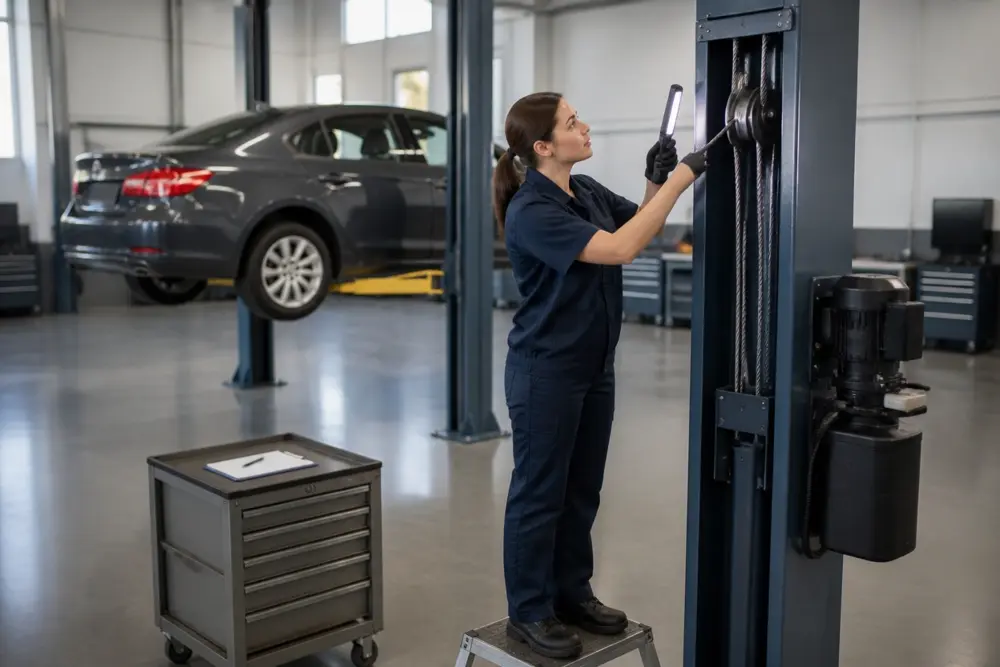
Proper 2 post lift maintenance runs on four schedules: a quick walkaround before the first vehicle of the day, a weekly clean and lube, a monthly check of anchors, cables and lock function, and one full annual inspection by a qualified lift inspector. That last one is not optional. The ANSI/ALI ALOIM:2020 standard requires an annual inspection on every vehicle lift, regardless of brand, age, or whether the lift itself is certified.
The good news is that the daily and weekly parts take about five minutes combined. The bad news is that most shops skip them, then pay for it three years later with a stretched cable or a lock that will not seat.
This is the full checklist, broken down by how often each task needs doing, with the specific warning signs that mean stop and call someone.
The 60-Second Version
Daily: walk the lift before you use it. Check cables, locks, arms, leaks, and pads. Weekly: clean the columns and wipe the cables. Monthly: lubricate, check anchor bolts, verify both carriages rise evenly, test every lock position. Annually: a qualified lift inspector does a full inspection and gives you a written record. Keep that record on file. Anything unusual (a new noise, a slow drift, a lock that hesitates) means take the lift out of service until it is checked.
What This Guide Covers
How Often Should You Do 2 Post Lift Maintenance?
Run a visual walkaround daily, a clean and wipe-down weekly, a lubrication and hardware check monthly, and a full professional inspection once a year. Here is the complete car lift maintenance checklist by interval.
| Interval | What to Check | Who Does It | Time Needed |
|---|---|---|---|
| Daily | Cables, safety locks, arm restraints, hydraulic leaks, pad condition (the CLAMP check) | Any trained operator | About 2 minutes |
| Weekly | Clean columns and carriages, wipe cables, clear debris from slide blocks and the base area | Shop staff | About 10 minutes |
| Monthly | Lubricate pivots, sheaves and cables, inspect anchor bolts, check cable tension and even rise, test every lock position, check fluid level | Shop lead or service tech | 30 to 45 minutes |
| Annually | Full structural, mechanical, hydraulic and electrical inspection, plus labels, documentation and training records | Qualified lift inspector | Scheduled visit |
| As needed | Cable replacement, hydraulic fluid change, pad and adapter replacement, arm restraint gear service | Qualified technician | Varies by job |
Busy shops running 15 or more cycles a day should tighten the monthly items to every two weeks. A home garage lift used a few times a month can stay on the schedule above, but never stretch the annual inspection.
The Daily Walkaround: The CLAMP Check
A daily lift inspection sounds like a chore until you give it a shape. Our team uses a five-point routine we call CLAMP, which follows the order you naturally walk around the lift: Cables, Locks, Arms, Motion, Pads.
Do it before the first vehicle goes up. Two minutes, every morning.
C is for Cables
Look at both equalizer cables from top to bottom. You are looking for fraying, kinks, rust, or a strand standing proud of the others. A cable that has started to unwind will catch a rag if you run one along it, which is the old trick and still the fastest test. Do not run a bare hand along a lift cable.
L is for Locks
Raise the empty lift a few feet and listen. You should hear both sides clicking as the pawls (the metal fingers that drop into the lock ladder) engage. Then lower it onto the locks and confirm both columns are resting on the same lock position. If one side clicks and the other does not, stop there.
A is for Arms and Restraints
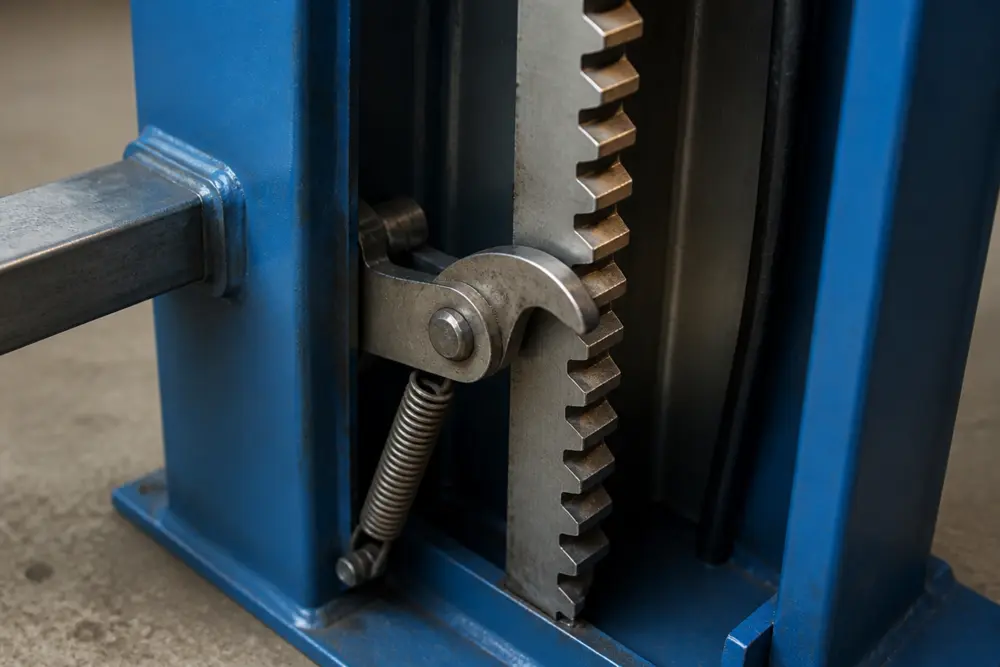
Swing each arm through its range. It should move smoothly and then lock in place when loaded. The arm restraint is the toothed gear at the base of each arm that stops it swinging once a vehicle is up. Worn or rounded teeth mean the arm can rotate under load, which is how vehicles come off lifts. Check for excessive play in the pivot pins too.
M is for Motion and Leaks
Cycle the lift up and down empty once. Both carriages should rise together and move without shuddering. Look at the base of each column, the power unit, and every hose fitting for wet spots or drips. A small weep today is a failed seal next month.
P is for Pads and Adapters
Rubber pads take a beating. Cracked, compressed, oil-soaked or missing pads let a vehicle slip on the arm. Check that all four are present and seated, and that any drop-in pads or height extensions are the right ones for the model. Our lift accessories and extension kits are matched to specific lift models, so do not mix parts between brands.
Safety First: Never Work Under a Lift You Have Not Locked
Raise the vehicle to working height, then lower it onto the mechanical locks before anyone goes underneath. Hydraulics hold a load. Mechanical locks are what keep it there. If any part of the CLAMP check fails, tag the lift out of service and get it looked at. Always follow the procedures in your specific model manual and use a qualified professional for any repair work.
Monthly 2 Post Lift Maintenance: Lubrication, Anchors and Cable Tension
The monthly service is where most of the real preventive work happens. Set a recurring calendar reminder, because "when we get to it" always becomes never.
What to Lubricate, and What to Leave Alone
Correct 2 post lift lubrication is about the right product in the right place, not about greasing everything you can reach.
| Component | What to Use | How Often |
|---|---|---|
| Lifting and equalizer cables | Light penetrating cable lubricant or spray grease, wiped on | Every 3 months |
| Sheaves and pulleys | Grease at the fitting where provided | Monthly |
| Arm pivot pins and rollers | Gear oil or grease per your manual | Monthly |
| Column slide blocks | Light grease on the contact face only | Monthly |
| Safety lock bars and pawls | Nothing. Clean and dry only | Wipe monthly |
Contrarian Take: Stop Greasing Your Safety Locks
Standard advice says lubricate all moving parts, and plenty of shops take that literally and hit the lock bars with grease. We think that is backwards. Grease on a lock pawl collects concrete dust, metal filings and brake dust, and that paste can stop the pawl from dropping fully into the ladder. A lock that hesitates is worse than a lock that squeaks. Keep the lock mechanism clean and dry, wipe it down monthly, and save the grease for the cables, sheaves, pivots and slide blocks.
Re-Torquing the Anchor Bolts
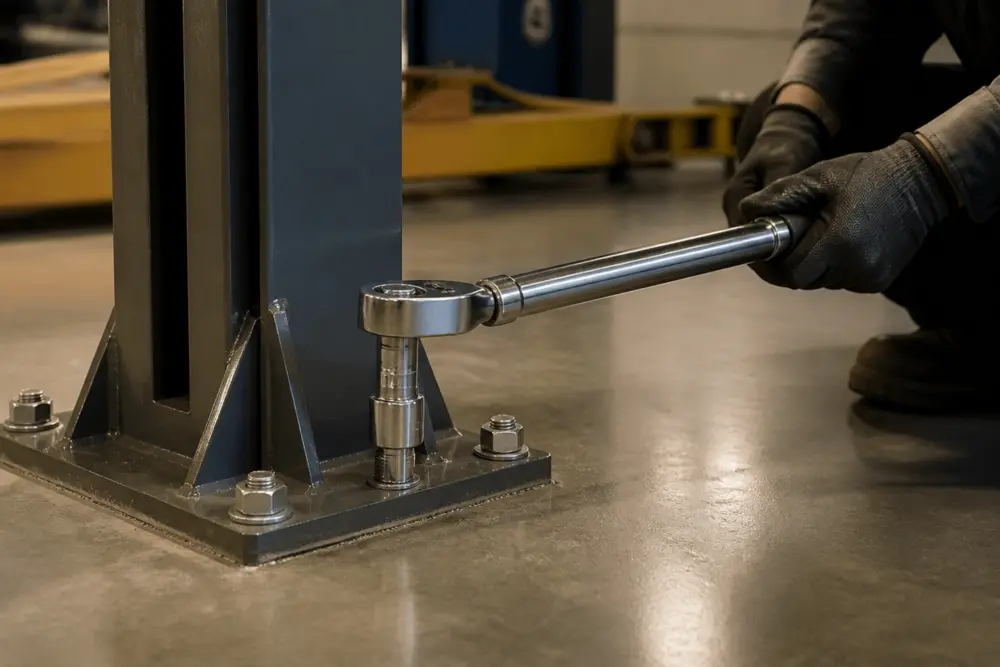
Anchor bolts are the only thing holding two steel columns to your floor. On a 2-post lift, the rear bolts on each column carry the most load, because the columns want to lean inward and forward when a vehicle is up.
Check every bolt monthly. You are looking for bolts that turn when the wrench touches them, gaps under the baseplate, rust weeping from the bolt hole, or hairline cracks radiating out through the concrete. Any of those means stop using the lift.
On anchor bolt torque for a 2 post lift, we are deliberately not printing a number here. The correct value varies by model, anchor type and slab spec, and using the wrong figure is genuinely dangerous. Use the torque value in your model's installation manual, and check it with a calibrated torque wrench rather than an impact gun. If the slab itself is the question, our guide to concrete slab requirements covers the thickness and PSI (a measure of how much pressure concrete can take before it cracks) that a 2-post lift needs.
Checking Cable Tension and Even Rise
Equalizer cables do not do the lifting. The hydraulics do that. The cables keep both carriages moving at the same rate, and over time they stretch.
Run the lift up empty and watch both carriages. If one side leads the other by more than a small amount, or if the lift stops on different lock positions, the cables need adjusting. Cable tension adjustment is a job for someone who has done it before, because over-tightening puts load into the sheaves and shortens cable life.
Lift Cable Inspection: When to Monitor and When to Replace
Cables are the single most inspected part of any 2-post lift, and for good reason. They give warning before they fail, but only if someone is looking.
How to Inspect a Lift Cable Properly
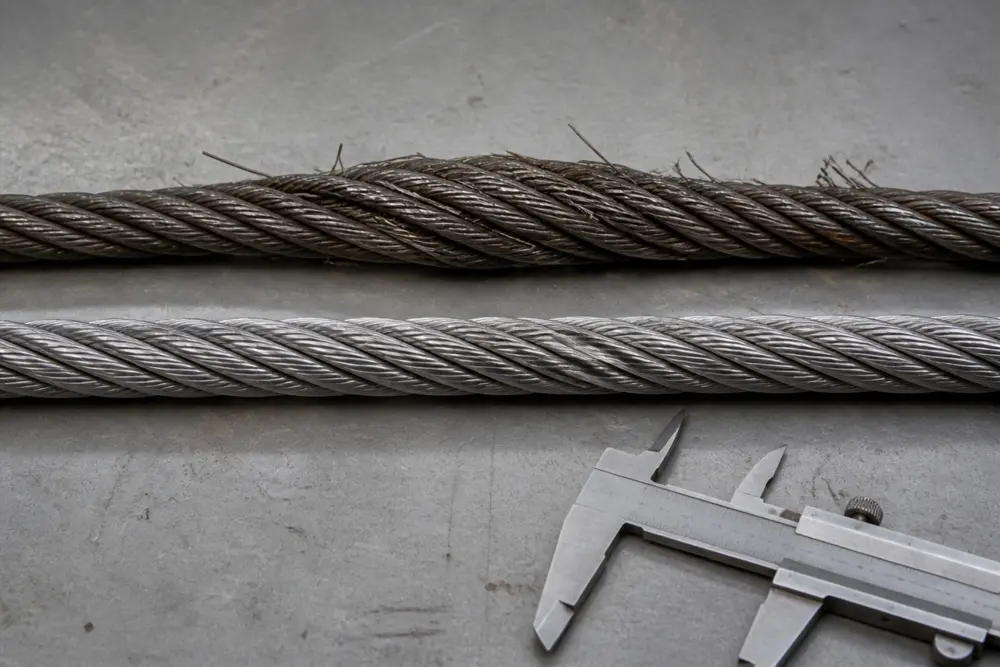
Wire rope is made of many thin steel wires twisted into strands, and those strands twisted into the finished cable. Wire rope inspection means checking the whole run, not just the parts at eye level.
Wear gloves. Work along the full length of each cable with a shop light, paying extra attention where the cable passes over a sheave, because that is where flexing concentrates. Look for broken wires, flat spots, rust, kinks, birdcaging (where the strands bulge outward), and any section that measures thinner than the rest.
The Replace-or-Monitor Decision
| What You See | What It Means | Action |
|---|---|---|
| Light surface rust, no pitting | Normal, needs lubrication | Clean and lubricate, monitor |
| A single broken wire | Early wear starting | Mark it, inspect weekly, plan replacement |
| Several broken wires in one strand, or scattered breaks across the cable | Cable strength is compromised | Replace both cables |
| Measurable reduction in cable diameter | Load rating has dropped below spec | Replace both cables |
| Kink, flat spot, birdcaging, or corrosion pitting | Structural damage | Take out of service, replace immediately |
Two rules on 2 post lift cable replacement. First, always replace cables in pairs, never one side. A new cable next to a stretched one guarantees uneven rise. Second, the exact broken-wire counts and diameter thresholds that trigger replacement are set by your manufacturer, so check your model manual for the specific figures rather than relying on a general rule of thumb. As a planning number, most shops budget for cable replacement somewhere in the three to five year range depending on how hard the lift works.
What Hydraulic Fluid Does a Car Lift Use, and How Often Should You Change It?
Most 2-post lifts run on an anti-wear hydraulic oil, commonly ISO grade AW-32 or AW-46, and some manufacturers approve automatic transmission fluid as an alternative. Your manual decides this, not the internet. Mixing incompatible fluids can swell seals and cause the exact leak you were trying to avoid.
Check the fluid level monthly with the lift fully lowered, because the level reads high when the carriages are up. Top up if it is low, but treat a dropping level as a leak to find rather than a top-up to repeat.
On change intervals, industry guidance for car lift hydraulic fluid generally lands around once a year for a busy commercial shop and every two to three years for a lightly used home garage lift. Change it sooner if the oil looks milky (water contamination) or dark and gritty. Under Daytona's warranty, power units, motors, pumps, cylinders and seal kits are covered for two years, so keeping clean fluid in the system is genuinely in your interest.
Car Lift Annual Inspection: What ANSI/ALI ALOIM:2020 Actually Requires
This is the part shop owners get wrong most often, so here it is plainly.
ANSI/ALI ALOIM:2020 is the American National Standard covering vehicle lift operation, inspection and maintenance. It requires that a lift owner or employer use a qualified lift inspector to inspect every lift at least once a year. According to the Automotive Lift Institute, that requirement applies to any car lift, truck lift or other vehicle lift at a location, regardless of type, age or manufacturer.
A proper automotive lift inspection covers the structural, mechanical, hydraulic, air and electrical systems. ALI notes that depending on the lift, this can run to as many as 120 inspection points. The inspector should also review your lift labels, safety materials, vehicle lifting instructions and operator training logs, and should leave you with a written record. Keep it on file.
Who Counts as a Qualified Lift Inspector?
Not your most experienced technician, in most cases. ALI runs a Lift Inspector Certification Program with defined requirements including documented related experience, a training workshop, written and practical exams, and a set of supervised field inspections. You can search for a certified inspector through the ALI Certified Lift Inspector directory.
You can and should do your own daily, weekly and monthly checks. The annual inspection is the one to hand over.
Does OSHA Require Car Lift Inspections?
Here is a myth worth killing. OSHA does not have a regulation written specifically for vehicle lifts, and there is no such thing as an "OSHA certified lift inspector." What OSHA does have is the General Duty Clause, which requires employers to provide a workplace free from recognized hazards. In practice, an inspector can reference the recognized industry standard, which is ANSI/ALI ALOIM. So the annual inspection is enforceable in effect, just not through a lift-specific rule.
Vehicle Lift Inspection Requirements in Canada
Canadian shops answer to provincial occupational health and safety law rather than OSHA. In Ontario, for example, lifting devices at industrial establishments fall under Regulation 851 of the Occupational Health and Safety Act, and vehicle hoists are widely expected to be inspected annually by a competent person. Requirements vary by province, so confirm the rule where you operate. Either way, an annual inspection plus a documented log is the defensible position in both countries.
The Maintenance Log Every Shop Should Keep
A lift maintenance log takes about 30 seconds to fill in and does two jobs. It shows a pattern, so you spot the cable that has needed attention three months running. And it is your evidence during a safety visit, an insurance review, or a warranty conversation.
Copy this into a spreadsheet or print it and clip it to the column. Keep one sheet per lift.
| Date | Lift ID / Serial | Check Performed | Result and Action Taken | Initials |
|---|---|---|---|---|
| 2026-01-06 | Bay 2 / SN 00000 | Daily CLAMP check | Pass. Left rear pad worn, ordered replacement | JM |
| 2026-01-31 | Bay 2 / SN 00000 | Monthly lube, anchors, cable tension | Anchors re-torqued to manual spec. Cables lubed. Rise even | JM |
| 2026-02-14 | Bay 2 / SN 00000 | Hydraulic level check | Topped up. Watch for leak at rear fitting | RT |
| 2026-03-03 | Bay 2 / SN 00000 | Annual inspection (certified inspector) | Passed. Written report filed in binder | Inspector |
What Your Warranty Does Not Cover, and Why That Matters
Most maintenance articles never mention warranty. We think that is a miss, because the two are directly connected.
Daytona's 5-2-1 warranty covers 5 years on structural components, 2 years on power units (motors, pumps, cylinders and seal kits) and 1 year on other non-wearing parts, with freight included on warranty parts within Canada and the continental US.
Now look at the exclusions. Wearing parts are not covered, and that list is cables, hoses, slider blocks, chains, gears, wedges and rubber pads.
Read That List Again
Cables, hoses, slide blocks, chains, gears, wedges, pads. Those are almost exactly the parts a maintenance routine protects. Which means car lift preventive maintenance is not just about safety and uptime. It is the only coverage that exists on the components no warranty in this industry covers. Every month you lubricate a cable, you are extending the life of a part you will otherwise buy yourself.
The other half matters too. Improper installation, improper use, modifications, overloading and outdoor use all void the warranty. All Daytona equipment is rated for indoor use only. If you want the install side done right from the start, read our guide on how to install an automotive lift, and make sure everyone in the bay knows how to use a car lift safely.
How Long Do Car Lifts Last With Proper Maintenance?
A well-built 2-post lift that is inspected, lubricated and used within its rating can run for 20 years or more. Structural steel rarely wears out. What ends a lift's life is usually accumulated neglect: seized sheaves that chew through cables, corroded anchors in a slab that was never right, or a control system nobody can source parts for.
Here is a scenario our team hears versions of regularly. A mixed-fleet shop passes its annual inspection in the spring with no findings. Six weeks later a tech notices the passenger side carriage stopping about an inch below the driver side. Nothing was frayed and nothing was broken. One equalizer cable had simply stretched more than the other under a run of heavy trucks. A twenty-minute adjustment fixed it.
The lesson is that an annual inspection is a snapshot, not a substitute. The daily walkaround is what catches the things that develop between visits.
Whatever you run, the maintenance principles are the same across every 2-post, 4-post and scissor model in our automotive lifts range. Check it daily, service it monthly, inspect it annually, and write it down.
Frequently Asked Questions
How often should you do maintenance on a 2 post lift?
Do a visual walkaround daily before first use, clean the lift weekly, and complete a full lubrication and hardware check monthly. On top of that, ANSI/ALI ALOIM:2020 requires a professional inspection by a qualified lift inspector at least once a year. Shops running heavy daily volume should move the monthly items to every two weeks.
How often should a car lift be inspected?
At least once every 12 months by a qualified lift inspector, according to the ANSI/ALI ALOIM:2020 standard. That applies to every vehicle lift regardless of type, age, manufacturer or certification status. The inspector should provide a written record, which you keep on file for insurance and health and safety purposes.
Who can inspect a car lift?
The annual inspection must be done by a qualified lift inspector, not just an experienced technician. The Automotive Lift Institute runs a Lift Inspector Certification Program with documented experience requirements, training, written and practical exams, and supervised field inspections. You can search for a certified inspector through ALI's online directory. Daily, weekly and monthly checks can be done by trained shop staff.
How often should 2 post lift cables be replaced?
Most shops plan on replacing lift cables somewhere in the three to five year range, though heavy daily use shortens that and light use extends it. Replace immediately if you find kinks, flat spots, birdcaging, corrosion pitting, multiple broken wires, or any measurable reduction in cable diameter. Always replace cables in pairs so both sides rise evenly, and check your model manual for the specific replacement thresholds.
How often should you grease a 2 post lift?
Lubricate sheaves, arm pivot pins, rollers and column slide blocks monthly, and lubricate the cables about every three months. Use the lubricant type specified in your model manual. Do not grease the safety lock bars or pawls, because grease traps concrete dust and metal filings that can stop a lock from seating properly. Keep the lock mechanism clean and dry instead.
What hydraulic fluid does a car lift use?
Most 2-post lifts use an anti-wear hydraulic oil, commonly ISO grade AW-32 or AW-46, and some manufacturers approve automatic transmission fluid as an alternative. Always follow the fluid type listed in your model manual, since mixing incompatible fluids can swell seals and cause leaks. Check the level monthly with the lift fully lowered.
How often should anchor bolts be re-torqued on a 2 post lift?
Inspect anchor bolts monthly and re-torque them to your model manual's specification using a calibrated torque wrench rather than an impact gun. Torque values vary by lift model, anchor type and slab specification, so never use a figure from another lift. Stop using the lift immediately if you find bolts that spin, gaps under the baseplate, or cracks in the concrete around the anchors.
Why is my 2 post lift rising unevenly?
The most common cause is equalizer cables that have stretched at different rates, which is normal wear over time and usually fixable with a tension adjustment. Other causes include a seized or dry sheave, debris in a column, or air in the hydraulic system. Take the lift out of service until it is corrected, because uneven rise puts unequal load on the carriages and locks.
Does OSHA require car lift inspections?
OSHA does not have a regulation written specifically for vehicle lifts, and there is no such thing as an OSHA certified lift inspector. However, the OSHA General Duty Clause requires employers to provide a workplace free from recognized hazards, and inspectors can reference the recognized industry standard, ANSI/ALI ALOIM. Canadian shops follow provincial occupational health and safety rules instead, such as Ontario's Regulation 851.
Does skipping maintenance void my lift warranty?
Improper use, improper installation, modifications, overloading and outdoor installation all void Daytona's 5-2-1 warranty. Just as important, wearing parts such as cables, hoses, slider blocks, chains, gears, wedges and rubber pads are excluded from coverage in the first place. Those are exactly the parts routine maintenance protects, which makes a maintenance routine the only real protection you have on them.

Need Parts, Service Support, or a Replacement Lift?
Send us your model number and a description of what the lift is doing. We will help you sort out whether it is a service item, a parts order, or time for a replacement, and connect you with a distributor in your area.
- 5-2-1 Limited Warranty (5 years structural, 2 years power, 1 year parts)
- Freight included on warranty parts in the US and Canada
- ALI Certified option available on the BR10-2OH-33
- Canadian-owned manufacturer since 1999
- Active distributor network across North America