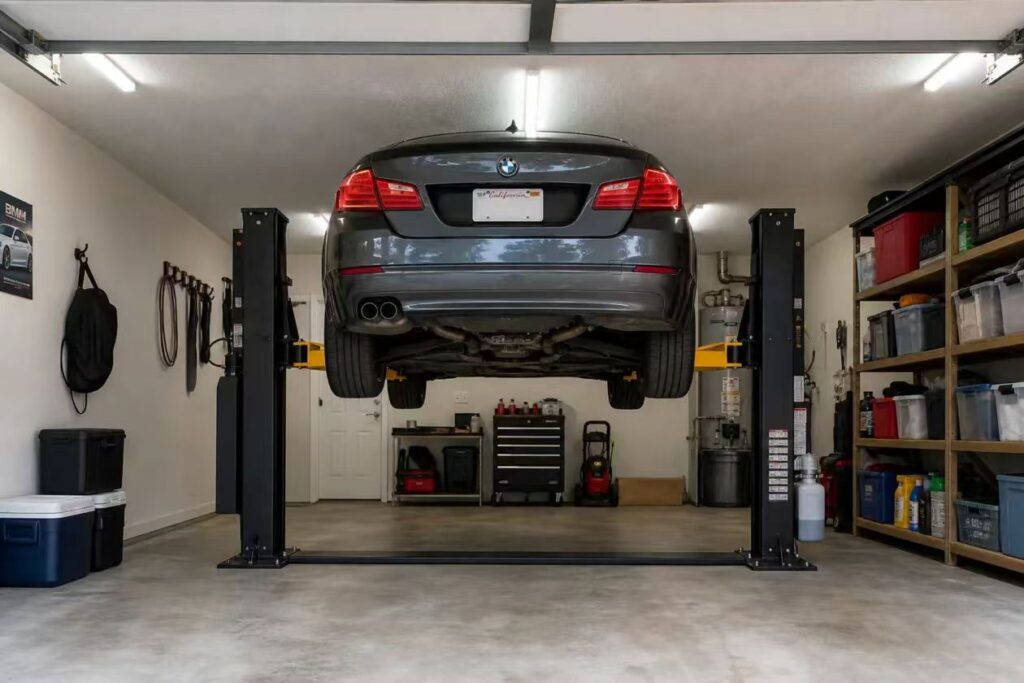
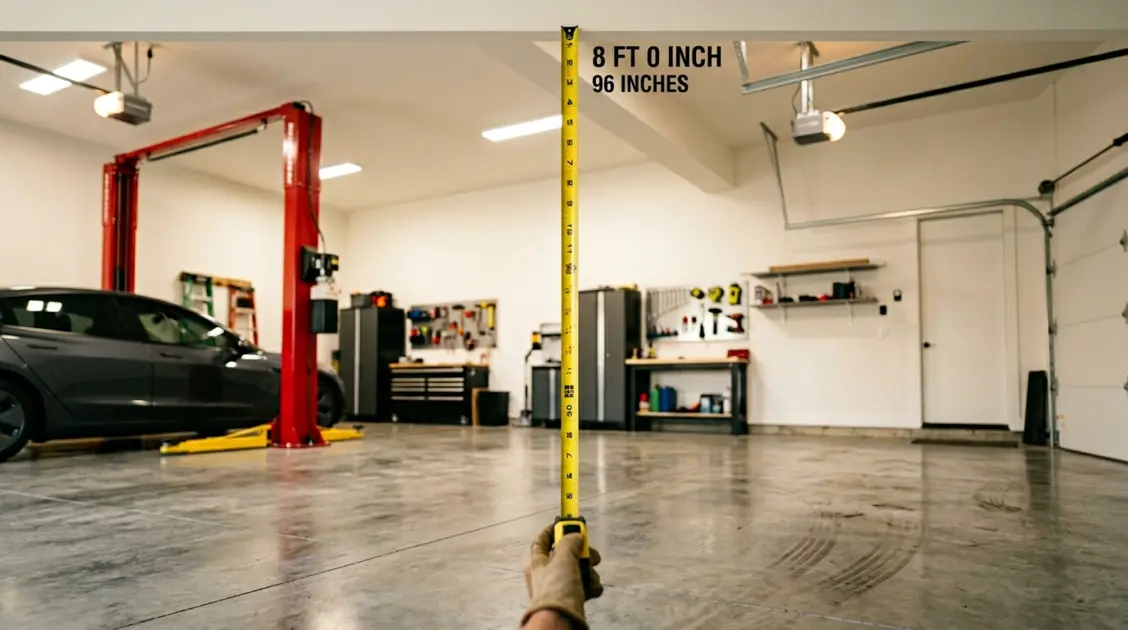
No standard overhead 2-post car lift fits an 8-foot ceiling. Overhead models typically stand 140 to 152 in. (3,556 to 3,861 mm) tall, and 8 ft gives you 96 in. (2,438 mm).
Under 8 ft, a mid-rise scissor lift or a portable two-post system is the realistic choice, and you will work seated. Floorplate 2-post lifts start to fit at about 9 ft 6 in. (2.90 m), because a steel plate at floor level replaces the overhead crossbar.
Measure to the lowest obstruction with the garage door open, not to the drywall. Then run two checks: the lift’s columns, and your vehicle’s roof at the height you plan to work.
Eight feet is tight. You will not walk upright under a raised pickup in a 96 in. garage, and no spec sheet changes that.
What you can do is raise a car or small SUV high enough for brakes, suspension, exhaust and fluid work, from a stool or a creeper. Getting there takes the right lift type and honest math, not a taller building.
Vehicle height matters as much as lift height. A sports car and a full-size pickup can sit 20 in. (508 mm) apart measured from the lift point to the roof, and that gap decides whether a lift is useful in your bay or just fits in it.
Below you will find the two-check formula, a table showing how high each vehicle type can go under 8 ft, the minimum ceiling for every major lift style, worked numbers for 9, 10, 11 and 12 ft garages, and the prep items that stall installs after the lift arrives.
Key takeaways
- Two checks. Lift overall height plus 6 in. (152 mm) must clear the ceiling, and so must rise plus vehicle height plus 6 in.
- Usable rise. Ceiling minus 6 in. minus vehicle height from lift point to roof tells you how high you can actually lift.
- 8 ft (96 in.). Mid-rise and low-rise scissor lifts, portable two-post systems and motorcycle lifts. Expect about 36 to 41 in. of rise with a sedan.
- 9 ft 6 in. to 10 ft. Floorplate 2-post lifts at 110 to 114 in. overall, with wheels-free access.
- 11 ft (132 in.). The point where most adults can stand under a sedan on a floorplate lift.
- 12 ft and up. Standard overhead and adjustable 2-post lifts at 140 to 152 in. overall.
- Door hardware. A high-lift track and a wall-mounted jackshaft opener can recover 6 to 18 in. (152 to 457 mm).
- Power and concrete. The LMS6 runs on 120V. Floorplate 2-post lifts need 240V single phase. Plan on at least 4 in. (102 mm) of cured 3,000 PSI concrete.
How do you calculate the ceiling height you need?
Run two checks, not one: the lift has to fit the room, and the raised vehicle has to fit under the ceiling. Most online calculators only run the second check, which is how buyers end up with columns that clip a door track.
Check 1: the column check
Lift overall height + 6 in. buffer = minimum clear height over the columns. A floorplate lift with a 110 in. (2,794 mm) overall height needs about 116 in. (2,946 mm) of clear space above each column. The buffer protects light fixtures, door tracks and opener motors.
Check 2: the roof check
Rise at the lock you will use + vehicle height from lift point to roof + 6 in. buffer = ceiling height needed. On a floorplate or scissor lift nothing sits above the vehicle, so the roof can climb higher than the columns. This check is the one that limits most low garages.
Flip it: how high can you actually lift?
Usable rise = lowest obstruction − 6 in. − vehicle height from lift point to roof. This version is more useful, because it tells you what you get rather than what you need.
Take an 8 ft garage and a midsize sedan measuring 52 in. (1,321 mm) from rocker to roof. That works out to 96 − 6 − 52, or 38 in. (965 mm) of usable rise. A mid-rise scissor lift rated for 54 in. will clear your ceiling only if you stop it at a lock position near 38 in. That is still enough for brakes, suspension and exhaust work from a rolling stool.
Measure in the right places
Open the garage door and measure to the lowest of the door tracks, the opener rail, the torsion spring above the door and any hanging lights. Measure again at each planned column position and where the roof will sit when raised. Many garage floors slope toward the door, so the height can change by an inch or more across the bay.
How tall is your vehicle from the lift point?
What matters is the distance from where the lift touches the vehicle to the highest point of the roof, not the vehicle’s total height. Lift points sit at the rocker pinch welds or the frame, usually 4 to 13 in. (102 to 330 mm) above the ground depending on the vehicle.
| Vehicle type | Typical total height | Approx. lift point to roof | Usable rise under 8 ft |
|---|---|---|---|
| Sports cars | 47–54 in. | 42–49 in. | 41–48 in. |
| Sedans | 55–60 in. | 49–54 in. | 36–41 in. |
| Compact SUVs | 62–68 in. | 54–60 in. | 30–36 in. |
| Full-size SUVs | 72–78 in. | 62–68 in. | 22–28 in. |
| Pickup trucks | 74–80 in. | 63–69 in. | 21–27 in. |
That last column explains the whole problem. An 8 ft garage works well for cars and gets marginal for trucks. A pickup gains about 2 ft (610 mm) of rise, which is useful for tires and brakes but not much else.
Two details catch people out. Roof racks, light bars and shark-fin antennas add height, so measure with them fitted. And electric vehicles carry battery packs under the floor, so they must be lifted only at the points the vehicle maker specifies. Our guide on how to use a car lift safely covers lift points and arm placement in detail.
What lift types work in low-ceiling garages?
Scissor lifts, portable two-post systems and floorplate 2-post lifts are the three families built for this. Most other designs assume a commercial bay with 12 ft (3.66 m) or more. For a full overview of every category, see our pillar guide to the different types of car lifts.
| Lift type | Overall or lowered height | Typical rise | Practical min. ceiling | Best for |
|---|---|---|---|---|
| Low-rise scissor lift | 4–5 in. lowered | 24–26 in. | 8 ft | Tires, brakes and detailing |
| Mid-rise scissor lift | 5–6 in. lowered | 40–54 in. | 8 ft (rise limited) | Seated undercar work on cars |
| Portable two-post system | About 89 in. assembled | About 48 in. | 8 ft | Garages that double as parking |
| Motorcycle and ATV lift | Low table | Up to 48 in. | 8 ft | Bikes, ATVs and small powersports |
| Floorplate 2-post lift | 109–114 in. | See spec sheet | 9 ft 6 in. to 10 ft | Wheels-free service in low shops |
| High-rise scissor lift | About 5 in. lowered | Up to about 75 in. | 10 ft; 11 ft for full rise | Flush-floor bays with no columns |
| 4-post storage lift | 82–96 in. | About 71–85 in. under | 10 to 12 ft to stack | Storage and stacked parking |
| Overhead 2-post lift | 140–152 in. | Full height | 12 ft and up | Full-service repair shops |
| 4-post service or alignment lift | 96 in. and up | Full height | 12 to 14 ft | Drive-on service and alignment |
The range runs from 8 ft for a basic scissor lift to 14 ft (4.27 m) for a full-size 4-post alignment lift. Your ceiling narrows the list fast, so start there before you compare capacity or price.
Mid-rise scissor lifts
If you truly have 8 ft, a mid-rise scissor lift is your strongest option. These sit 5 to 6 in. (127 to 152 mm) off the floor when lowered and raise a vehicle 40 to 54 in. (1,016 to 1,372 mm).
A low lowered height matters as much as the top height. It lets the lift slide under lowered sports cars that a floor jack struggles with. You will work from a creeper or stool. Some designs put a platform under the center of the car, so check the layout if you need open access to the transmission or exhaust.
Portable two-post systems
Portable two-post systems run around 89 in. (2,261 mm) assembled, fit under 8 ft and come apart when you need the floor back. Capacity is typically 6,000 to 7,000 lb with a maximum rise near 48 in. (1,219 mm).
They suit a home garage that doubles as a parking spot. You trade capacity, rise and setup time against a permanent floorplate lift, and most still need anchors set into a sound slab.
Low-rise scissor lifts
Low-rise scissor lifts top out around 24 to 26 in. (610 to 660 mm). That covers tire rotations, brake pads, detailing and bodywork, and not much else. They fit almost anywhere, and many run on standard 120V power.
Motorcycle and ATV lifts
Bikes are the easy win in a low garage. The LMATV lifts 2,200 lb to a 48 in. maximum, switches between ATV and motorcycle mode with removable side extensions, and runs on 120V / 1HP / 8A / 1PH / 60Hz. Browse the full motorcycle and ATV lift range for options.
Floorplate vs overhead (clear floor) 2-post lifts in a low garage
An overhead lift, also called a clear floor lift, routes its equalization through a beam across the top, so it needs the most ceiling. A floorplate lift moves that link to the floor and drops the overall height by 2 to 3 ft (610 to 914 mm).
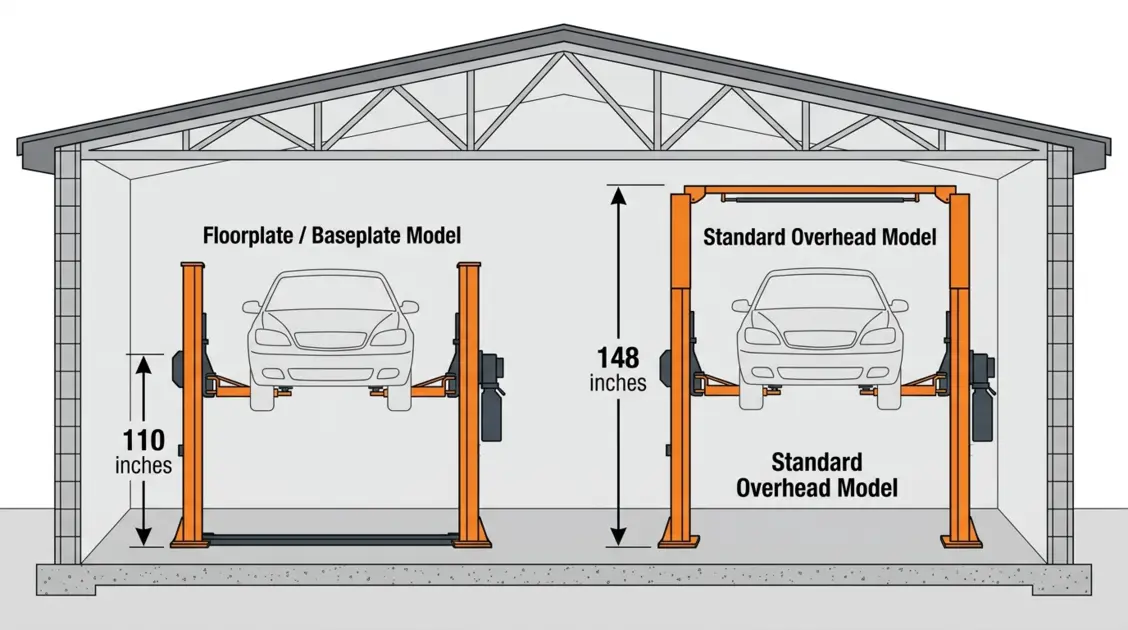
A floorplate 2-post lift is the closest thing to a full-size 2-post lift that fits a low ceiling. A steel plate at floor level joins the columns and carries the cables or hydraulic lines between them. You keep wheels-free access, so brake jobs, suspension swaps and exhaust work are all on the table.
The tradeoff is the plate itself, usually about 2 in. (51 mm) tall and 8 to 9 in. (203 to 229 mm) wide. You drive over it, and transmission jacks, creepers and oil drains roll over it. Most technicians stop noticing it within a week.
One safety difference gets little attention. Most overhead lifts carry a shutoff bar under the top beam that stops the lift if a roof touches it. A floorplate lift has nothing between the columns, so nothing stops a tall roof before it reaches your ceiling. Mark the highest safe lock position on the column for each vehicle you lift, and teach everyone who uses the lift to watch the roof on the way up.
Column spacing and drive-through width matter too, especially for wider trucks. Our 2-post lift dimensions guide explains overall width versus width between columns, and the best 2-post car lift buyer’s guide compares configurations side by side.
Daytona lifts that fit low ceilings
Our floorplate, scissor and parking lines exist because of this exact question. After 25+ years supplying shops and home garages across the US and Canada, ceiling clearance is the constraint our distributors hear about most.
| Model | Type | Capacity | Key height | Power | Fits from about |
|---|---|---|---|---|---|
| LMS6 | Mid-rise scissor | 6,000 lb | 5.5 in. lowered, 54 in. max | 120V / 1.5HP / 15A / 1PH / 60Hz | 8 ft, rise set by vehicle |
| LTPF9 | Floorplate 2-post | 9,000 lb | 110 in. overall | 240V / 3HP / 13A / 1PH / 60Hz | 9 ft 6 in. to 9 ft 8 in. |
| LTPF12 | Floorplate 2-post | 12,000 lb | 114 in. overall | 240V / 3HP / 13A / 1PH / 60Hz | 9 ft 10 in. to 10 ft |
| LHS7 | High-rise scissor | 6,600 lb | 5 in. lowered, 74.5 in. max | 240V / 3HP / 12A / 1PH / 60Hz | 10 ft; 11 ft for full rise |
| LFPP9 | 4-post parking | 9,000 lb | 70.9 in. clearance | 120V / 1.5HP / 26A / 1PH / 60Hz | 10 ft with a low car under; 11 ft 6 in. or more for two sedans |
| LMATV | Motorcycle and ATV | 2,200 lb | 48 in. max | 120V / 1HP / 8A / 1PH / 60Hz | 8 ft |
The Daytona LTPF9 is a 9,000 lb floorplate 2-post lift with an overall height of 110 in. (2,794 mm). It runs chain-over hydraulic cylinders, automatic safety locks with single-point release, high-polymer polyethylene slide blocks and three-stage front arms.
For heavier vehicles, the LTPF12 raises capacity to 12,000 lb at 114 in. (2,896 mm) overall, using dual chain-drive cylinders and the same lock system. Both floorplate models need a dedicated 240V single-phase circuit.
If your ceiling is under 9 ft 6 in., the LMS6 mid-rise scissor lift gives 6,000 lb of capacity, a 54 in. maximum lift, a 45-second rise time and a 5.5 in. (140 mm) lowered height, with height extensions included. It runs on 120V, which suits most residential and small-shop panels.
Shops with 10 to 11 ft that want a flush floor with no columns can look at the LHS7 high-rise scissor lift. It is rated 6,600 lb with double hydraulic equalizing, a pneumatic safety lock and a 74.5 in. (1,892 mm) maximum height, and it needs a 240V circuit.
If you have 12 ft or more, the full overhead range opens up. The BR10-2OH-33 is our ALI Certified 10,000 lb overhead model. The LTPO15 must be assembled with its included 2 ft height extension kit, so plan for a tall bay.
Every lift above carries our 5-2-1 warranty: 5 years structural, 2 years on power units and 1 year on parts, for indoor use only, with freight covered on warranty parts within Canada and the continental US.
What fits with a 9, 10, 11 or 12 foot ceiling?
Each extra foot buys you either a new lift type or about 12 in. (305 mm) more working height. Here is the math for a midsize sedan at 52 in. and a pickup at 66 in. from lift point to roof.
9 ft (108 in. or 2.74 m)
Usable height is 102 in. A sedan gets about 50 in. (1,270 mm) of rise, close to the full travel of the LMS6. A pickup gets about 36 in. Floorplate 2-post lifts do not fit yet, because 110 in. columns need more than 108 in. A few short-column 2-post models near 106 in. exist, but check their maximum rise, which is usually limited.
10 ft (120 in. or 3.05 m)
This is where a floorplate lift becomes practical. The LTPF9 clears with room to spare, and the LTPF12 fits with about 6 in. over its columns. With 114 in. of usable height, a sedan rises about 62 in. (1,575 mm), a compact SUV about 57 in. and a pickup about 48 in. You will work stooped or seated under most vehicles, with full wheels-free access.
11 ft (132 in. or 3.35 m)
Usable height is 126 in., so a sedan on a floorplate lift rises about 74 in. (1,880 mm). Most adults can stand under it. A pickup rises about 60 in. The LHS7 reaches its full 74.5 in. with a sedan at roughly 11 ft. Overhead lifts still do not fit, since most stand 140 in. or taller.
12 ft and up (144 in. or 3.66 m)
Standard overhead and adjustable 2-post lifts start to fit, including the LTPA10 and LTPA12 with three width settings each. Optional height extension kits add column height, so rerun the column check if you add one. Full-size 4-post service lifts still want 12 to 14 ft.
Not sure what fits? Take your ceiling height measured to the lowest obstruction, your bay width and the vehicles you work on to a local Daytona distributor. They quote, deliver and install, including single home-garage orders. Have a question first? Talk to our team.
Find a Daytona DistributorHow much ceiling do you need to stand under the car?
To stand upright under a raised vehicle, the lift pads need to sit at about your height plus 3 in. (76 mm). Add the vehicle height and the 6 in. buffer and you have the ceiling you need for standing work.
Standing ceiling = your height + 3 in. + vehicle height from lift point to roof + 6 in. For a technician who is 5 ft 10 in. (1.78 m), that works out as follows.
| Vehicle type | Lift point to roof | Ceiling for standing work |
|---|---|---|
| Sports car | 45 in. | 124 in. (about 10 ft 4 in.) |
| Midsize sedan | 52 in. | 131 in. (about 10 ft 11 in.) |
| Compact SUV | 57 in. | 136 in. (about 11 ft 4 in.) |
| Pickup truck | 66 in. | 145 in. (about 12 ft 1 in.) |
If your ceiling falls short of the standing number, the lift is still worth it. Seated work on a rolling stool at 38 to 50 in. of rise is far faster and safer than lying on a creeper under jack stands. Try a friend’s lift at your planned height before you commit, so you know how it feels.
Parking lift math for stacking two cars
Stacking ceiling = clearance under the runways + runway thickness + upper vehicle’s total height + 6 in. The upper vehicle sits on its wheels, so use its full height, not the lift-point figure.
Take the LFPP9 at its full 70.9 in. (1,801 mm) of under-runway clearance with a 58 in. sedan on top. That is 70.9 + 58 + 6, or about 135 in. before you add runway thickness from the spec sheet. Plan on roughly 11 ft 6 in. or more to stack two sedans at full height.
At 10 ft, you can still stack by using a lower lock position, as long as the car underneath is low. A sports car under a sedan often works. Two SUVs do not. For taller vehicles, the LFPP10-XLT offers 85 in. of clearance, but it needs a taller bay to match. The LTPP6 shared-post parking lift is another option on 110V power. Check its overall height on the spec sheet.
Compare storage and service designs in our 2-post lift vs 4-post lift guide, or browse the full parking lift range.
Garage prep checklist before you buy
Ceiling height gets the attention, but door hardware, concrete, power and permits are what stall installations. Check every item below before you order.
Garage door and opener
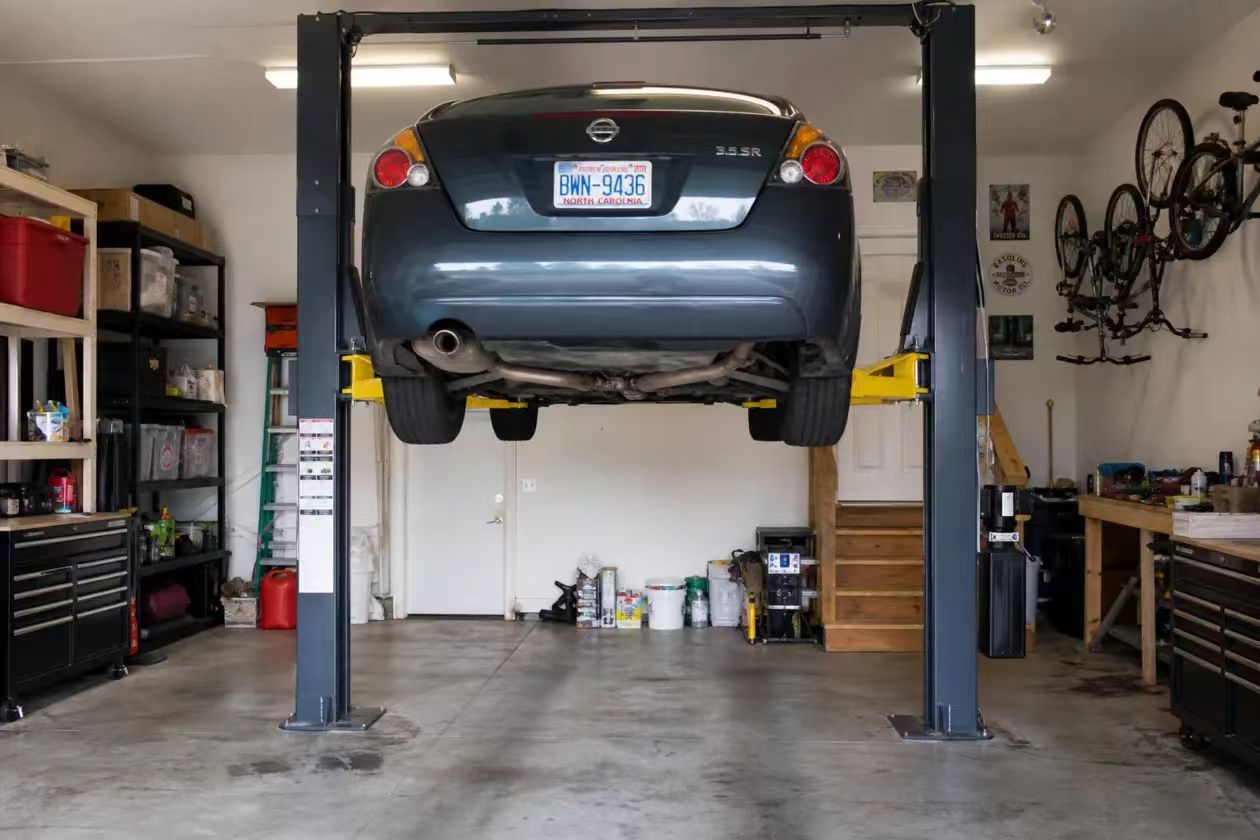
In many low garages the door hardware, not the ceiling, is the real limit. A standard track holds the open door horizontally just below the ceiling, right where a raised roof wants to be.
What a high-lift track conversion does
A high-lift conversion changes the door track so the open door runs up the wall before turning, and sits tight to the ceiling. Pair it with a wall-mounted jackshaft opener instead of a ceiling rail and you can recover 6 to 18 in. (152 to 457 mm) of clearance. The torsion spring above the door may also need to move. Prices vary widely by door size and region, so get a written quote from a garage door company and add it to your budget.
Ceiling structure and fixtures
Look up and list everything below the ceiling plane: lights, attic hatches, storage racks, ductwork, sprinkler heads and exposed trusses. Swapping hanging fluorescent fixtures for flush-mount LEDs buys an inch or two. Never cut or notch roof trusses to gain clearance without a structural engineer’s sign-off.
Floor slope and level
Garage floors often slope toward the door for drainage. That slope changes your ceiling height across the bay and can affect how level the columns sit. Check the manual’s tolerance for floor level at the column positions before you choose a spot.
Concrete slab
Most 2-post lifts need at least 4 in. (102 mm) of reinforced, cured 3,000 PSI concrete, and 6 in. (152 mm) is better above 10,000 lb capacity. The slab should be at least 28 days old, free of major cracks and reasonably level where the posts sit. Scissor lifts spread the load more evenly, but follow the manual either way. Our concrete thickness guide for 2-post lifts covers testing, cracks and post-tension slabs. Consult a qualified professional before drilling a post-tension slab.
Electrical supply
Low-rise and many mid-rise scissor lifts, including the LMS6, run on a standard 120V circuit, which is a real advantage in a home garage. Floorplate 2-post lifts, including the LTPF9 and LTPF12, need 240V single phase on a dedicated circuit. If the garage has no 240V supply, book a licensed electrician before delivery. Our 2-post lift power requirements guide lists what to ask for.
Permits and local rules
Requirements vary by jurisdiction and are set by your local Authority Having Jurisdiction. The new circuit almost always needs an electrical permit. Ask your local building department what applies to the lift itself before you order.
Safety and standards
The Automotive Lift Institute publishes safety tips covering vehicle positioning, lock engagement and routine inspection. Read them before your first lift arrives.
OSHA has no lift-specific standard, but it enforces the General Duty Clause, so in a commercial shop, training, inspection and following the manufacturer manual are required. Operation and inspection practice follows the ANSI/ALI ALOIM standard, which calls for at least annual inspection by a qualified lift inspector. Our 2-post lift maintenance checklist covers the daily and monthly checks in between.
How to decide which lift fits your garage
Work from your measured height to the lowest obstruction, then run both checks. Five steps get you to a shortlist.
Step 1. Measure to the lowest obstruction with the door open: door track, opener rail, torsion spring, light fixture or beam. Write it down in inches.
Step 2. Match that number to a lift category in the table below. This is the column check.
| Measured height | Recommended lift type | Daytona option |
|---|---|---|
| Under 96 in. | Low-rise or mid-rise scissor at reduced rise | LMS6, check rise with the roof formula |
| 96–113 in. | Mid-rise scissor, portable 2-post or motorcycle lift | LMS6, LMATV |
| 114–119 in. | Floorplate 2-post, lighter capacity | LTPF9, 110 in. overall, 9,000 lb |
| 120–131 in. | Floorplate 2-post, high-rise scissor or parking lift with a low car underneath | LTPF12, LHS7, LFPP9 |
| 132–143 in. | Floorplate with standing room under cars, or parking lifts stacking two sedans | LTPF9, LTPF12, LFPP9 |
| 144 in. and up | Overhead or adjustable 2-post | BR10-2OH-33, full 2-post lineup |
Step 3. Run the roof check against the tallest vehicle you will lift. If rise plus vehicle height plus 6 in. exceeds your measured height, plan on a lower lock position or a different lift.
Step 4. Verify concrete, power, door clearance and local permit rules. None of these depend on the lift, and any one of them can delay an install.
Step 5. Budget the whole project, not just the lift. Our home garage car lift cost guide and car lift installation cost guide break down delivery, electrical, concrete and labor. Third-party financing may be available. Approval not guaranteed.
When you are ready, the 2-post lift installation guide and our complete automotive lift installation guide walk through anchoring, cable routing and the first test lift. You can also download the full product brochure to compare specifications across the range.
Build a garage you’re proud of
Tell your local Daytona distributor your ceiling height, bay width and the vehicles you service. They will recommend a model that clears your space, quote it and install it. Have a question first? Talk to our team.
- LTPF9. 9,000 lb floorplate 2-post, 110 in. overall height.
- LTPF12. 12,000 lb floorplate 2-post, 114 in. overall height.
- LMS6. 6,000 lb mid-rise scissor, 5.5 in. lowered, 120V.
- 5-2-1 warranty. 5 years structural, 2 on power units, 1 on parts. Indoor use only.
- Since 1999. Canadian owned, serving the US and Canada.
Compare the 2-post lineup, browse scissor lifts, or see every automotive lift we build.
Find a Daytona DistributorAbout the author

The Daytona Team
Written by the team at Daytona Automotive Equipment, a Canadian-owned manufacturer of automotive lifts, tire changers and wheel service equipment since 1999.
Our team works daily with shop owners, home garage builders, distributors and installers, matching capacity, clearance and floor space in bays that were never designed around a lift.
- Specializations. Floorplate 2-post, scissor and parking lifts for low-clearance and residential bays.
- Standards. Guidance aligned to ANSI/ALI ALIS installation practice and ANSI/ALI ALOIM operation, inspection and maintenance practice.
- Reviewed by. Daytona product and technical support staff, October 2026.
Daytona Automotive Equipment Inc. · Brighton, ON, Canada · Automotive lifts, tire changers and wheel service equipment since 1999.
References and sources
- Automotive Lift Institute. Be a Smart Auto Lift User. ALI, accessed October 2026.
- Occupational Safety and Health Administration. Standard interpretation on automotive lifts and the General Duty Clause. OSHA, 19 November 2014.
- Automotive Lift Institute. ANSI/ALI ALOIM, Safety Requirements for Operation, Inspection and Maintenance. ANSI/ALI, current edition.
- Automotive Lift Institute. ALI Directory of Certified Lifts. ALI, accessed October 2026.
Heights, capacities and vehicle dimensions in this article are representative figures for planning and are not quotations. Confirm clearance, concrete and electrical requirements against the installation manual for your specific lift before purchase or installation. Daytona Automotive Equipment is not affiliated with Harbor Freight’s Daytona tool brand.