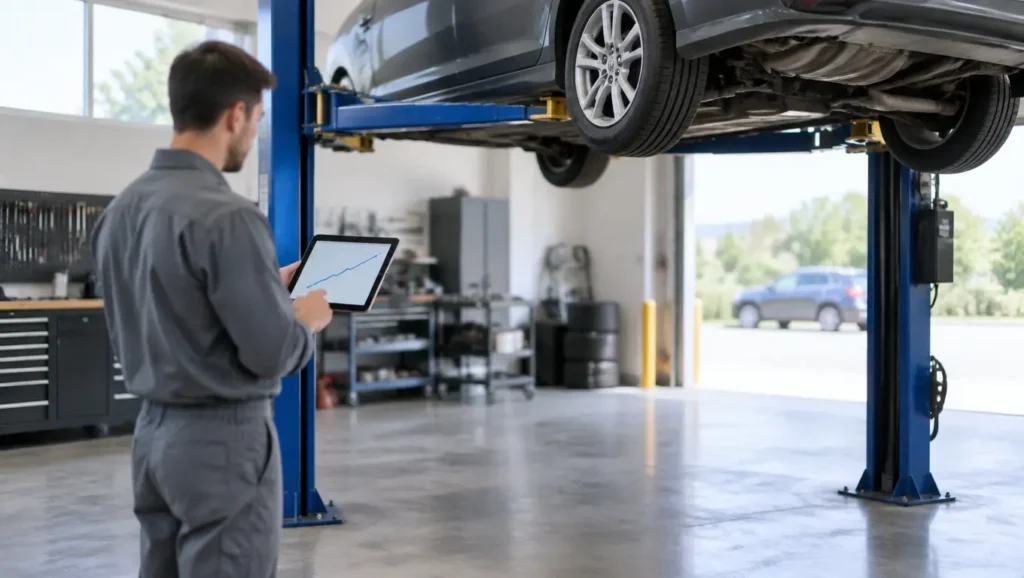
Is a car lift worth it? For a working shop, almost always, since one extra job a day usually pays back the equipment in under a year. For a home garage, it depends on how often you actually turn a wrench.
The math is different for each buyer, and most of the guides online only run one side of it. This one runs both, plus the tax side that neither side usually thinks about until year one is over.
Here is the short version: shops pay a lift back with throughput. Home garages pay it back with avoided labor bills. Both sides can use Section 179 or Capital Cost Allowance to make the math faster, but none of it matters until your ceiling, slab, and electrical service can actually take the lift you want.
Ask ten shop owners if a car lift is worth it and nine will say yes before you finish the question. That instinct is usually right, but it is not a number, and a number is what actually justifies the purchase order.
We build lifts in Brighton, Ontario and sell through distributors across the US and Canada, so we hear this question from two very different buyers: a shop owner comparing a lift against three other equipment purchases, and a home mechanic comparing it against a season of oil changes at a shop counter. Our full car lift cost breakdown covers what you spend. This guide covers what you get back, when the math says wait, and what has to be true about your building before either number matters at all.
Key takeaways
- Shops pay back fastest. One extra job a day, priced at a typical shop labor rate, often covers the equipment cost within a year.
- Home garages pay back slower but still pay back. The math runs on avoided shop labor bills instead of new revenue.
- Feasibility comes before the math. Ceiling height, slab thickness and cure, anchor bolts, and electrical service decide whether you can install a lift at all, before any payback number is relevant.
- Bay utilization matters more than bay count. A busy-looking shop can still be losing money if vehicles sit on the lift instead of being worked on.
- Tax treatment changes the real cost. Section 179 and 100 percent bonus depreciation in the US, and the Accelerated Investment Incentive in Canada, both shrink the net cost in year one.
- ALI certification and insurance protect the payback you calculated. An independently tested lift model and the right coverage keep a fast payback from turning into an unplanned expense.
- Capacity decisions affect payback. Buying more lift than your work requires slows the payback clock without adding real capability.
- Ownership costs continue after payback. The ANSI/ALI ALOIM standard calls for an annual inspection on every lift, regardless of brand, and that cost belongs in the math too.
How much does a car lift actually pay back?
A commercial car lift commonly pays back its full cost within four months to two years, based on published industry ROI reporting, depending on shop volume and labor rate. A home garage lift usually pays back in two to four years through avoided shop labor bills instead of new revenue.
Those numbers come from two different mechanisms, and mixing them up is where most online calculators go wrong. A shop lift pays back through throughput: more billable hours per bay, per day. A home garage lift pays back through avoidance: money you stop handing to someone else's shop.
Neither number is a guarantee. Both depend on you actually using the lift. A lift sitting mostly idle pays back on nobody's schedule, which is exactly why the next two sections split the math by buyer type instead of averaging them together.
Is a car lift worth it for a commercial shop?
For a shop already turning down work or losing bay time to slow undercar access, a lift is almost always worth it, because the payback comes from capacity you already have demand for. The harder question is not whether, it is how fast.
The bay throughput math
A 2025 industry survey of 752 general repair shops by PartsTech found the average shop runs 6 bays and services about 2.2 vehicles per bay per day. That is your baseline. A faster lift cycle, better undercar access, and less time spent positioning a vehicle on jack stands all push that number up.
Even a small gain compounds fast. Move one bay from 2.2 vehicles a day to 3.2, and you have added roughly 20 vehicles a month without adding a bay, a technician, or a square foot of floor space.
What one extra job a day is really worth
Run your own shop's average repair order against one extra completed job per bay per day, five days a week. According to industry benchmarking, average repair order values commonly fall between $500 and $749 for general repair shops. Even at the low end, one extra job a day adds real weekly revenue that a lift purchase can be measured against directly.
The hidden cost of not having a lift
Here's the thing most cost comparisons miss: the cost of staying on jack stands is not zero, it is just invisible on a balance sheet. Turned-away work during a busy week, a technician working slower and less comfortably on the floor, and the comeback risk from a rushed under-vehicle inspection all cost money that never shows up as a line item labeled "lift." Industry cost-benefit models built around this exact question commonly put the daily loss from an out-of-service or bottlenecked bay somewhere in the low hundreds of dollars, once lost labor margin and delayed jobs are counted together. That figure will not match your own invoice, but it is a real cost even though no line item on your books is labeled "lift."
Key takeaway: measure the gap, not the average
A blended shop-wide average understates the payback for your busiest bay and overstates it for your slowest one. Run the throughput math per bay, not per shop, before you decide.
The Four T's: an original framework for lift ROI
We built this framework because most online calculators only measure one thing, and the real decision has four moving parts. We call it the Four T's: Time saved, Throughput gained, Turned-away work recovered, and Tax treatment.
Time saved is the easiest to measure and the smallest number. It is minutes per job, multiplied by jobs per week. Throughput gained is bigger. It is whether that saved time turns into an actual extra completed job, which depends on your parts flow and scheduling as much as your lift.
Turned-away work recovered is the number nobody tracks and everybody underestimates. If your shop has ever told a customer "we can't get you in this week," that is lost revenue a faster bay could have captured. Tax treatment is the quiet fourth lever: the same lift purchase costs less in year one once Section 179 or the Accelerated Investment Incentive is applied, which we cover in detail below.
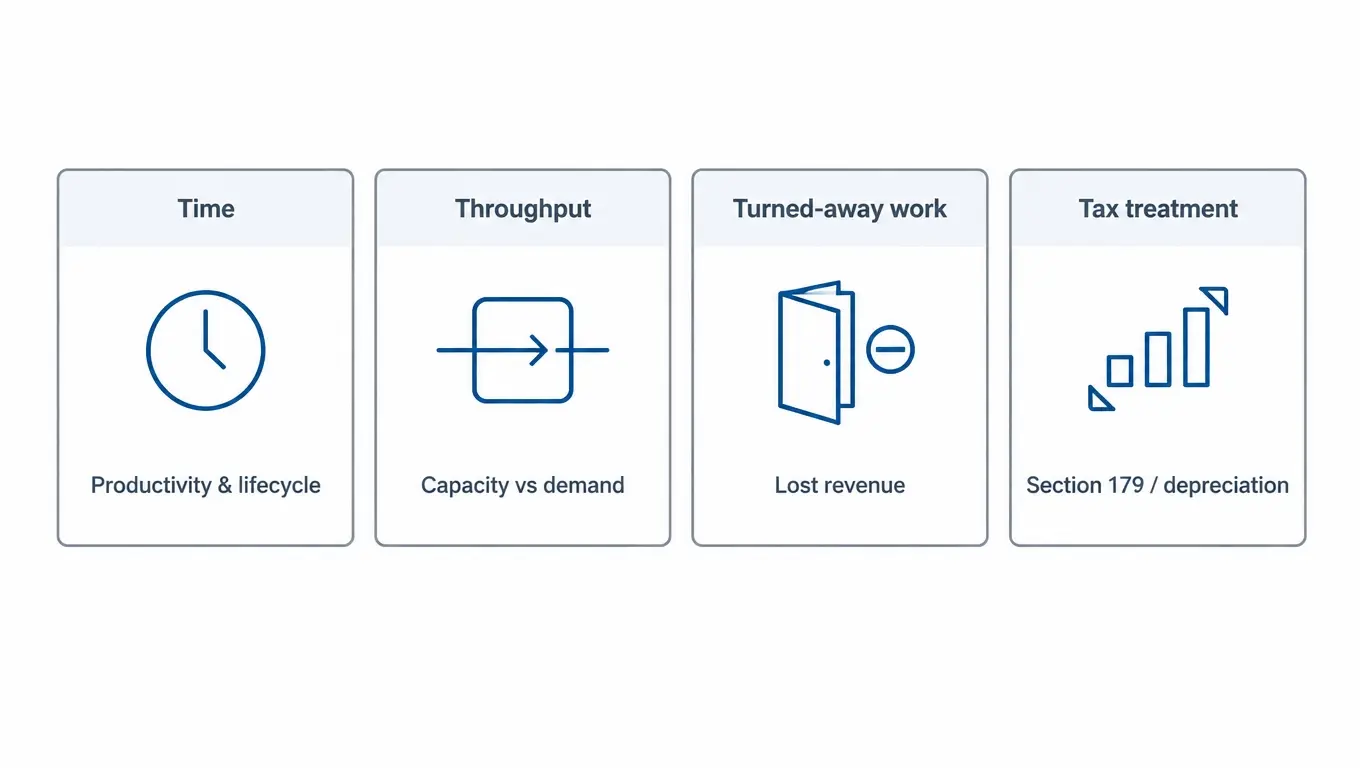
Most calculators only model the first two. Run all four, and the payback period usually looks better than the generic online tool suggested, because turned-away work and tax treatment both push in the same direction: faster payback, lower real cost.
Is your garage or shop actually ready for a lift?
None of the payback math above matters until your building can physically take the lift you want. This is a feasibility question, not a shopping question, and it applies whether you are adding a bay to a commercial shop or a lift to a home garage. A lift is a machine that suspends a vehicle over a person working underneath it, and the properties that make that safe belong to your building, not to the lift's spec sheet.
Four checks decide feasibility before a single quote makes sense. Ceiling clearance comes first, and it is the cheapest check to run yourself: full-rise two-post lifts commonly need roughly 11 to 12 feet of overhead clearance once you account for the lift's overhead beam, while low-overhead or floor-plate designs can work in spaces down to roughly 9 to 9.5 feet without reaching the same full-rise height. Measure your lowest overhead obstruction, including any garage door track or light fixture, not your flat ceiling height.
Slab thickness and condition come next, and this is the one no article, including this one, can settle for you. Installation guidance commonly calls for a minimum of about 4 inches of concrete at roughly 3,000 psi for lifts up to about 10,000 lb capacity, with more required for heavier-rated equipment, plus a full 28-day cure on any new pour before anchor loads are applied. Thickness alone does not confirm a slab is ready. Cracks, prior patches, or a cold joint running through the lift's footprint can disqualify an otherwise adequate-looking floor, and that determination belongs to the lift manufacturer's installation manual and a qualified installer or structural professional who can inspect your actual slab.
Anchor bolts are the third check, and they are not a generic hardware-store purchase. They are engineered to the specific lift model's load path and must be installed to the depth, spacing, and torque spec in that model's manual, in a slab that already meets the thickness and cure requirements above. The fourth check is electrical: most residential- and light-commercial-capacity lifts run on a dedicated 220 to 240 volt circuit, commonly in the 20 to 30 amp range, though some smaller portable or lower-capacity models are rated for 110 to 120 volts. Confirm the exact voltage and amperage on your specific lift's spec sheet before an electrician runs the circuit, since undersizing it is a common and entirely avoidable installation delay. Many jurisdictions also require a building permit for a permanently anchored lift, particularly where new concrete or electrical work is involved, so a call to your local building department belongs on this same checklist.
Why ALI certification belongs on this checklist too
A fifth item worth checking alongside the four physical gates is whether the lift model itself is ALI certified. The Automotive Lift Institute runs the only independently accredited program in North America that load-tests a lift model against the ANSI/ALI ALCTV safety standard and audits ongoing production. Certification applies per model, not per brand, so the specific lift matters more than the manufacturer's name on the box. Our BR10-2OH-33, a 10,000 lb overhead two-post lift, is one of the Daytona models that has been independently tested and is listed in the ALI directory; checking any lift you are considering against that same public directory takes about thirty seconds and is worth doing before you buy, regardless of brand.
None of these five checks replace a conversation with a qualified installer, and none of them are optional shortcuts, since they are also exactly what an insurance adjuster or building inspector will ask about if something ever goes wrong. Our home garage car lift cost guide walks through the full installed budget, including the site work these checks often require.
Is a car lift worth it for a home garage?
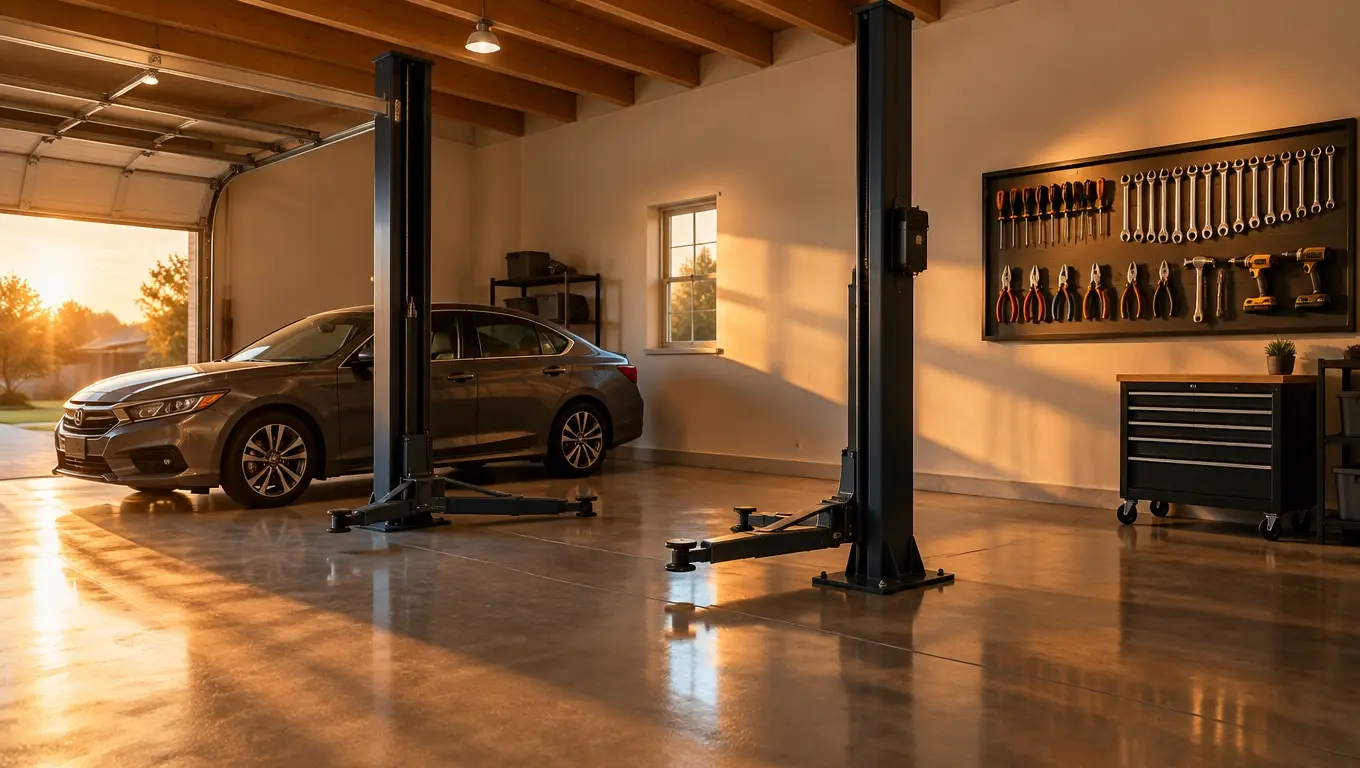
For a home garage, a lift is worth it if you service your own vehicles more than a handful of times a year, since the payback comes from money you stop paying a shop rather than new revenue you generate.
The math here is simpler than the commercial side. Add up what you currently pay a shop for the jobs a lift would let you do yourself: oil changes, brake jobs, suspension work, and inspections. Divide the lift's total installed cost by that annual figure, and you have a rough payback period.
Here is what that math looks like with real numbers. According to AAA's 2026 shop labor rate benchmarking, most general repair shops price labor between $120 and $159 an hour, with a national average landing close to $140. A hobbyist who tackles a brake job and a suspension inspection each year, on top of routine oil changes and the occasional bigger job, commonly avoids somewhere in the neighborhood of $1,200 to $1,500 a year in shop labor alone, before counting the parts markup a shop would also charge. Against an installed lift cost in the $4,500 to $6,000 range, that works out to a payback of roughly three to four years, which lines up with the frequent home DIYer row in the table further down this page. Someone who only wrenches once or twice a year will see that same math stretch out considerably, which is exactly why the table splits frequent and occasional DIYers into separate rows instead of averaging them together.
If you rarely open the hood, or your garage cannot fit the lift type your vehicles need, the math will tell you honestly that it is not worth it yet.
How long does it take a car lift to pay for itself?
The honest answer depends entirely on which buyer you are and how many hours the lift actually sees use in a week. Here is a representative range by buyer type, compiled from published industry ROI reporting rather than a single source.
| Buyer type | Payback mechanism | Typical payback range |
|---|---|---|
| Busy commercial shop | New revenue from added throughput and recovered turned-away work. | 4 to 12 months |
| Moderate-volume shop | Steady throughput gain, fewer turned-away jobs to recover. | 1 to 2 years |
| Mobile or independent technician | Faster job completion translating into more jobs booked per week. | 1 to 2 years |
| Frequent home DIYer | Avoided shop labor bills on oil changes, brakes, and suspension work. | 2 to 4 years |
| Occasional home DIYer | Fewer jobs to offset the cost against; payback stretches out significantly. | 4 years or longer |
Common mistake: confusing occupancy with utilization
A bay with a vehicle sitting on the lift is occupied, not necessarily productive. A car parked on a lift for three days waiting on a part looks busy but earns nothing. Count only the hours a technician is actively working on the vehicle when you calculate payback, or the number will lie to you.
Overbuying capacity slows payback on both sides of this table. A shop servicing sedans and half-ton pickups does not need a 15,000 lb lift, and a home garage with two daily drivers does not need a fleet-grade alignment lift. The extra capital tied up in unused capacity is capital that is not paying you back.
The payback number a calculator won't give you: site work
Concrete flatwork, a new electrical circuit, or reinforcing an undersized slab can add real dollars and real weeks to a project that a quick online calculator never accounted for, quietly stretching the payback period the tool promised. Price the site work alongside the lift itself, using the feasibility checks above, so the payback number you start with is the one you actually get.
Can you deduct a car lift on your taxes?
Often yes, in both the US and Canada, but the mechanism and the timing are different in each country. This section explains the general framework. It is not tax advice, and your specific situation should go through your own accountant.
Section 179 and bonus depreciation in the United States
Section 179 lets a qualifying business deduct the full purchase price of eligible equipment in the year it is placed in service, rather than spreading the deduction over several years. According to the IRS guidance on the One, Big, Beautiful Bill, the maximum Section 179 deduction for tax years beginning in 2026 is $2,560,000, with a phase-out beginning once total qualifying purchases exceed $4,090,000.
Bonus depreciation stacks on top of that. The same IRS guidance confirms a permanent 100 percent additional first-year depreciation deduction for qualifying equipment placed in service after January 19, 2025. In plain English, that means a lift purchase can often be fully deducted in year one, whether you pay cash or finance it, as long as it is used more than half the time for business.
Capital Cost Allowance in Canada
Canada uses a different system called Capital Cost Allowance, administered by the Canada Revenue Agency. Instead of one full write-off, most equipment depreciates gradually at a fixed annual rate tied to its CRA-defined class. According to the Canada Revenue Agency's guidance on capital cost allowance classes, most general machinery and equipment, which typically includes shop equipment like a vehicle lift, falls into Class 8 at a 20 percent declining balance rate.
The half-year rule many guides still mention doesn't fully apply right now. Under the CRA's Accelerated Investment Incentive, eligible equipment acquired after November 20, 2018 and put into use before 2028 qualifies for an enhanced first-year allowance. For property placed in service during the 2024 to 2027 phase-out window, which includes 2026, that works out to double the normal half-year deduction, effectively the full 20 percent Class 8 rate in year one rather than the reduced 10 percent. In plain terms, a lift bought and put into service in Canada before 2028 can generally claim a full year-one CCA deduction at the class rate, not a half one, per the CRA's own guidance on the incentive.
US versus Canada: the tax mechanics side by side
| Factor | United States | Canada |
|---|---|---|
| Primary mechanism | Section 179 plus 100% bonus depreciation | Capital Cost Allowance, Class 8, under the Accelerated Investment Incentive |
| Typical timing | Full purchase price deductible in year one, up to the annual cap. | Full 20 percent Class 8 rate deductible in year one for property placed in service before 2028; the standard half-year rule returns afterward unless the incentive is extended. |
| 2026 limit or rate | $2,560,000 maximum deduction | 20 percent annual Class 8 rate, fully available in year one under the current incentive through 2027 |
| Financed purchases | Financing does not automatically block the deduction; it is based on full purchase price. | CCA is claimed on the capital cost regardless of financing structure. |

If you are financing rather than paying cash, our guide to financing a car lift explains how NewLane Finance and Active Growth Financial structure equipment loans and leases, and how that interacts with the tax treatment above.
Estimate your tax savings: a US and Canada calculator
Use the tool below to get a rough, planning-level estimate of your year-one deduction and tax savings under either country's current rules. It assumes full Section 179 plus bonus depreciation eligibility in the US, and the full Class 8 rate under the Accelerated Investment Incentive in Canada. This is not a tax filing tool, and it does not account for your specific business structure, other equipment purchases in the same year, or phase-out thresholds beyond the basic cap. Confirm your actual figures with a qualified accountant.
Quick estimate
- Estimated year-one deduction
- $6,000
- Estimated year-one tax savings
- $1,500
- Estimated net cost after tax savings
- $4,500
Assumes full Section 179 expensing plus 100% bonus depreciation on qualifying business-use equipment placed in service in 2026, up to the $2,560,000 annual cap.
This is a planning estimate only, not tax advice. Actual deductions depend on your business structure, total equipment purchases for the year, and other rules your accountant will apply.
What does a lift cost to own after the payback period?
Payback is not the finish line. Once a lift pays for itself, it keeps costing a little to run, and skipping that math overstates how much the lift is really saving you.
| Item | How often | Why it matters to the math |
|---|---|---|
| Annual inspection | Every 12 months | Required by ANSI/ALI ALOIM regardless of brand; a small, predictable line item. |
| Wear parts | As needed | Cables, slider blocks, and pads wear over time and sit outside most warranties. |
| Hydraulic fluid | Per manual schedule | A minor recurring cost that keeps the lift running at rated speed. |
| Insurance / liability coverage | Confirm before install, then annually | Homeowners policies often exclude a lift as a named peril without an added rider, and commercial shops should confirm their liability policy names the equipment specifically. A coverage gap turns a paid-back lift into an uninsured liability. |
| Downtime for service | Occasional | A bay out of service for a day is lost throughput, the same currency your payback was measured in. |
Pro tip: call your insurer before your installer
A lift changes the risk profile of your garage or shop, and coverage does not update itself. Before signing an installation contract, call your homeowners or commercial insurance agent and ask directly whether a permanently anchored lift is covered under your current policy or requires an endorsement. It is a five-minute call that can prevent a five-figure gap in coverage later.
Pro tip: budget the inspection before you buy, not after
According to the Automotive Lift Institute, every vehicle lift should be inspected at least annually by a qualified lift inspector, regardless of certification, age, or brand. Build that cost into your payback math from day one instead of treating it as a surprise in year two.
Our 5-2-1 warranty covers structural components for 5 years and power units for 2 years, which absorbs the biggest ownership risks during the payback window itself. Wearing parts, like cables and slider blocks, are excluded from any manufacturer's warranty industry-wide, which is exactly why they show up in the ownership table above.
When is a car lift NOT worth it?
Most articles on this topic end with an unconditional yes. We would rather be useful than agreeable, so here is our honest take: a lift is not worth it yet in four specific situations.
First, if your ceiling height, floor space, or slab thickness and condition cannot support the lift type your vehicles actually need, the payback math is irrelevant until the site is fixed. Second, if you service fewer than a handful of vehicles a year and have no plan to grow that number, the avoided-labor math for a home garage simply will not clear a reasonable payback window. Third, if you are buying capacity you do not currently use, whether that is a 15,000 lb lift for sedans or a four-post alignment rig for a shop that never does alignments, you are tying up capital that a smaller, cheaper lift would have paid back faster.
Fourth, and this one shows up after the purchase order is signed rather than before it: unbudgeted site work. Concrete flatwork, a new electrical circuit, or reinforcing an undersized slab can add real dollars and real weeks to a project that a quick online calculator never accounted for, quietly stretching the payback period the calculator promised. Price the site work alongside the lift itself, not after.
None of these are permanent no's. They are reasons to fix the underlying constraint first, whether that is the slab, the ceiling, the capacity assumption, or the site-work budget, before running the payback numbers again.
A realistic shop scenario: running the numbers
We see a version of this scenario across our distributor network often enough that it is worth walking through with real assumptions, without pretending every shop's numbers will match exactly. A six-bay general repair shop is running close to the PartsTech industry average of 2.2 vehicles per bay per day. The owner adds a two-post lift to a bay that was previously running on a lower-throughput setup, and within a few months that bay is completing closer to 3 vehicles a day instead of 2.2.
That is roughly 0.8 extra vehicles a day, or about 4 extra completed jobs a week. At even a conservative average repair order in the $500 to $749 range reported across the industry, that bay is now generating meaningfully more weekly revenue than it was before the lift went in, well before accounting for any tax deduction on the purchase itself.
Stat callout: the numbers behind the scenario
- 2.2 vehicles per bay per day is the reported industry average across 752 surveyed shops, according to PartsTech's 2025 report.
- 100 percent bonus depreciation is now permanently available in the US for qualifying equipment placed in service after January 19, 2025, per current IRS guidance.
- 20 percent declining balance, fully available in year one is the Class 8 Capital Cost Allowance rate most shop equipment falls under in Canada, through 2027 under the current Accelerated Investment Incentive.
Now layer the tax treatment on top. If that shop is in the US and elects full Section 179 expensing with bonus depreciation, the effective net cost in year one drops substantially. If the shop is in Canada, the same purchase can generally claim the full 20 percent Class 8 rate in year one under the current incentive, rather than the reduced half-year amount, which changes the size of the year-one tax benefit without changing the underlying throughput math at all. Either way, the lift was already paying for itself through the extra jobs alone.
Want to run this math against your own shop? Send us your bay count, your average repair order, and the vehicles you service most, and we will help you build a payback estimate that reflects your numbers instead of an industry average.
Talk to a Lift SpecialistRun the numbers for your own shop or garage
Send us your bay count or garage layout, the vehicles you service most, and your typical labor rate or shop bill, and we will help you build a realistic payback estimate before you request a quote.
- Full lineup. Lifts from 2,200 lb to 35,000 lb across two-post, four-post, alignment, parking, and scissor designs.
- 5-2-1 warranty. 5 years structural, 2 on power units, 1 on parts, protecting the payback window itself.
- Financing available. Third-party financing through NewLane Finance in the US and Active Growth Financial in Canada.
- Since 1999. Canadian owned and operated, serving the US and Canada.
About the author

The Daytona Team
Written by the team at Daytona Automotive Equipment, a Canadian-owned manufacturer of automotive lifts, tire changers and wheel service equipment since 1999.
- Specializations. Two-post, four-post, alignment, parking and scissor lifts from 2,200 lb to 35,000 lb, plus wheel service equipment and lift accessories.
- Standards. Guidance aligned to ANSI/ALI ALOIM operation, inspection and maintenance practice.
- Reviewed by. Daytona product and customer care staff, September 2026.
Daytona Automotive Equipment Inc. · Brighton, ON, Canada · Automotive lifts, tire changers and wheel service equipment since 1999.
References and sources
- Internal Revenue Service. Treasury, IRS issue guidance on the additional first year depreciation deduction. IRS, 14 January 2026.
- Canada Revenue Agency. Self-employed Business, Professional, Commission, Farming, and Fishing Income, capital cost allowance classes. Government of Canada, accessed September 2026.
- Canada Revenue Agency. Accelerated Investment Incentive. Government of Canada, accessed September 2026.
- Automotive Lift Institute. Annual Lift Inspections Provide Peace of Mind. ALI, accessed September 2026.
- Automotive Lift Institute. Directory of Certified Lifts. ALI, accessed September 2026.
- PartsTech. 2025 State of General Auto Repair Shops in the U.S. PartsTech, 2025 survey of 752 shops.
- AAA. Average Mechanic Labor Rate: Repair Costs in Your State. AAA, 2026.
This article is for general educational purposes only and is not financial, legal, or tax advice. Payback, ROI, and tax calculator figures are representative planning estimates compiled from published industry sources, not guarantees of revenue, performance, or actual tax outcome. Confirm your specific tax treatment with a qualified accountant, your insurance coverage with your agent, and your installation requirements against your lift's manual and local building department before purchase.