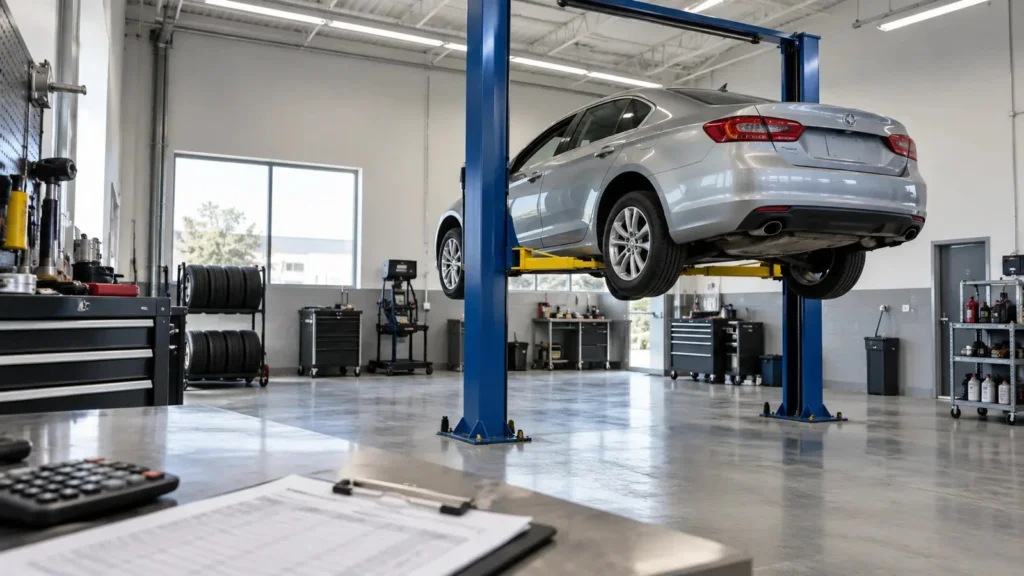
Across published North American industry reporting in 2026, a complete car lift project typically lands between $3,000 and $13,000, installed. The lift itself is usually only 60 to 80 percent of that total.
The rest goes to freight, the electrical circuit, any concrete work, and installation labor. A light-duty scissor or motorcycle lift sits at the bottom of that band. A heavy-duty alignment lift sits well above it.
Here is what buyers get wrong: they budget the sticker and forget the truck. Freight alone can be a four-figure line item, and it shows up before the lift ever leaves the pallet.
Ask how much does a car lift cost and you will get a number that is almost always too low. Not because anyone is lying, but because most published prices cover the equipment and stop there.
We have been building lifts in Brighton, Ontario since 1999, and we see the same gap every week. A shop budgets for the lift, then discovers the freight bill, the electrician’s quote, and the core-drilling estimate. This guide walks the whole project, not just the box on the truck.
Key takeaways
- Total project, not sticker. Published 2026 industry reporting puts a complete installed car lift project between roughly $3,000 and $13,000, depending on type and site.
- Capacity is the biggest driver. Heavier capacity means thicker steel, larger cylinders and stronger cables, and cost climbs with all three.
- Freight surprises almost everyone. Lifts ship by freight truck on pallets, and liftgate or residential delivery adds more.
- Your slab may already be fine. Many shop floors need no concrete work at all. Some need a new pad, which is the single largest swing in the budget.
- Most lifts need a dedicated circuit. Nearly all of our two-post models run 240V single phase, and our parking and mid-rise models run on 120V.
- Year two has costs too. ANSI/ALI ALOIM calls for an annual inspection by a qualified lift inspector, on every lift, regardless of brand.
- Warranty is a cost variable. Our 5-2-1 warranty covers freight on warranty parts within Canada and the continental US, which is real money over five years.
How much does a car lift cost in 2026?
A car lift costs roughly $1,500 to $12,000 for the equipment alone in 2026, with most shop-grade two-post and four-post models falling between $3,000 and $8,000. Add freight, power and installation, and the complete project usually runs $3,000 to $13,000.
Those are planning ranges compiled from published North American industry reporting, not quotes. Daytona sells through distributors and installers on a quote basis, so your real number depends on your model, your location and your site.
| Lift type | Typical capacity | Equipment range | Who it suits |
|---|---|---|---|
| Motorcycle and ATV | 2,200 lb | $1,500 – $3,000 | Powersports shops and home enthusiasts servicing bikes, ATVs and small utility vehicles. |
| Mid-rise scissor | 6,000 lb | $2,000 – $4,500 | Tire and brake work, low ceilings, and bays that need the floor clear between jobs. |
| High-rise scissor | 6,600 lb | $3,500 – $6,500 | Full undercar access where a two-post will not fit the bay layout. |
| Two-post | 9,000 – 15,000 lb | $2,800 – $8,000 | The default general repair lift. Best wheels-free access for brakes, suspension and exhaust. |
| Four-post parking | 9,000 – 10,000 lb | $3,200 – $7,500 | Vehicle storage, stacking two cars in one footprint, and drive-on convenience. |
| Four-post alignment | 12,000 – 35,000 lb | $6,000 – $20,000+ | Alignment bays and fleet work, with built-in slip plates and turntables. |
Notice the overlap. A well-specified two-post can cost more than an entry-level four-post, which is why choosing by category alone is a mistake. Capacity and configuration matter more than the label.
A note on the name
Daytona Automotive Equipment is not affiliated with the “Daytona” tool brand sold by Harbor Freight. We are a Canadian-owned manufacturer of automotive lifts and wheel service equipment, founded in 1999 and selling through distributors across the US and Canada.
What actually drives the price of a car lift?
Five things move a lift’s price more than anything else: capacity, configuration, certification, included equipment, and warranty coverage. Understanding them tells you why two lifts that look similar can be thousands apart.
Capacity and the steel behind it
This is the big one. Going from 9,000 lb to 15,000 lb is not a software change. The columns use heavier-gauge steel, the hydraulic cylinder gets larger, the cables and chains get stronger, and the carriage assemblies get reinforced.
Our own line runs from the 2,200 lb LMATV motorcycle and ATV lift to the 35,000 lb LFPA35 alignment lift. That is a sixteenfold spread in capacity, and the material cost scales with it.
Buy the capacity you actually need, plus a sensible margin. A shop servicing half-ton pickups does not need a 15,000 lb lift, and paying for one is the most common way to overspend.
Configuration: overhead, floorplate or adjustable
Two-post lifts come in three main layouts, and each carries a different build cost. Overhead models use a top crossbar to route the equalization cables. Floorplate models route them through a plate in the floor instead, which is what makes them work under low ceilings.
Adjustable-width models add engineering on top of that. Our LTPA10 and LTPA12 both offer three width settings, which means the baseplates, arms and carriage all have to accommodate multiple positions.
If you are weighing layouts, our guide to the different types of car lifts breaks down the trade-offs in detail.
Does certification affect cost?
Yes. Third-party certification testing costs the manufacturer money, and that shows in the price. Industry reporting suggests certified models commonly carry a premium of a few hundred dollars over otherwise comparable equipment.
Our BR10-2OH-33 overhead two-post lift is our ALI Certified model, rated at 10,000 lb. It is the only Daytona lift carrying that certification. Every other model in our lineup is built with the same safety hardware but is not third-party certified.
Certification claims worth knowing before you shop
According to the Automotive Lift Institute, some claims you will see in this market are not valid. ANSI does not certify products, so “ANSI certified” means nothing. OSHA does not certify lifts or inspectors either, so “OSHA certified” is not a real credential.
The accurate phrasing is that a specific model is certified to the ANSI/ALI ALCTV standard by a third party. If a seller cannot name the standard and the certifying body, treat the claim carefully.
What comes in the box
Included equipment changes the comparison more than people expect. Our LTPO15 ships with its 2 ft height extension kit included, and the BR10-2OH-33 includes drop-in pads plus 1.5 in., 3 in. and 6 in. extensions.
On other models those are separate line items. When you compare two quotes, compare what arrives on the pallet, not just the headline figure. Browse our lift accessories and extension kits to see what is bundled and what is not.
Warranty coverage as a cost variable
Warranty is rarely discussed as part of price, and we think that is a mistake. A lift with thin coverage can cost more over five years than a lift with a higher sticker.
Our 5-2-1 Limited Warranty covers structural components for 5 years, power units for 2 years, and other non-wearing parts for 1 year. Freight on warranty parts is covered within Canada and the continental US.
That freight clause matters. Shipping a replacement power unit across the country is not a small bill.
The Five F’s: a complete car lift budget worksheet
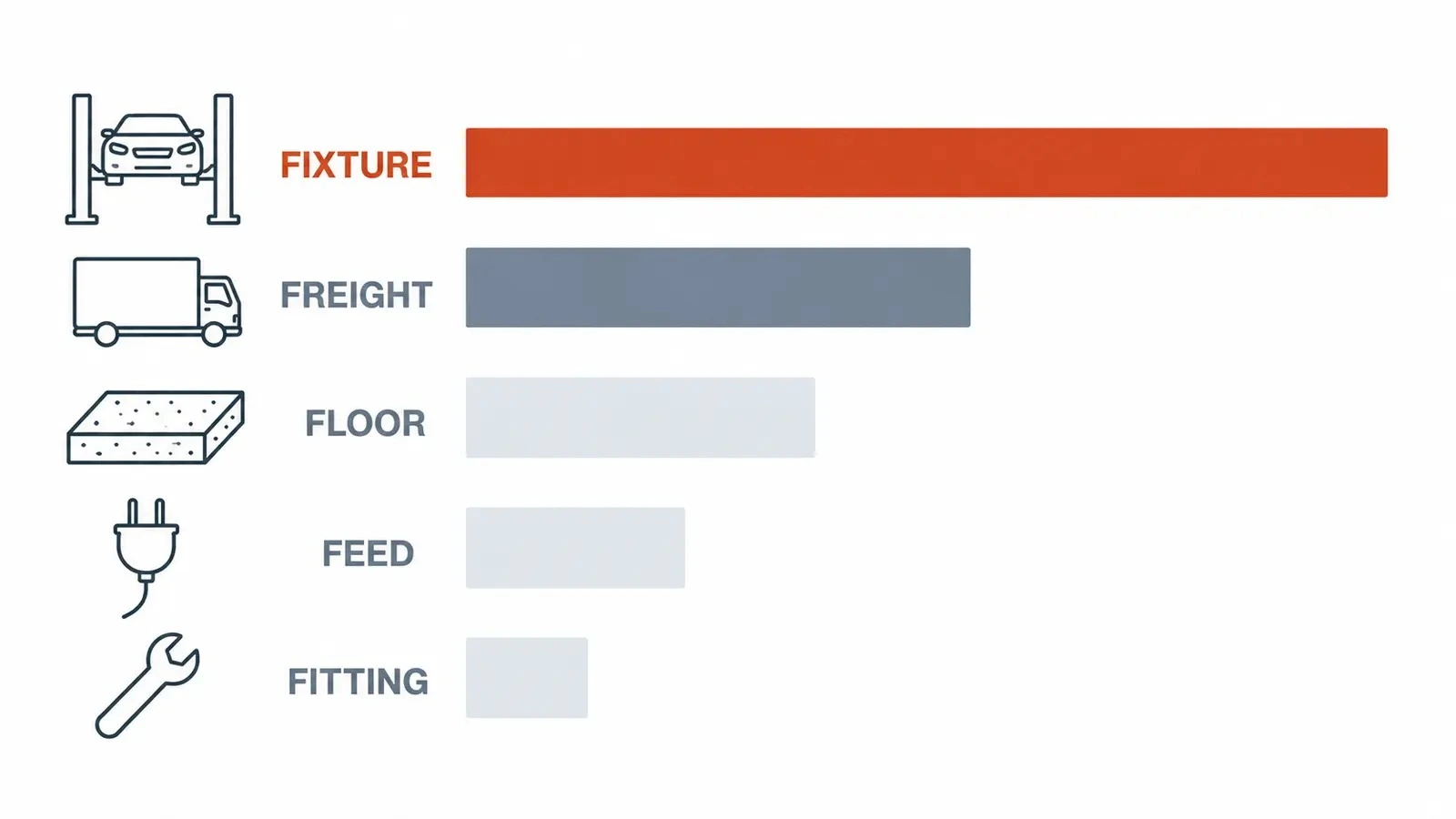
Every car lift project breaks into five costs: Fixture, Freight, Floor, Feed and Fitting. Work through all five before you commit, and your budget will hold.
We built this framework because too many buyers plan for one line item and get surprised by four. Here is the worksheet.
| Component | What it covers | Typical range | Can you skip it? |
|---|---|---|---|
| 1. Fixture | The lift itself, plus any extension kits, rolling jacks or adapters you add. | $1,500 – $20,000 | No |
| 2. Freight | Palletized freight delivery, liftgate service, and residential or limited-access surcharges. | $300 – $900 | No, though terminal pickup can reduce it. |
| 3. Floor | Slab assessment, core sampling if needed, and new concrete or a thickened pad if the floor is not adequate. | $0 – $3,000 | Often $0 if your existing slab already meets the manual. |
| 4. Feed | A dedicated electrical circuit, breaker, conduit, disconnect and the electrician’s labor. | $150 – $700 | Rarely. Most lifts need a dedicated circuit. |
| 5. Fitting | Assembly, setting and torquing anchors, shimming to plumb, hydraulic bleed, testing and permits. | $400 – $1,500 | Only with the skills and tools to do it correctly. |
How much does freight and delivery add?
Freight on a car lift commonly runs $300 to $900 in published 2026 industry reporting, and more for residential or hard-access sites. A two-post lift is heavy, oversized and palletized, so it moves as LTL freight, meaning your pallets share a truck with other shipments.
Several things push that number up. Liftgate service, where the truck lowers the pallet hydraulically because there is no loading dock, is an added fee. So is residential delivery, and so is any site the driver considers limited access.
Plan the receiving end before the truck books. You need a forklift or a liftgate, and you need people. Columns are awkward and heavy, and a missed delivery window can mean redelivery charges.
Will your concrete slab add to the cost?
For most commercial shops, the answer is no, because the existing slab already meets the requirement. When it does not, concrete becomes the single largest swing in the whole budget, from nothing to a few thousand dollars.
Every lift manual states a minimum slab thickness, a minimum concrete strength, and a minimum cure time. Those figures belong to your specific model, so read the manual rather than a general rule. For general background on how concrete strength and cure time are measured, the American Concrete Institute publishes the underlying standards, though your lift manufacturer’s manual is always the authority for your specific installation.
Our full guide to concrete thickness for a 2-post lift covers slab depth, edge distance from joints and slab edges, and what to do with an unknown floor.
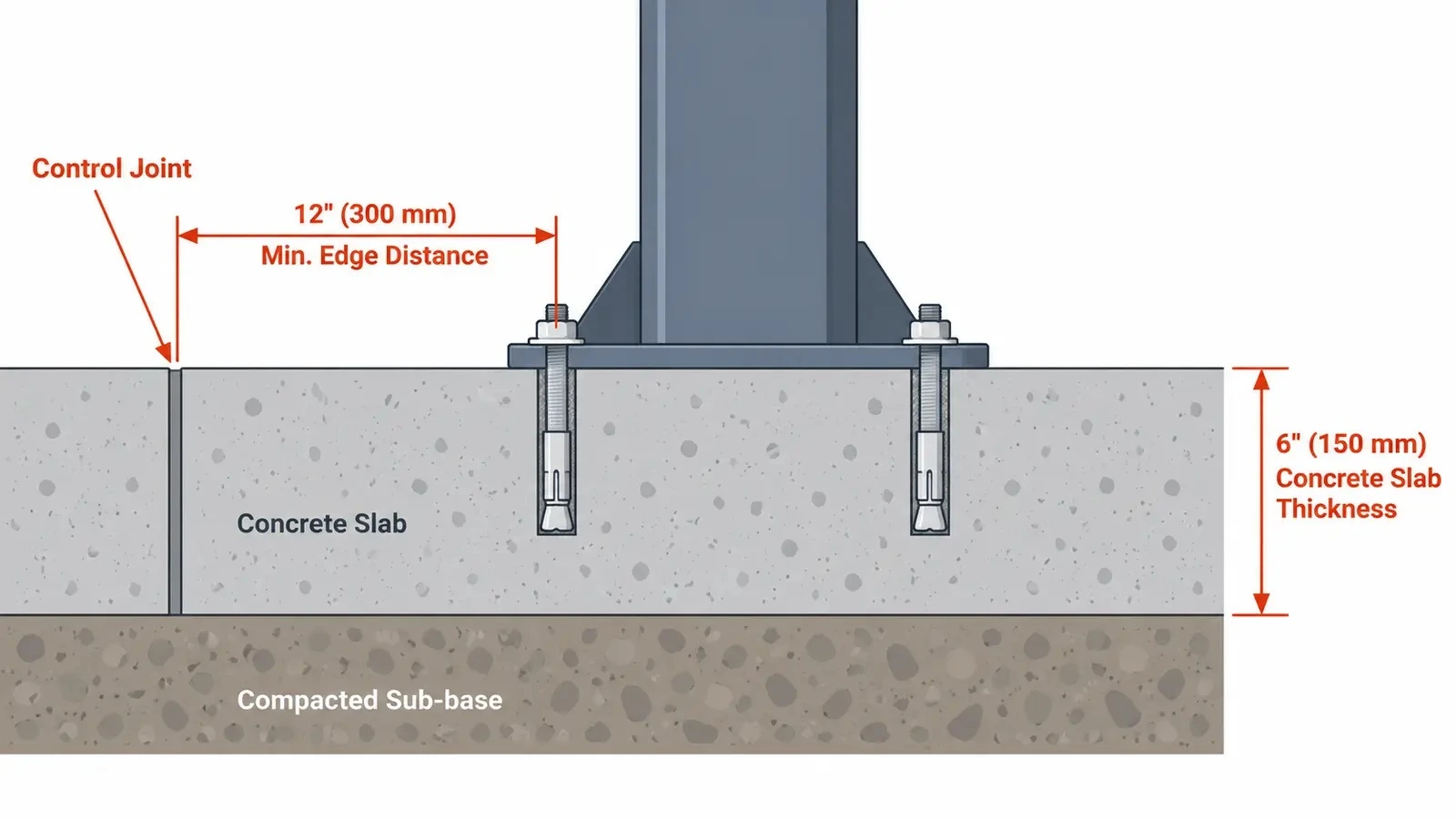
If your slab is unknown, a core sample is cheap insurance. It is a small cost that prevents a very expensive mistake.
Stop before you drill a post-tension or suspended slab
Post-tension slabs contain steel tendons under high tension. Drilling into one can be catastrophic. Suspended slabs, meaning any floor over a basement, crawlspace or parking level, are a separate engineering question entirely.
In both cases, involve a structural engineer and your local authority having jurisdiction before anyone drills. This is not a place for a judgment call on site.
What will the electrical hookup cost?
A dedicated circuit for a car lift typically costs $150 to $700 installed, according to published industry reporting, depending on panel capacity and the run length to your bay. If your panel is full or far from the lift, expect the higher end.
Single phase means standard utility power, the kind most shops and garages already have. Three phase is a commercial supply that some older or larger facilities have. Every lift in our lineup runs on single phase.
| Model | Capacity | Voltage | Motor and draw |
|---|---|---|---|
| BR10-2OH-33 | 10,000 lb | 240V / 1PH / 60Hz | 3HP / 12A |
| LTPO15 | 15,000 lb | 240V / 1PH / 60Hz | 3HP / 13A |
| LTPA12 and LTPA10 | 12,000 and 10,000 lb | 240V / 1PH / 60Hz | 3HP / 13A |
| LTPF12 and LTPF9 | 12,000 and 9,000 lb | 240V / 1PH / 60Hz | 3HP / 13A |
| LHS7 high-rise scissor | 6,600 lb | 240V / 1PH / 60Hz | 3HP / 12A |
| LFPA alignment series | 12,000 – 35,000 lb | 240V / 1PH / 60Hz | 4HP / 15A |
| LFPP parking series | 9,000 – 10,000 lb | 120V / 1PH / 60Hz | 1.5HP / 26A |
| LMS6 mid-rise scissor | 6,000 lb | 120V / 1PH / 60Hz | 1.5HP / 15A |
| LMATV | 2,200 lb | 120V / 1PH / 60Hz | 1HP / 8A |
Here is a useful planning note. Our parking lifts and the LMS6 mid-rise run on 120V, which many garages already have. That can remove the electrical line item entirely.
For a deeper breakdown of breaker sizing and wire runs, see our guide to 2-post lift power requirements.
How much does installation labor cost?
Professional car lift installation commonly runs $400 to $1,500 in published 2026 industry reporting, with two-post lifts at the higher end because of anchor setting and plumb alignment. Four-post lifts often cost less to install since they are freestanding.
Daytona does offer installation directly, but only within about two hours of our Brighton, Ontario office. Outside that radius, our distributor and installer network handles it. You can find a Daytona distributor near you to arrange local installation.
Should you install it yourself?
Some experienced shop owners do, and do it well. The honest answer is that it depends on whether you have a forklift or engine hoist, a rotary hammer, a calibrated torque wrench, and a helper.
We recommend professional installation for two-post lifts specifically. The anchors, the plumb alignment and the cable equalization all have to be right, and a mistake on any of them is a safety issue rather than an inconvenience.
Our complete automotive lift installation guide walks the full process, and our installation cost breakdown covers what installers charge and why.
Do you need a permit?
Sometimes, and it depends entirely on where you are. Permit requirements for vehicle lifts are set locally by your authority having jurisdiction, which is usually the municipal building department.
Commercial installations are more likely to need one, and any project involving new concrete or new electrical work usually does. Call before you buy. A permit is inexpensive, but discovering you needed one after installation is not.
In the US, OSHA’s general duty clause also requires employers to keep a workplace free of recognized hazards, which includes lifting equipment that is properly installed and maintained, giving shops another reason to get the anchoring and wiring right the first time.
What does a car lift cost by type?
Cost tracks capacity and complexity, so the cheapest lift that genuinely does your work is almost always the right financial answer. Here is how the categories compare against our own lineup.
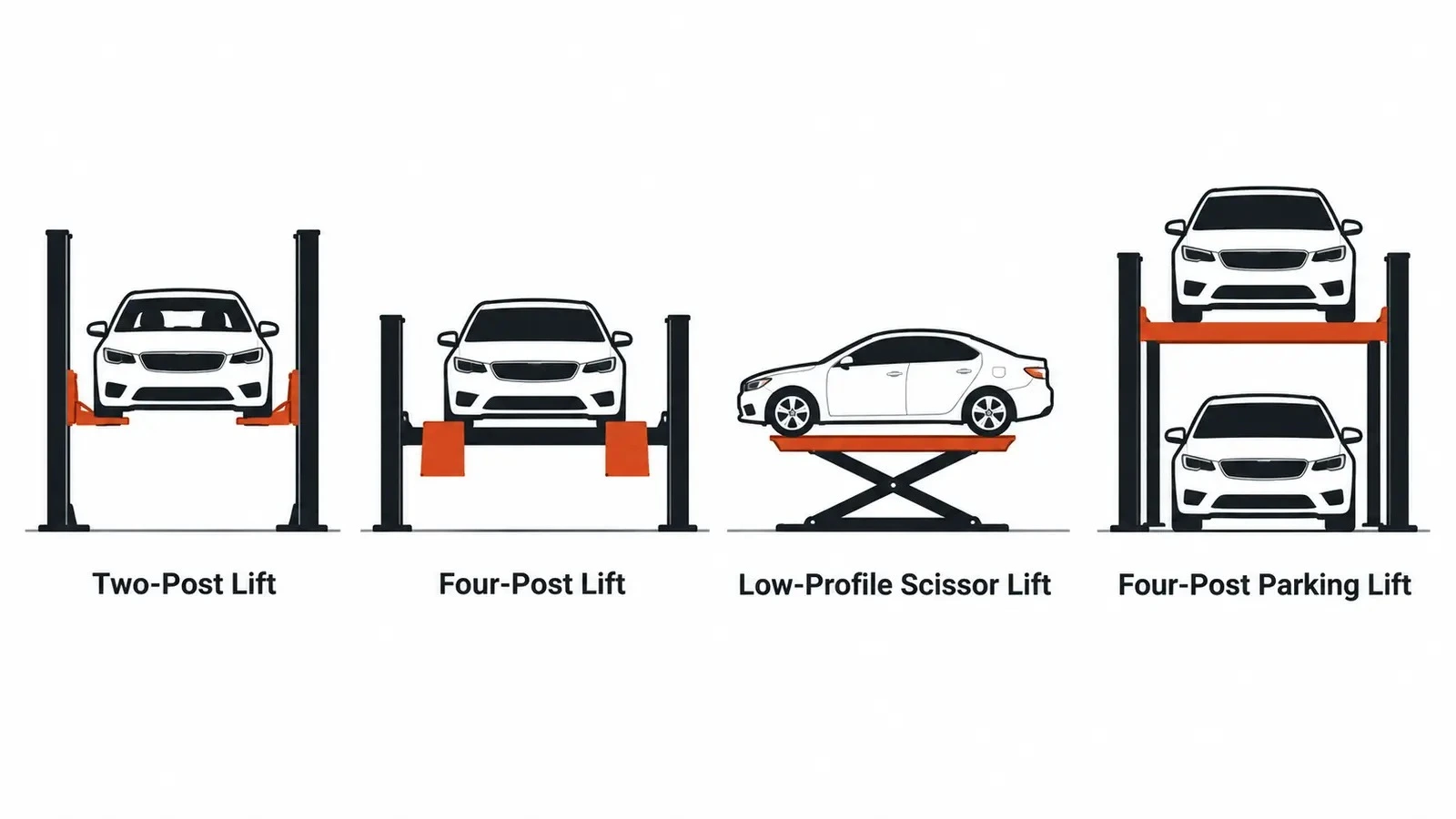
Two-post lifts
The workhorse of general repair, and usually the best value per bay for service work. Wheels hang free, so brakes, suspension and exhaust are all accessible.
Our two-post lift range spans 6,000 lb to 15,000 lb across overhead, floorplate and adjustable designs. If you are comparing models, start with our 2-post car lift buyer’s guide.
Four-post alignment lifts
The most expensive category, and for good reason. Built-in slip plates and adjustable turntables are precision components, and the runways are long and heavy.
Our alignment lift range runs from the 12,000 lb LFPA12 to the 35,000 lb LFPA35. If you do alignments daily, the throughput usually justifies the spend quickly.
Four-post parking lifts
Storage rather than service. These stack two vehicles in one footprint, and because they are freestanding, they often skip both the anchor work and the 240V circuit.
Our parking lift range covers 9,000 lb and 10,000 lb models, including the extra-long and extra-tall LFPP10-XLT.
Scissor lifts
The answer for low ceilings and tight bays. Our scissor lift range includes the 6,000 lb LMS6 mid-rise and the 6,600 lb LHS7 high-rise.
The LMS6 in particular is worth a look if budget is tight, since it runs on 120V and has a 5.5 in. minimum clearance.
Motorcycle and ATV lifts
The lowest entry point. Our 2,200 lb LMATV motorcycle and ATV lift runs on standard 120V power and includes a wheel chock and mobility kit.
Heavy-duty lifts
Once you go past 15,000 lb, you are in fleet and commercial territory, and costs climb steeply. Everything scales: steel, cylinders, cables and freight.
Not sure which capacity you actually need? Send us your bay dimensions, ceiling height and the heaviest vehicle you service, and we will tell you what fits.
Ask a Lift SpecialistWhat does a car lift cost to own after year one?
Budget for an annual inspection, periodic wear parts, and hydraulic fluid. Most published cost guides stop at installation, which leaves out a real recurring line item.
The annual inspection is not optional. According to the ANSI/ALI ALOIM standard, every vehicle lift must be inspected at least once a year by a qualified lift inspector, regardless of brand, age or certification status.
ALI also runs the only ANSI-accredited third-party lift inspector certification program in North America, and recommends a Check360 inspection when any lift is first installed.
| Item | How often | Notes |
|---|---|---|
| Annual inspection | Every 12 months | Required by ANSI/ALI ALOIM, performed by a qualified lift inspector, with a written record kept on file. |
| Hydraulic fluid | Per manual | Check levels regularly and change on the schedule in your manual. |
| Cables and chains | Inspect often, replace as needed | Wearing parts. Not covered under the Daytona 5-2-1 warranty. |
| Slider blocks and pads | As they wear | Also wearing parts, and also outside warranty coverage. |
| Lubrication | Monthly | Sheaves, pivot pins, rollers and column slide blocks. |
Worth knowing: our 5-2-1 warranty specifically excludes wearing parts such as cables, hoses, slider blocks, chains, gears, wedges and rubber pads, along with electronic parts. That is standard across the industry, and it is exactly why maintenance pays.
Our 2-post lift maintenance checklist covers the daily, weekly, monthly and annual tasks that keep those parts alive.
Indoor use only
Daytona lifts are warranted for indoor use only. Installing a lift outdoors, or in an uncovered or unprotected space, voids the warranty. Weather exposure also accelerates cable and finish wear, which raises your ownership cost even setting the warranty aside.
How much does a car lift cost in Canada?
Canadian buyers face the same five cost components, but freight, currency and provincial requirements change the math. Most cost guides written for this market quietly assume a US buyer, which leaves Canadian shops planning against the wrong numbers.
Equipment shipped from US suppliers into Canada carries cross-border freight, customs processing and currency exchange on top of the base price. Those are not small adjustments.
Being Canadian-owned and operating from Ontario shortens that supply line for Canadian customers, and our warranty parts freight is covered within Canada as well as the continental US.
Provincial rules also differ. Workplace equipment requirements in Ontario fall under the Occupational Health and Safety Act and its regulations, and other provinces have their own frameworks. Check with your provincial authority before you install.
Is a car lift worth the money?
For a working shop, a lift usually pays for itself through bay throughput rather than any single job. The math is simple: a lift lets one technician do in minutes what takes much longer on jack stands, and it does that every day.
Run the numbers for your own shop. Take your average billable hourly rate, estimate the hours per week a lift saves across all jobs, and divide the total project cost by the weekly saving. That gives you a payback period in weeks.
Most commercial shops we talk to land somewhere between one and three years, depending on volume. Higher volume shortens it sharply.
For home garages, the calculation is different and more personal. You are buying capability, safety and comfort rather than billable hours. Our home garage car lift cost guide works through that scenario, and our lift payback and ROI guide covers throughput math and equipment tax treatment in both countries.
Where can you cut costs safely, and where should you not?
Cut on convenience features and capacity you will never use. Do not cut on installation, anchors, or the slab. That line is not arbitrary. One side affects comfort, the other affects whether the lift holds a vehicle over someone’s head.
| Decision | Verdict | Why |
|---|---|---|
| Right-sizing capacity | Safe cut | Paying for 15,000 lb when you service sedans and half-tons is the most common overspend. |
| Terminal pickup instead of liftgate | Safe cut | If you have a forklift and a trailer, collecting from the freight terminal reduces delivery cost. |
| Skipping optional accessories at first | Safe cut | Rolling jacks and extension kits can be added later as the work demands them. |
| Choosing 120V models where suitable | Safe cut | Parking lifts and the LMS6 can remove the electrical line item entirely. |
| Skipping the slab assessment | False economy | Anchoring into inadequate concrete is the failure mode that causes the worst outcomes. |
| Reusing old anchors | False economy | Use new anchors specified for your lift and set them to the manual’s torque. |
| Skipping the annual inspection | False economy | ANSI/ALI ALOIM requires it, and small faults get expensive when they go unfound. |
| Buying an unknown used lift | Usually false economy | No warranty, unknown history, and parts availability is often the hidden problem. |
Can you finance a car lift?
Yes. Equipment financing is common for lift purchases, and it spreads the cost across the years the lift is earning. For a working shop, financing often makes more sense than paying cash, since the equipment generates revenue from week one.
Daytona works with third-party lenders: NewLane Finance for US customers and Active Growth Financial for Canadian customers. Details are on our automotive lift financing options page.
Daytona is not a lender and is not a party to any financing agreement. All terms, rates and approvals are set by the finance provider.
Our guide to financing a car lift explains how lenders assess applications and how leases compare to loans.
Get a real number for your bay
Send us your bay dimensions, ceiling height, the heaviest vehicle you service and your postal or ZIP code. We will come back with the models that fit and connect you with a distributor who can quote freight and installation.
- Full lineup. Lifts from 2,200 lb to 35,000 lb across two-post, four-post, alignment, parking, scissor and powersports.
- ALI Certified option. The BR10-2OH-33 at 10,000 lb is our ALI Certified overhead two-post lift.
- 5-2-1 warranty. 5 years structural, 2 on power units, 1 on parts, with warranty parts freight covered in Canada and the continental US. Indoor use only.
- Financing available. Third-party financing through NewLane Finance in the US and Active Growth Financial in Canada.
- Since 1999. Canadian owned and operated, serving the US and Canada.
About the author

The Daytona Team
Written by the team at Daytona Automotive Equipment, a Canadian-owned manufacturer of automotive lifts, tire changers and wheel service equipment since 1999.
- Specializations. Two-post, four-post, alignment, parking and scissor lifts from 2,200 lb to 35,000 lb, plus wheel service equipment and lift accessories.
- Standards. Guidance aligned to ANSI/ALI ALIS installation practice and ANSI/ALI ALOIM operation, inspection and maintenance practice.
- Reviewed by. Daytona product and technical support staff, September 2026.
Daytona Automotive Equipment Inc. · Brighton, ON, Canada · Automotive lifts, tire changers and wheel service equipment since 1999.
References and sources
- Automotive Lift Institute. Lift Inspection Frequently Asked Questions. ALI, accessed September 2026.
- Automotive Lift Institute. ANSI/ALI ALOIM Standard, current edition. ALI, accessed September 2026.
- Automotive Lift Institute. Get Your Lift Inspected. ALI, accessed September 2026.
- Occupational Safety and Health Administration. Standard Interpretation on vehicle lift requirements. US Department of Labor, 19 November 2014.
- American Concrete Institute. Concrete standards and guidance. ACI, accessed September 2026.
Figures in this article are representative for planning and are not quotations. Confirm requirements against the installation manual for your specific lift before purchase or installation.