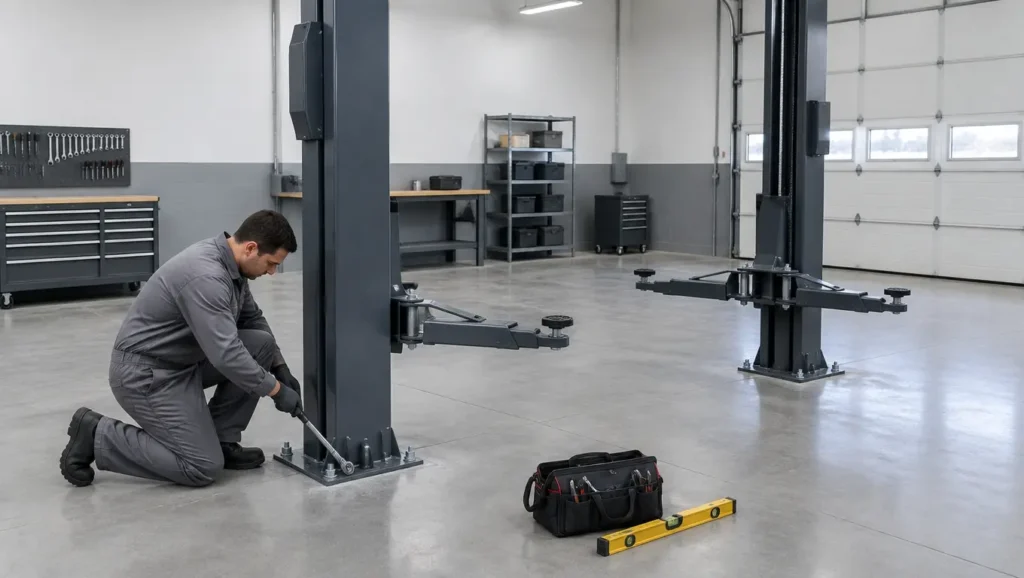
Car lift installation cost commonly runs $400 to $1,500 in labor, on top of the equipment price, based on publicly listed North American installer and retailer pricing surveyed in September 2026. Two-post lifts sit at the higher end of that range because of anchor setting and plumb alignment.
Four-post lifts are usually cheaper to install because they are freestanding and skip most of the anchoring work. Add freight and any electrical or concrete work, and the full installed project moves closer to the numbers in our complete car lift cost breakdown.
Here is the part most buyers miss: the installation quote is not one number. It is four separate jobs, and knowing what each one costs is how you catch a bad quote before you sign it.
Ask three installers what a car lift installation cost is and you will get three different numbers, and none of them will explain why. That is not because anyone is padding the bill. It is because installation is really four separate jobs bundled into one line item on your quote.
We build lifts in Brighton, Ontario and sell through a distributor and installer network across the US and Canada, so we see a lot of installation quotes cross our desk. This guide breaks the bill down the way an installer actually builds it, not the way a marketing page presents it.
Key takeaways
- Installation is not one job, it is four. Rigging, anchor setting, electrical tie-in and commissioning each carry their own cost, and knowing the split helps you spot a vague quote.
- Two-post costs more to install than four-post. Anchoring and plumb alignment take real time. Four-post lifts are freestanding, so that cost mostly disappears.
- The circuit and the tie-in are different jobs. A licensed electrician runs the new circuit. The installer connects and tests the lift on that circuit. Two separate line items, two separate skill sets.
- DIY is possible but not casual. The ANSI/ALI ALIS standard defines installer qualifications for good reason. A two-post lift over someone's head is not a place to learn as you go.
- Permits depend on your local authority. There is no single national rule. Call your building department before you buy, not after.
- The cheapest quote is not always the cheapest lift. A rushed install can cost you a warranty claim later, and that math rarely favors the discount installer.
How much does it cost to install a car lift?
Car lift installation cost typically runs $400 to $1,500 in labor, separate from the price of the lift itself. Two-post lifts land near the top of that range because of anchor setting and alignment work, while four-post lifts, which are freestanding, often land near the bottom.
That range covers the installer's labor only, not freight, not a new electrical circuit, and not concrete work if your slab needs it. Those are separate costs, and we walk through each one later in this guide. If you want the full project math in one place, our car lift cost guide adds freight, power and concrete on top of this number.
Pricing here reflects publicly listed North American installer and retailer figures surveyed in September 2026. Daytona sells through distributors and installers on a quote basis, so your real number depends on your model, your site, and your region.
What actually makes up a car lift installation bill?
Every professional car lift installation breaks into four labor blocks: rigging and positioning, anchor setting and torque, electrical tie-in and testing, and commissioning and documentation. We call this the Four Labor Blocks, and once you see a quote this way, a vague one-line estimate stops looking normal.
Rigging and positioning
Before anything gets anchored, the columns and carriage assemblies have to come off the pallet and get moved into place. That takes an engine hoist or forklift, at least one helper, and enough clearance to maneuver a heavy, awkward load without damaging the floor or the equipment.
For a two-post lift, this usually means setting two columns at the manual's exact width and squaring them against each other before drilling starts. Get this step wrong and every anchor hole that follows is wrong too.
Anchor setting and torque
This is usually the biggest single cost inside a two-post installation, and it is also the step where corner-cutting causes real damage later. The installer drills into the slab, sets new anchors specified for your lift, and torques each one to the manual's spec with a calibrated wrench.
Cost to anchor a car lift climbs if the existing anchor holes from a prior lift do not line up, if the slab needs a core sample first, or if edge distance from a joint or slab edge forces a layout change. Four-post lifts mostly skip this cost, since they sit on the floor rather than bolt into it.
Common mistake: reusing old anchors
Old anchor holes from a previous lift almost never line up correctly, and reusing worn anchors instead of new, manual-specified ones is a false economy. New anchors set to the correct torque cost little compared to what a failed anchor can cost later.
Electrical tie-in and testing
This step is smaller than most buyers expect, and it is easy to confuse with a bigger job it is not. Car lift electrical installation cost for running a brand-new dedicated circuit is a separate line item handled by a licensed electrician, covered in our guide to 2-post lift power requirements.
What the installer does here is different: connect the lift's power unit to the completed circuit, verify the motor runs correctly, and confirm the safety cutoffs and limit switches respond as they should before anyone stands under the lift.
Commissioning and documentation
The last block is the one buyers forget to ask about. A full commissioning cycle means bleeding air from the hydraulic lines, running the lift through its full range with no load, checking that both sides rise and lower evenly, and recording the completed installation for your records.
That written record matters more than it sounds. It is the document you will want on hand at your first annual inspection, and it is proof the lift was installed to spec if a warranty question ever comes up.
| Labor block | What it covers | Typical range | Applies to 4-post? |
|---|---|---|---|
| Rigging and positioning | Moving columns or frame into place, squaring to the manual's layout. | $100 – $300 | Yes |
| Anchor setting and torque | Drilling, setting new anchors, torquing to the manual's spec. | $150 – $600 | Rarely, most 4-post models are freestanding |
| Electrical tie-in and testing | Connecting the power unit and verifying motor and safety cutoffs, not the circuit itself. | $50 – $200 | Yes |
| Commissioning and documentation | Hydraulic bleed, full-range test cycle, written installation record. | $100 – $400 | Yes |
What does installation cost by lift type?
Two-post lift installation cost generally runs $700 to $1,500, four-post lift installation cost runs $400 to $900, and scissor or mid-rise installation runs $300 to $700. The gap comes almost entirely from the anchor setting block above.
| Lift type | Installation labor range | Why it costs what it costs |
|---|---|---|
| Two-post | $700 – $1,500 | Anchored into the slab, requires plumb columns and precise cable equalization. |
| Four-post parking or alignment | $400 – $900 | Freestanding in most cases, so anchoring cost mostly disappears. |
| Scissor or mid-rise | $300 – $700 | Compact, lighter, and simpler to position and level than a two-post. |
| Alignment lift with slip plates | $600 – $1,200 | Long runways and turntable calibration add time beyond a standard 4-post. |
Two-post lift installation cost
This is the category where doing it right matters most. Anchor setting, plumb alignment, and cable equalization all have to be correct, and a mistake in any of them is a safety issue, not just an inconvenience.
Our ALI Certified BR10-2OH-33 is the one Daytona model with third-party certification, but every two-post lift in our lineup, certified or not, needs the same careful anchor and alignment work at install time.
Four-post lift installation cost
Four-post lifts are the easier install of the two main categories, and that is reflected in the price. Since the frame sits on the floor rather than bolting into it, the anchor setting block from our framework mostly falls away.
That does not mean zero work. Runways still need to be leveled, and alignment models with slip plates and turntables need those components calibrated before the lift is ready to use.
Scissor and mid-rise lift installation cost
Scissor lifts are usually the fastest and cheapest of the three to install. They are compact, lighter than a full two-post system, and most models need less structural anchoring.
That makes a scissor lift worth a look if your budget is tight and your work is mostly tires, brakes, and undercar inspection rather than full suspension teardowns.
What else gets added to the installation bill?
Installation labor is only one piece of the full project. Freight typically runs $300 to $900 depending on delivery access, and it arrives as its own invoice before the installer ever touches the lift.
If your existing slab does not meet the thickness and strength called for in the lift manual, concrete work becomes the largest possible addition to the whole project, from nothing up to a few thousand dollars. Our guide to concrete thickness for a 2-post lift covers how to check your slab before you commit to a purchase.
Electrical work is the other common add-on. Most two-post and alignment lifts run on a dedicated 240V circuit, and running that circuit is separate from the installer's tie-in fee described above. See our breakdown of 2-post lift power requirements for voltage, amperage and typical wiring cost.
If you're installing in a home garage rather than a commercial bay, a few of these numbers shift. Residential ceiling height, floor slab age, and available amperage often differ from a shop setting, so it's worth checking our home garage car lift cost guide for numbers specific to a residential install before you finalize a budget.
Should you install a car lift yourself or hire a professional?
For a two-post lift, we recommend professional installation over DIY, because the safety margin for anchor and alignment error is thin. Four-post and scissor lifts are more forgiving, and a confident DIYer with the right tools can reasonably handle one.
The ANSI/ALI ALIS 2022 standard spells out the required qualifications, training, and documentation for anyone installing or servicing a vehicle lift. It exists because installation quality is a safety issue, not a convenience one.
As R.W. Bob O'Gorman, president of the Automotive Lift Institute, put it when the standard took effect: "Staying safe in the service bay starts with buying an ALI-certified lift, but it doesn't end there. It's crucial that the lift be installed properly by a qualified installer, inspected at least annually by a qualified lift inspector, and serviced as needed by a qualified service technician."
Paying for a qualified installer also protects the return on your purchase. A lift installed to spec keeps its resale value and avoids the downtime and repair cost that comes with a botched anchor job, so see our breakdown of car lift ROI for how that math plays out over the life of the lift.
| Factor | DIY installation | Professional installation |
|---|---|---|
| Upfront cost | Lowest cash outlay, plus tool rental if you do not already own the equipment. | Installation fee added to the project, typically $400 to $1,500. |
| Tools and crew | Rotary hammer, torque wrench, engine hoist or forklift, and at least one helper. | Installer supplies the crew and specialized tools. |
| Time investment | A full day or more, longer on a first attempt. | Typically a half day to a full day. |
| Anchor and plumb accuracy | Depends entirely on your patience and attention to the manual's tolerances. | Set to the manual's spec as a routine part of the job. |
| Warranty risk | Improper installation can void warranty coverage on the lift. | Installation matching the manual protects your warranty claim. |
Pro tip: request a site survey before you get a firm quote
A quote given without seeing your bay, your slab, or your electrical panel is a guess. Ask any installer to walk the site first, or at minimum request photos and measurements, before you treat a number as final.
Do you need a permit to install a car lift?
Sometimes, and it depends entirely on your local authority having jurisdiction, usually your municipal building department. There is no single North American rule that applies everywhere, which is exactly why this step trips people up.
Commercial installations are more likely to need a permit than a home garage project, and any job involving new concrete or new electrical wiring usually does regardless of setting. Building code enforcement in most US and Canadian municipalities is administered locally, often referencing model codes published by bodies such as the International Code Council, but the final call always belongs to your local department.
In Canada, provincial workplace safety frameworks add another layer for commercial shops. The Canadian Centre for Occupational Health and Safety is a useful starting point for understanding how those provincial rules typically apply to shop equipment.
Call before you buy. A permit is inexpensive next to the cost of finding out you needed one after the fact.
How do you get a fair, apples-to-apples installation quote?
Vague quotes are the single biggest reason installation costs feel unpredictable. Ask every installer you compare the same set of questions, in writing, before you decide.
- Does the quote include all Four Labor Blocks, or just some of them? A quote that skips commissioning and documentation is not comparable to one that includes it.
- Are new anchors included, or will old anchors be reused? New, manual-specified anchors should be a line item, not an assumption.
- Who runs the electrical circuit, and is that quoted separately? A licensed electrician's circuit work and the installer's tie-in fee are two different costs.
- Has anyone assessed your slab? A quote given without confirming your concrete meets the manual is incomplete.
- Will you receive written commissioning documentation? You will want this record for your first annual inspection.
- What happens if the site does not match the quote? Ask how change orders are handled before there is a surprise on site.
If you're weighing installation against your overall budget, many buyers roll it into their equipment financing rather than paying the full amount upfront. Our guide to car lift financing covers how that typically works and what a monthly payment might look like with installation folded in.
How long does car lift installation take?
Most professional installations take a half day to a full day per lift, longer for a first-time DIY attempt or a job that uncovers a slab or wiring problem. Two-post lifts generally take longer than four-post, since anchor setting and alignment add time that a freestanding frame does not need.
Build in buffer time if your slab has not been assessed, or if the electrical circuit has not been run yet. Both can turn a one-day job into a multi-day project if they surface as surprises on install day rather than being handled beforehand.
How do you find a qualified car lift installer?
Daytona installs directly for customers within roughly two hours of our Brighton, Ontario office. Outside that radius, our distributor and installer network covers the rest of the US and Canada.
If you are searching for a car lift installer near me, the fastest path is through the manufacturer's own network rather than a general contractor search, since a lift-specific installer already knows the anchor specs, torque values, and commissioning steps for your model. You can find a Daytona distributor near you to start that process.
Ready to get a real number for your bay? Send us your lift model, your ceiling height, and your location, and we will connect you with a distributor who can quote both the equipment and the installation.
Request a QuoteGet matched with a qualified installer
Tell us your lift model, your bay layout, and your location, and we will connect you with a Daytona distributor or installer who can walk your site and quote the full job, not just a guess.
- Direct install near Brighton, ON. Within roughly two hours of our office, we can install directly.
- Distributor network across US and Canada. Outside that radius, our installer partners cover both markets.
- 5-2-1 warranty. 5 years structural, 2 on power units, 1 on parts, protected by installation done to spec.
- Since 1999. Canadian owned and operated, serving the US and Canada.
About the author

The Daytona Team
Written by the team at Daytona Automotive Equipment, a Canadian-owned manufacturer of automotive lifts, tire changers and wheel service equipment since 1999.
- Specializations. Two-post, four-post, alignment, parking and scissor lifts from 2,200 lb to 35,000 lb, plus wheel service equipment and lift accessories.
- Standards. Guidance aligned to ANSI/ALI ALIS installation practice and ANSI/ALI ALOIM operation, inspection and maintenance practice.
- Reviewed by. Daytona product and technical support staff, September 2026.
Daytona Automotive Equipment Inc. · Brighton, ON, Canada · Automotive lifts, tire changers and wheel service equipment since 1999.
References and sources
- Automotive Lift Institute. New ANSI/ALI Safety Standard Covering Car Lift Installation and Service. ALI, 15 August 2022.
- Automotive Lift Institute. Get Your Lift Inspected. ALI, accessed September 2026.
- International Code Council. Model codes and code adoption. ICC, accessed September 2026.
- Canadian Centre for Occupational Health and Safety. Workplace equipment safety guidance. CCOHS, accessed September 2026.
Cost figures in this article are representative planning ranges aggregated from publicly listed North American installer and retailer pricing surveyed in September 2026. They are not quotations, and they exclude taxes, duties and currency effects. Confirm all technical requirements against the installation manual for your specific lift, and confirm permit requirements with your local authority having jurisdiction, before purchase or installation.