The 2 post lift safety features that actually hold a vehicle in the air are the mechanical safety locks inside each column. Everything else on the lift, the arm restraints, the equalization cables, the limit switches, exists to keep the vehicle positioned correctly and to catch a problem before it becomes an accident. Knowing which part does which job is the difference between a safe bay and a close call.
That distinction gets blurred constantly. Spec sheets list a dozen features in one long row of bullet points, so everything looks equally important. It is not. Some of these systems are load-bearing. Some are not designed to hold any load at all, and a few of the most common shop injuries happen because somebody assumed otherwise.
Here is the honest breakdown of what each safety system on a 2-post lift does, what it will not do for you, and how to check that it still works.
The Short Answer
A 2-post lift protects you in five layers. Mechanical safety locks hold the load. Hydraulic velocity fuses control the speed of a failure. Equalization cables and slack detection keep both sides level. Arm restraints, adapters and limit switches keep the vehicle positioned. Anchor bolts and the concrete slab hold the whole thing to the floor.
Only the first layer is designed to carry the weight of the vehicle. That is why you always lower onto the locks before you go underneath.
What Are the Safety Features of a 2-Post Lift?
The safety features of a 2-post lift are automatic mechanical safety locks in both columns, a single-point or dual-point lock release, hydraulic velocity fuses or flow restrictors, equalization cables with slack detection, automatic arm restraints, a height limit switch, lifting adapters and pads, and the anchor bolts that fix each column to a qualifying concrete slab.
Read that list again and notice something. Only one item on it is built to hold several thousand pounds indefinitely. The locks. Every other feature either slows a failure down, keeps parts aligned, or warns you that something is wrong.
That is not a flaw in the design. It is the design. Lifts are built in layers so that no single failure drops a car, and so we recommend thinking about them that way rather than as a checklist.
The Five Layers of 2-Post Lift Safety
Most articles hand you a flat list. We use a layered model instead, because it lets you look at any lift, including the one already bolted into your bay, and work out exactly where your protection is strong and where it is thin.
| Safety System | What It Does | What It Does NOT Do | How You Check It |
|---|---|---|---|
| Mechanical safety locks | Carries the full weight of the vehicle at fixed height positions | Does not engage if you never lower onto it | Listen for a crisp click on the way up, both columns |
| Single-point lock release | Releases both column locks from one lever | Does not hold anything, it only unlocks | Lever springs back on its own when let go |
| Velocity fuse or flow restrictor | Slows or stops descent if a hose or line bursts | Does not stop a slow hydraulic leak | Visual check of hoses and fittings for weeping oil |
| Equalization cables | Keeps both carriages rising at the same rate | Does not lift the vehicle, the hydraulics do | Even tension, no fraying, no broken strands |
| Cable slack detection | Stops the lift if a cable goes loose or breaks | Does not exist on every lift, so confirm it | Check the switch is present and free of debris |
| Automatic arm restraints | Stops arms swinging out of position during service | Does not catch a falling vehicle | Push each arm sideways when raised, it should not move |
| Height limit switch | Cuts power before the carriage over-travels | Does not protect the roof of a tall vehicle | Confirm the lift stops on its own at full height |
| Anchor bolts and slab | Resists the tipping force at the base of each column | Does not compensate for thin or cracked concrete | Re-torque to the manual spec, look for slab cracking |
Layer 1: Mechanical Load-Holding
This is the layer that matters most. Spring-loaded steel latches inside each column drop into a notched lock ladder as the carriage rises. If hydraulic pressure disappears for any reason, the carriage falls only as far as the next notch, then stops.
Think of them as built-in jack stands. Nobody works under a car held up by a floor jack alone, and the same logic applies here.
Layer 2: Hydraulic Failure Control
A hydraulic velocity fuse is a small valve inside the cylinder or line that reacts to flow rate rather than pressure. Normal lowering flows slowly, so the valve stays open. A burst hose sends fluid rushing out, and the sudden surge snaps the valve shut. A flow restrictor works on the same principle, capping how fast fluid can escape so descent stays controlled.
Neither one helps with a slow seep. That is what your eyes are for.
Layer 3: Synchronization
On a 2-post lift, the power unit sits on one column and feeds cylinders in both. Equalization cables run between the two carriages to keep them level. Cable slack detection is a switch that trips if tension is lost, cutting the lift before one side can drop away from the other. It is genuinely useful, and it is not standard on every lift on the market, so ask.
Layer 4: Positioning Control
Automatic arm restraints, lifting pads and adapters, the height limit switch, and the polymer slide blocks in the carriage all live here. None of them hold load. They keep the vehicle where you put it and keep the carriage running smoothly in the column. Daytona uses high-polymer polyethylene wear-resistant slide blocks for that reason, since a carriage that binds or chatters is a carriage that wears unevenly.
Layer 5: The Foundation
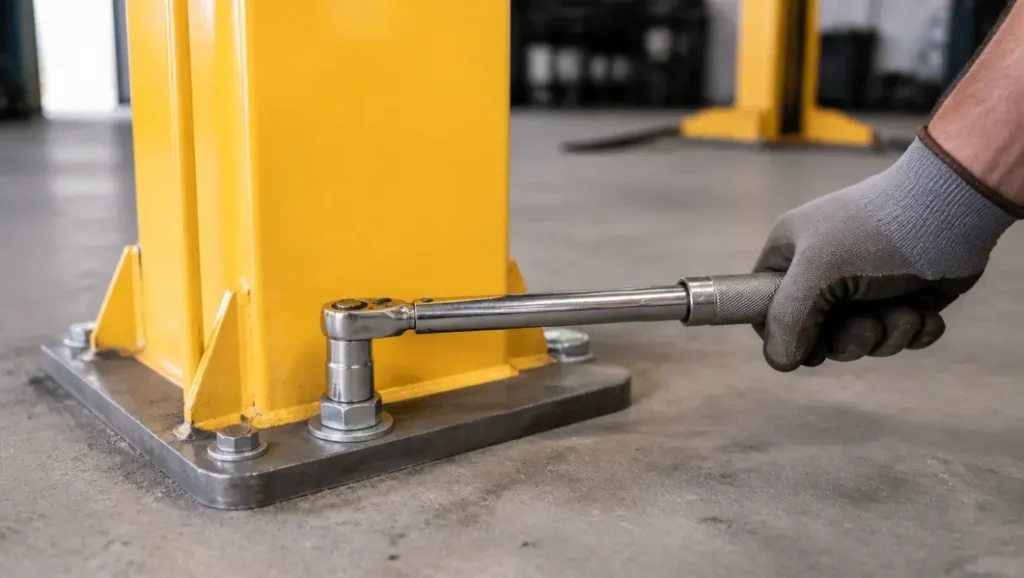
A 2-post lift transfers a large tipping force into a small footprint at the base of each column. Anchor bolts and the slab underneath them are the last layer, and the one people skip. Most 2-post lifts call for a minimum of about four inches of 3,000 PSI concrete cured for 28 days, but the number that matters is the one in your model's manual. Our full breakdown on how thick of concrete a 2-post lift needs covers slab depth, rebar and post-tension warnings in detail.
How Do Car Lift Safety Locks Work?
Car lift safety locks work by dropping a spring-loaded steel latch into a notched ladder inside each column as the carriage rises. The latches engage automatically at fixed intervals, usually every few inches, and you hear a distinct metal click each time one seats.
Here is the part that trips people up. Hydraulics raise the vehicle. Hydraulics are not meant to hold it. Seals wear, hoses fail, and fittings loosen. The locks are the only component designed to sit under load for hours.
What Is Single-Point Lock Release, and Why Does It Matter?
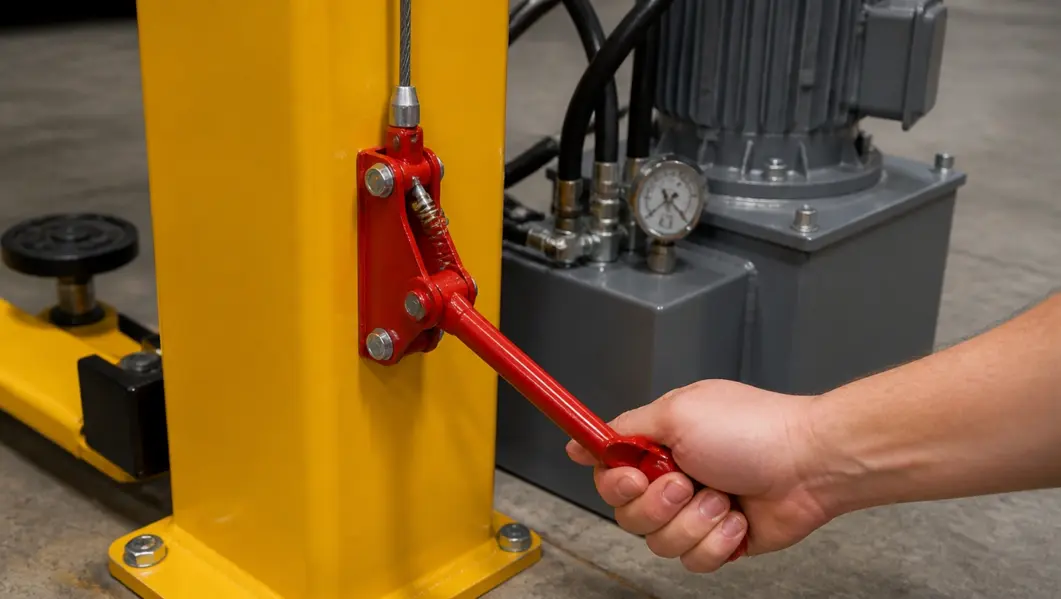
A single point release lift lets you disengage the locks in both columns from one lever, normally mounted right beside the power unit. Pull the lever, hold it down, and open the lowering valve with your other hand. Let go of the lever at any point and both locks snap straight back in.
A dual-point release does the same job but needs you to walk to each column and release them separately.
Daytona Team Take: The Feature Buyers Ignore Most
Single-point release gets treated as a convenience upgrade. We would call it a safety feature. When lowering means two trips around the lift, a busy technician starts looking for shortcuts, and shortcuts around lock mechanisms are how bad habits form. A lever you can reach without moving is a lever that gets used properly every single time.
Every Daytona 2-post lift ships with automatic safety locks and single-point release as standard.
Why You Must Lower the Lift Onto the Locks Every Time
Raise the vehicle a little past your working height, then lower it until you hear both locks take the weight. Now the load sits on steel, not oil.
It takes four seconds. Skipping it is the most common unsafe habit in any shop, and it is the one that shows up again and again in incident reports.
What Are Automatic Arm Restraints, and What Can They Actually Do?
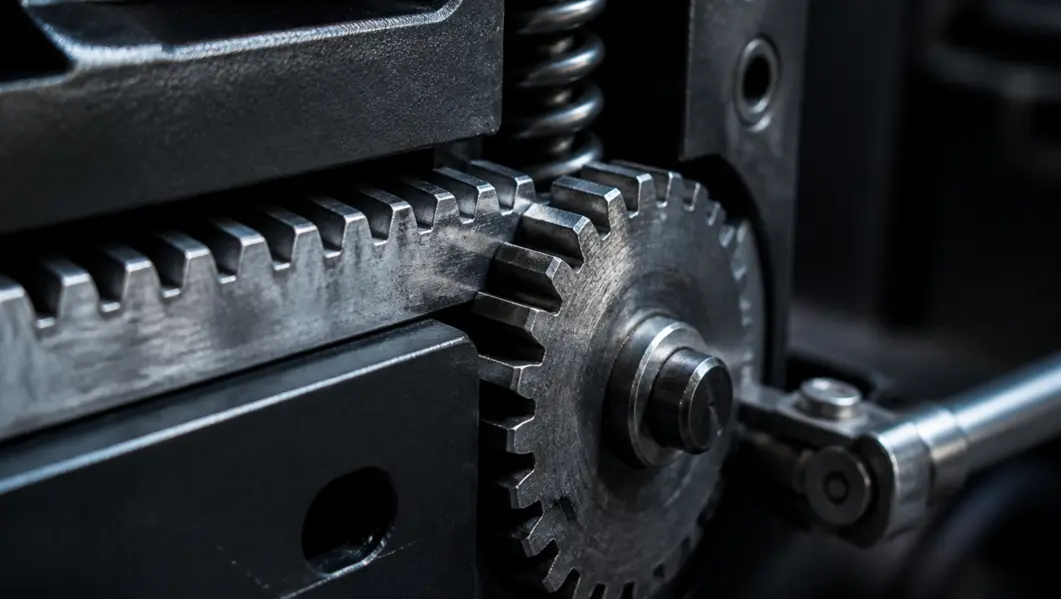
Automatic arm restraints are a spring-loaded gear system at the joint where each swing arm meets the carriage. When the lift sits on the floor, a release rod contacts the ground and lifts the gear clear, so you can swing the arms freely into position. As soon as the lift rises, the gears mesh and the arms lock to their current angle.
They stop arms drifting while you work, and they stop somebody knocking an arm out of position with a toolbox or a knee. That is a real and valuable job.
Arm Restraints Are Not Arm Locks
Plenty of people call these 2 post lift arm locks and assume they will hold an arm in place while a vehicle slides off a pad. They will not, and believing otherwise is genuinely dangerous.
The ANSI/ALI ALCTV standard sets the lateral load-holding requirement for arm restraints at 150 pounds with the arms fully extended. A vehicle beginning to shift generates forces far beyond that in a fraction of a second. Restraints are a positioning device, not a catch device.
The practical consequence: never let a correctly engaged restraint talk you out of the shake test. Raise the vehicle a few inches, push firmly on a bumper, confirm every pad is seated on a factory lift point, then go up.
Do Equalization Cables Hold the Vehicle Up?
No. Equalization cables on a 2 post lift keep both carriages travelling at the same rate. The hydraulic cylinders do the lifting. This is one of the most persistent misunderstandings in the industry, and it matters because it changes how you inspect them.
You are not looking for cables that might snap under the car's weight. You are looking for cables that have stretched, frayed, lost tension, or started to unwind a strand, because an out-of-sync lift puts uneven load on the carriage and the arms.
Cable slack detection adds a second line of defence. A switch monitors tension and cuts the lift if a cable goes loose. If a lift you are comparing does not list it, that is worth a direct question to the seller.
Does a 2-Post Lift Have to Be ALI Certified in 2026?
In most of North America, yes, for new installations. This is the biggest change in lift safety rules in years and it still catches buyers by surprise in 2026.
The 2024 International Residential Code added Section R317.7, which requires automotive lifts to be listed and labelled in accordance with ANSI/ALI ALCTV. The International Building Code carries the same requirement for commercial buildings. According to the Automotive Lift Institute, the IRC is in use or adopted in 49 US states plus the District of Columbia. Lifts also may not be installed inside habitable space.
ALI certification means an independent, OSHA-accredited testing lab has tested the model against ANSI/ALI ALCTV, covering structural integrity, proper operation, overload protection, labelling and operator training materials, with ongoing inspections of the production facility.
Two details worth knowing. Certification applies to an individual lift model, never to a whole brand, so a manufacturer having one certified lift tells you nothing about the rest of the range. And the only way to confirm a model is genuinely certified is to look it up in the ALI Directory of Certified Lifts.
Being straight with you: Daytona has one ALI Certified 2 post lift, the BR10-2OH-33 10,000 lb overhead lift. If your project needs code compliance, that is the model to look at. Our other 2-post lifts are built with the same automatic locks, single-point release and limit switches, but they are not certified, and we will not pretend otherwise.
The 60-Second Pre-Lift Check
Safety features only work if they still work. A 2 post lift daily inspection does not need paperwork or tools, just a habit. Run this before the first vehicle of the day.
| Check | What You Are Looking For | Stop-Work Trigger |
|---|---|---|
| Safety locks | Crisp click from both columns on the way up | One column silent or a lazy, muffled click |
| Arm restraints | Arms will not swing when the lift is raised | Any lateral movement at all |
| Cables | Even tension, no fraying or broken strands | A single broken strand, or one side visibly slack |
| Hydraulics | Dry hoses, fittings and cylinder rods | Any weeping or pooled oil |
| Pads and adapters | Rubber intact, no chunks missing, correct type | Cracked, oil-soaked or mismatched pads |
| Anchors and slab | Bolts tight, no cracks radiating from base plates | Any loose bolt or fresh concrete cracking |
On top of the daily habit, the ANSI/ALI ALOIM:2020 standard calls for a qualified inspector to inspect every lift at least once a year. Book it, keep the record, and treat it the way you would a fire extinguisher service.
Safety Features Are Only Half the System
UK Health and Safety Executive guidance on vehicles falling from 2-post lifts was issued after two incidents, one fatal, in which vehicles struck mechanics working underneath. That guidance is British, so the enforcement side does not apply in North America, but the causes translate exactly: arm locking systems that were missing or had stopped working, and vehicles loaded onto the wrong points.
Equipment rarely fails on its own. Loading does. Three habits carry most of the weight:
- Use the vehicle's factory lift points. Not the side skirts, not the floor pan, not wherever the pad happens to reach.
- Match the adapter to the vehicle. Frame cradle pads for body-on-frame trucks and SUVs, standard rubber pads for unibody cars. Never stack adapters to gain height.
- Keep the centre of gravity between the pads. Pulling an engine or a transmission shifts the balance of a vehicle that is already in the air.
Capacity matters too, and not the way most people assume. Rated capacity is the total for the lift, and no single arm should ever be asked to carry more than a quarter of it. Our 2-post lift capacity guide works through the per-arm maths, and the step-by-step guide to using a car lift safely covers the full lifting cycle. For a wider look at the safe operating procedure, ALI publishes free operator guidance.
One Rule That Overrides Everything
Never put any part of your body under a vehicle that is resting only on hydraulic pressure. Lower onto the locks first, every time, no exceptions, no matter how quick the job is.
If a lift will not lower onto its locks cleanly, it is out of service until it is repaired. Do not work around it.
How Daytona Builds Safety Into Every 2-Post Lift
Daytona has built lifts for shops and garages across the US and Canada since 1999. Across our 2-post range you get automatic safety locks with single-point release, height limit switches, high-polymer polyethylene slide blocks, rubber door guards and a powder-coat finish.
The ALI Certified BR10-2OH-33 is our certified model, with dual direct-drive cylinders and 3-stage arms. The LTPA10 and LTPA12 adjustable lifts add three width settings so you can match the lift to your bay rather than the other way round, and if door clearance drives your decision, our comparison of symmetric versus asymmetric 2-post lifts explains the trade-off.
Every lift is backed by our 5-2-1 limited warranty, which covers 5 years structural, 2 years power units and 1 year parts. Wearing parts such as cables, hoses, slide blocks and rubber pads are not covered, which is exactly why they sit on the daily check list above. All Daytona equipment is for indoor use only, and outdoor installation voids the warranty.
Browse the full 2-post lift range or the automotive lifts hub, and see our best 2-post car lift buyer's guide for the full selection framework.
One last note on installation. Always follow your model's manual and have the lift installed by a qualified professional, especially where post-tension slabs or unknown concrete are involved. No article, including this one, replaces the manual that shipped with your lift.
Frequently Asked Questions
Are 2 post lifts safe?
Yes, 2 post lifts are safe when they are installed to spec on qualifying concrete, operated correctly, and inspected regularly. The main risk is not equipment failure but loading error, meaning the vehicle is placed on the wrong lift points or its centre of gravity is not between the pads. Lowering the lift onto its mechanical safety locks before going underneath removes most of the remaining risk.
Do arm restraints stop a car from falling?
No. Automatic arm restraints are designed to stop the swing arms drifting or being knocked out of position during normal service, not to catch a falling vehicle. The ANSI/ALI ALCTV standard sets their lateral load-holding requirement at 150 pounds with the arms fully extended, which is far below the force a shifting vehicle creates. Always confirm pad placement with a shake test at a few inches before raising a vehicle to working height.
Why do you lower the lift onto the safety locks?
Hydraulic systems are designed to raise a vehicle, not to hold it for extended periods, because seals, hoses and fittings can fail. The mechanical safety locks are the only components built to carry the load continuously. Raise the vehicle slightly above your working height, then lower it until both locks audibly take the weight before anyone goes underneath.
What is the difference between single-point and dual-point lock release?
A single-point release lets you disengage the safety locks in both columns from one lever, usually located beside the power unit. A dual-point release requires the operator to walk to each column and release the locks separately. Both are safe when used correctly, but single-point release is faster and reduces the temptation to take shortcuts during a busy day.
Do equalization cables hold the vehicle up on a 2 post lift?
No, equalization cables synchronize the two carriages so both sides rise and lower at the same rate. The hydraulic cylinders do the actual lifting and the mechanical locks hold the load. Cables should still be inspected regularly for fraying, broken strands and uneven tension, because a lift that is out of sync puts uneven stress on the carriages and arms.
How often should a 2 post lift be inspected?
The ANSI/ALI ALOIM:2020 standard calls for every vehicle lift to be inspected at least once a year by a qualified lift inspector. On top of that annual inspection, run a quick daily visual check before the first vehicle of the day, covering the safety locks, arm restraints, cables, hydraulic hoses, lift pads and anchor bolts. Keep a record of both.
Does a 2 post lift need to be ALI certified for a home garage?
In most of the United States, yes for new installations. The 2024 International Residential Code Section R317.7 requires automotive lifts to be listed and labelled in accordance with ANSI/ALI ALCTV, and the IRC is in use or adopted in 49 states. Verify any model in the ALI Directory of Certified Lifts before buying, and check with your local building department, since adoption dates and local amendments vary.
Does a higher weight capacity make a lift safer?
Not on its own. A higher rated capacity gives you more headroom above the vehicles you service, but capacity alone says nothing about the quality of the locks, cables, arm restraints or anchoring. An uncertified lift with a high rating is not safer than a properly certified lift with a lower one. Match the capacity to your heaviest vehicle, then judge the lift on its safety systems and certification.
What is a height limit switch on a 2 post lift?
A height limit switch cuts power to the lift when the carriage reaches its maximum travel, preventing the carriage from over-travelling at the top of the column. It protects the lift mechanism itself, not the roof of the vehicle. On overhead 2-post lifts, a separate shut-off bar in the crossbeam stops the lift if a tall vehicle makes contact with it.
Can one person safely operate a 2 post lift?
Yes, a 2 post lift is designed for a single operator who stays at the control throughout the lifting cycle. A second set of eyes helps when spotting an unusually long, heavy or awkward vehicle, but it is not required for routine work. What matters is that whoever is operating the lift has been trained on that specific model and keeps bystanders clear while the vehicle is in the air.

Spec Your Next Lift Around Safety, Not Just Capacity
Tell us your ceiling height, your slab details and the heaviest vehicle you plan to lift. We will spec the right Daytona 2-post lift and connect you with a distributor or installer in your area.
- Automatic safety locks with single-point release across the 2-post range
- ALI Certified option available on the BR10-2OH-33
- 5-2-1 Limited Warranty (5 years structural, 2 years power, 1 year parts)
- Canadian-owned manufacturer since 1999
- Freight included on warranty parts in the US and Canada