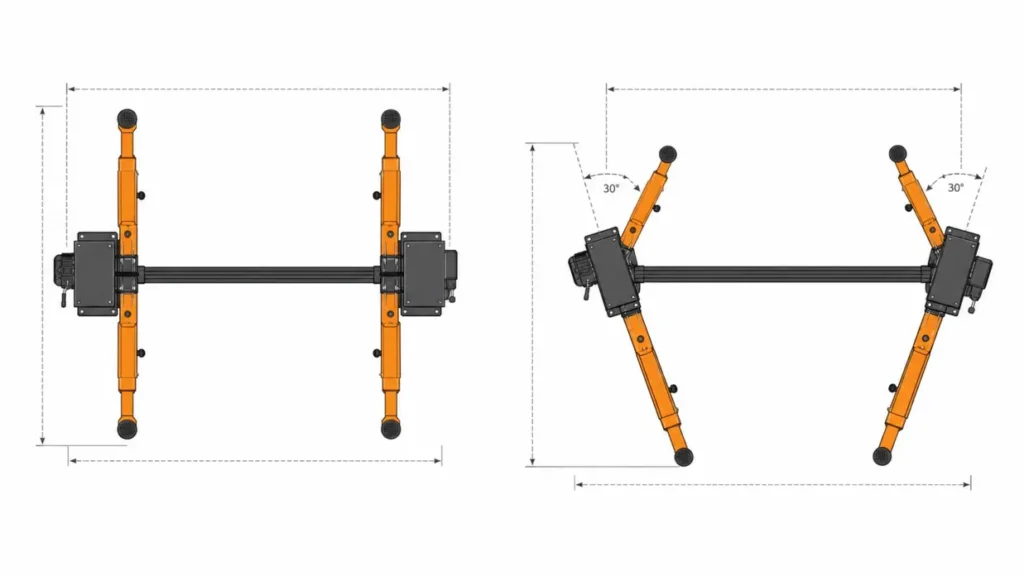
The difference between a symmetric and asymmetric 2 post lift comes down to two things: arm length and column angle. A symmetric lift has four equal-length arms and columns that face each other squarely, so the vehicle sits centered between the posts. An asymmetric lift has shorter front arms, longer rear arms, and columns rotated about 30 degrees, which shifts the vehicle back and clears the doors from the posts. Symmetric setups suit longer, heavier vehicles like trucks and vans. Asymmetric setups give better door and cabin access, which most shops want for everyday cars.
That is the short answer. But the choice affects door dings, technician comfort, how far you park from the wall, and even which vehicles you can safely rack. So let's walk through it properly, the way we would explain it to a shop owner standing in an empty bay in 2026.
Quick Answer
Choose symmetric if you mostly service full-size trucks, vans, and long-wheelbase vehicles that need balanced, frame-rail lifting.
Choose asymmetric if you work on everyday cars and SUVs and want the doors to open freely for interior access. Many modern arms adjust to do a bit of both.
What's the difference between a symmetric and asymmetric 2 post lift?
A 2 post lift is a vehicle lift that raises a car on two vertical columns using four swing arms that engage the frame or pinch welds. Both symmetric and asymmetric designs share that basic setup. What changes is how the arms and columns are arranged, and that small change drives almost every practical difference you'll notice.
What is a symmetric 2 post lift?
A symmetric 2 post lift is a two-column lift with four equal-length arms and posts that sit directly across from each other. The vehicle parks in the middle, with roughly half its length in front of the columns and half behind. That even split is where the word "symmetric" comes from.
Because the load sits centered, weight is spread evenly across both posts and carriages. That's great for stability with heavy, long vehicles. The catch: on a normal passenger car, the doors line up right next to the posts. Open a door and you can catch it on the column. Not fun on a customer's paint.
What is an asymmetric 2 post lift?
An asymmetric 2 post lift is a two-column lift with shorter front arms, longer rear arms, and columns rotated about 30 degrees outward. This positions the vehicle further back, roughly 30 percent in front of the posts and 70 percent behind, so the front doors clear the columns and open freely. It's the go-to setup for door and cabin access on everyday cars.
Here's the clever part. Moving the car back would normally throw off the balance. To fix that, engineers rotate the columns so the arms can still cradle the vehicle's center of gravity near the posts. The result is a lift that keeps the car balanced while giving you room to actually open the door and get inside.
The 30-degree rule, in plain English
Want a mental picture? Hold both hands straight out in front of you, palms facing each other. Now turn your palms slightly toward yourself. That outward-angled stance is roughly what asymmetric columns look like. Squared-up and facing each other flat is symmetric.
The 30-Degree Rule
Symmetric columns face each other squarely. Asymmetric columns are rotated about 30 degrees outward, paired with shorter front arms and longer rear arms. That single design choice is what buys you door clearance.
Symmetric vs asymmetric 2 post lift: side-by-side comparison
The fastest way to see the trade-offs is to line them up. This table covers the points buyers ask about most, from door clearance to the type of vehicle each design handles best.
| Feature | Symmetric 2 post Lift | Asymmetric 2 post Lift |
|---|---|---|
| Arm lengths | All four arms equal | Shorter front, longer rear |
| Column angle | Squared, facing each other | Rotated ~30 degrees outward |
| Vehicle position | Centered (~50/50) | Shifted back (~30/70) |
| Door clearance | Limited on cars | Excellent |
| Best weight bias | ~50/50, mid-point balance | ~60/40, front-heavy |
| Ideal vehicles | Trucks, vans, long wheelbase | Cars, SUVs, daily drivers |
| Drive-through width | Wider | Slightly tighter |
| Positioning care needed | Forgiving | More precise |
Notice there's no clear winner. Each column of that table is a strength for one design and a compromise for the other. The right pick depends on what rolls into your bay, which is exactly what the next section digs into.
How weight distribution decides which lift you need
Weight distribution is the balance of a vehicle's mass from front to back, and it's the real reason these two designs exist. Get the match wrong and the lift works harder than it should, the arms strain, and positioning gets fiddly. Get it right and the car sits balanced with room to spare.
Most rear-wheel-drive trucks, vans, and large sedans carry their weight fairly evenly, close to a 50/50 split from bumper to bumper. That even balance is a natural fit for a symmetric lift, where the vehicle sits centered and both posts share the load equally.
Front-wheel-drive cars are a different story. With a transverse engine and transmission sitting over the front axle, they're often closer to a 60/40 front-heavy balance. An asymmetric lift is built for exactly that, capturing the forward center of gravity near the posts while sliding the cabin back for door access.
In our experience, this is the single most overlooked factor when shops buy their first lift. Buyers fixate on capacity, which matters, but they forget that where the weight sits changes how the vehicle balances on the arms. A 10,000 lb lift that's the wrong configuration for your fleet still makes daily work harder.
Which 2 post lift is better for your shop?
The better 2 post lift is the one that matches the vehicles you service most and the work you do on them. There's no universal answer, but there is a clear pattern once you look at your typical jobs. Use the table below as a starting point, then confirm against your own repair mix.
| Your typical work | Recommended configuration | Why |
|---|---|---|
| Full-size trucks and vans | Symmetric | Even weight, frame-rail lifting, stability |
| Everyday cars and small SUVs | Asymmetric | Door clearance and cabin access |
| Mixed fleet, mostly cars | Asymmetric or adjustable arms | Covers the majority, flexes for the rest |
| Heavy commercial and fleet | Symmetric, higher capacity | Load balance under weight |
| Home garage, one or two vehicles | Match your specific vehicles | Buy for what you actually own |
Can you lift a truck on an asymmetric lift?
Yes, you can lift a truck on an asymmetric lift, as long as the truck is within the lift's rated capacity and you position it per the manufacturer's manual. The old claim that "asymmetric lifts can't handle pickups" is a myth. What's true is that a very long or heavy truck balances more naturally on a symmetric lift, and a short-bed or lighter truck does fine on an asymmetric one.
The key is the center of gravity. As long as it lands just rearward of the columns and the arms reach the correct lifting points, the vehicle sits balanced. If your bread and butter is heavy long-bed trucks, though, symmetric is the safer, simpler default.
What about a home garage with mixed vehicles?
For a 2 post lift for a home garage, most people are best served by an asymmetric setup or a lift with adjustable, multi-position arms. Home users usually keep a couple of cars and maybe one truck, and door access matters a lot when you're the one climbing in and out all afternoon.
If your driveway leans toward one heavy truck you plan to service often, weigh that honestly against the cars. Buy for the vehicle you'll lift most, not the one you own that's the most fun to talk about.
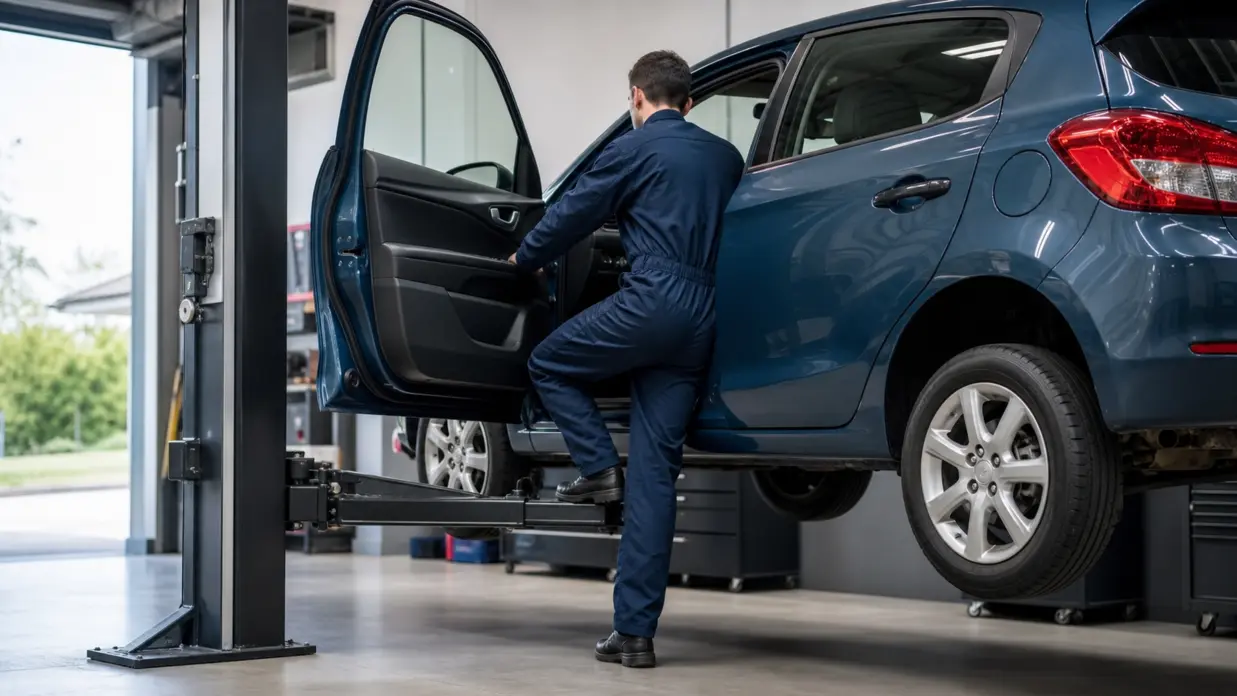
How do you position a vehicle on an asymmetric lift?
Positioning a vehicle on an asymmetric lift means centering the car's weight just behind the columns, setting the arms to the manufacturer's recommended lifting points, and confirming the load is balanced before you raise it more than a few inches. The offset design is less forgiving than symmetric, so a little care up front prevents a lot of trouble.
Here's a clean sequence to follow every time:
- Drive in slowly and stop with the front doors just clear of the posts, so the vehicle's center of gravity sits slightly behind the columns.
- Swing the shorter arms to the front lifting points and the longer arms to the rear points.
- Set the pads under the manufacturer's designated pinch-weld or frame lifting points, never on the floor pan or a random spot.
- Raise the lift only until the tires are about to leave the ground, then stop.
- Shake the vehicle gently by hand to confirm it's stable and seated on all four pads.
- Only then raise to working height, and always engage the safety locks before going under.
Not sure where the correct lifting points are on a given vehicle? Don't guess. The Automotive Lift Institute's Vehicle Lifting Points Guide maps recommended pads for thousands of cars, SUVs, vans, and light trucks, and it's the trusted reference in the industry.
Positioning Safety
An asymmetric lift rewards precise placement. If the vehicle rocks at all during your shake test, lower it, reset the pads to the correct lifting points, and try again. A balanced car is a safe car.
Space, ceiling, and concrete: how the config affects your bay
Bay planning is the practical side of the symmetric vs asymmetric lift decision, and it changes a few real numbers you'll live with daily. Column angle and vehicle offset affect how far you park from the wall and how much room you have to move around the car.
As a general rule, an asymmetric lift's columns sit closer to the front wall, often around 9 to 10 feet from the wall measured to the column centers, because roughly 30 percent of the vehicle sits in front of the posts. A symmetric lift usually wants a bit more distance since the car is centered. Always confirm the exact figure in your model's manual before you drill anything.
Ceiling height and concrete matter for both designs equally. Most 2 post lifts need a solid, properly cured slab and enough overhead clearance for the vehicle plus the lift structure. We cover the slab side in detail in our guide on how thick your concrete needs to be for a 2 post lift, and the room-planning side in our 2 post lift dimensions and clearance guide. If ceiling height is your worry, a floorplate design can help, which we compare in our breakdown of floorplate versus overhead 2 post lifts.
One more layout note. Symmetric lifts give a wider drive-through space, which is genuinely handy in a busy bay when you're pulling vehicles in and out all day. Asymmetric lifts trade a little of that width for the door clearance most car-focused shops prefer. It's the same trade-off, just seen from the doorway instead of the door handle.
Safety, inspection, and code you should know before buying
Lift safety is a set of standards, inspections, and code requirements that govern how a vehicle lift is built, installed, and maintained. It applies no matter which arm configuration you choose, and skipping it is where shops and homeowners get into real trouble.
Start with certification. As of the 2024 International Residential Code and International Building Code, automotive lifts installed in residential and commercial settings must be listed and labeled to the ANSI/ALI ALCTV safety standard, which in practice means they must be ALI certified. You can read the requirement straight from the Automotive Lift Institute's IRC summary. Certification is granted per model, not per brand, so always confirm the exact model in the ALI Directory of Certified Lifts.
Then there's ongoing safety. The governing standard for use and upkeep is ANSI/ALI ALOIM, which calls for a qualified inspector to check every lift at least once a year. On top of that, operators should run a quick daily check of controls, locks, and restraints before the first vehicle goes up, and everyone using the lift should be trained.
A quick myth-buster while we're here. There's no such thing as an "OSHA certified" lift or inspector. Per the ALI inspection FAQ, those claims are invalid. OSHA has no standard written specifically for automotive lifts, but it can and does cite shops under its General Duty Clause when inspections or operator training are missing, as seen in this OSHA citation record. Translation: annual inspections and daily checks aren't optional if you care about safety or liability.
Where Daytona's adjustable 2 post lifts fit in
Daytona builds a full range of 2 post lifts designed around real-world shop and garage needs, with adjustable arms and multiple width settings so you can dial the fit to your vehicles. We've been doing this as a Canadian-owned manufacturer since 1999, and our lifts are backed by a 5-2-1 warranty covering structure, power units, and parts.
If door access and everyday cars are your focus, our adjustable models give you flexible arm reach and multiple width positions. The LTPA10 10,000 lb adjustable lift and the higher-capacity LTPA12 adjustable lift both use dual direct-drive columns and three width settings, so you're not locked into one narrow setup.
When code compliance is on the table, certification becomes the deciding factor. Our ALI Certified BR10-2OH-33 overhead 2 post lift is our sole ALI-certified model, independently tested to the ANSI/ALI safety standard. If you need a lift that satisfies the 2024 IRC and IBC requirements out of the box, that's the straightforward choice.
Want to compare the full lineup side by side? Browse all of our 2 post lifts, or if you're weighing this against another buying decision, start with our 2 post car lift buyer's guide.
Frequently Asked Questions
What is the main difference between a symmetric and asymmetric 2 post lift?
A symmetric 2 post lift has four equal arms and squared columns, so the vehicle sits centered. An asymmetric 2 post lift has shorter front arms, longer rear arms, and columns rotated about 30 degrees, which shifts the vehicle back for better door and cabin access.
Which is better, a symmetric or asymmetric lift?
Neither is universally better. Symmetric lifts suit trucks, vans, and long-wheelbase vehicles that balance evenly. Asymmetric lifts suit everyday cars and SUVs where door clearance matters. The right choice depends on the vehicles you service most.
Can you lift a full-size truck on an asymmetric lift?
Yes, as long as the truck is within the lift's rated capacity and positioned per the manual. Very long or heavy trucks balance more naturally on a symmetric lift, but short-bed and lighter trucks work fine on an asymmetric one.
Why are asymmetric lift columns rotated 30 degrees?
The 30-degree rotation lets the shorter front and longer rear arms cradle the vehicle's center of gravity near the posts even though the car is shifted back. It keeps the load balanced while opening up door clearance, which is the whole point of the asymmetric design.
Do asymmetric lifts have better door clearance?
Yes. Because the vehicle sits further back, the front doors clear the posts and open fully. That improved 2 post lift door clearance is the main reason car-focused shops and home garages choose asymmetric over symmetric.
Which lift is best for a home garage?
For most home garages with everyday cars, an asymmetric or adjustable-arm 2 post lift for a home garage is the best fit because door access matters when you climb in and out often. If you mainly service a heavy truck, weigh a symmetric setup instead.
Are asymmetric lifts less stable than symmetric lifts?
Not when used correctly. Asymmetric lifts are balanced by design, but they need more precise vehicle positioning. If a car is placed too far forward or back, the load can become uneven, so always confirm balance before raising to working height.
How far from the wall should a 2 post lift be installed?
An asymmetric lift's columns often sit around 9 to 10 feet from the front wall, measured to the column centers, while a symmetric lift usually wants slightly more room since the vehicle is centered. Always confirm the exact distance in your model's manual before drilling.
Does a 2 post lift need to be ALI certified?
Under the 2024 IRC and IBC, residential and commercial lifts must be listed and labeled to the ANSI/ALI ALCTV standard, meaning ALI certified. Certification is per model, not per brand, so verify the exact model in the ALI Directory of Certified Lifts before buying.
Do Daytona 2 post lifts have adjustable arms for both setups?
Daytona's adjustable 2 post lifts, such as the LTPA10 and LTPA12, use multiple width settings and adjustable arms so you can fit a range of vehicles. For code-driven projects, the BR10-2OH-33 is our ALI-certified model. Contact us and we'll match a lift to your vehicle mix.

Not Sure Which Configuration Fits Your Bay?
Tell us the vehicles you lift most and the size of your space, and we'll help you choose the right 2 post lift and connect you with an installer near you.
- 5-2-1 Limited Warranty (5 years structural, 2 years power, 1 year parts)
- ALI Certified option available on the BR10-2OH-33
- Canadian-owned manufacturer since 1999
- Adjustable arms and multiple width settings across the 2 post range
- Freight included on warranty parts in the US and Canada