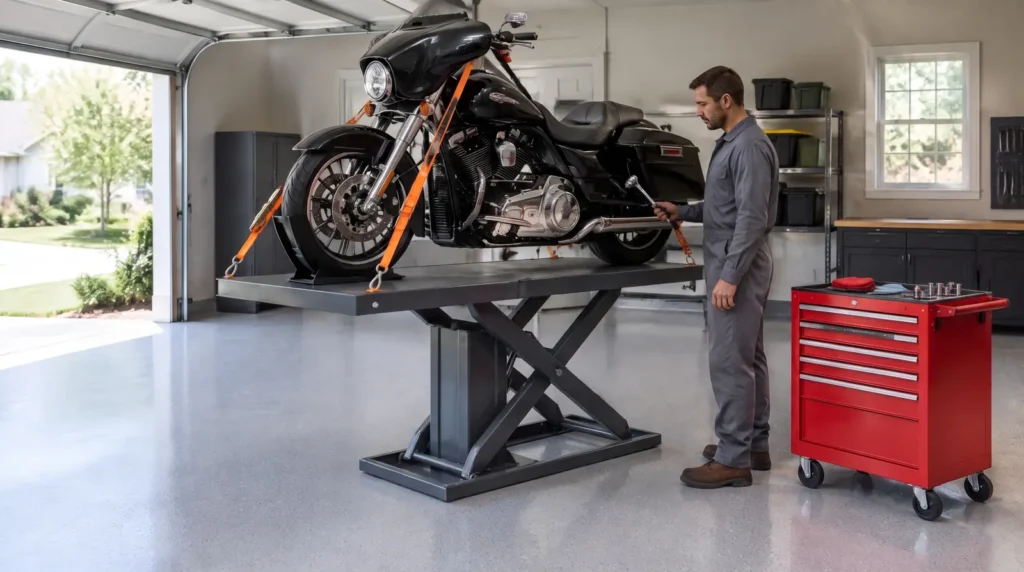
A motorcycle lift tableis a electrically powered lift that raises motorcycle and ATVs up. How you choose one will depend on the weight and width of your vehicle, height (raised and lowered), platform size, powertype and how it will hold your motorbike.
The most common mistake is buying on capacity alone. Raised height and power type shape every job.
If you work on your bike from a creeper or an upturned bucket, you already know the cost. Sore knees, a stiff back, and jobs that take twice as long as they should. A motorcycle lift table fixes that by bringing the machine up to you.
This guide gives you a simple way to pick the right one for your home garage or shop. We call it the WHEEL check, and it works for any brand. We'll also show where our own motorcycle and ATV lifts fit, and where they don't.
Key takeaways
- Wet weight rules. Size capacity to your heaviest machine with fluids, fuel and gear, then leave headroom.
- Height beats extras. A table that raises to about 48 in. (1,219 mm) changes your posture more than any add-on.
- Check lowered height too. A low deck keeps the ramp gentle for low cruisers and baggers.
- Power decides your setup. Air tables need a compressor. Electric-hydraulic tables need only a suitable 120V outlet.
- Measure tire edges and wheelbase. Tires must sit fully on the deck, and long tourers must fit between the chock and the rear edge.
- Hold the bike two ways. Use a wheel chock or vise plus tie-down straps, every time.
- Indoor use only. Daytona lifts are warrantied for indoor use. Outdoor use voids the warranty.
What is a motorcycle lift table?
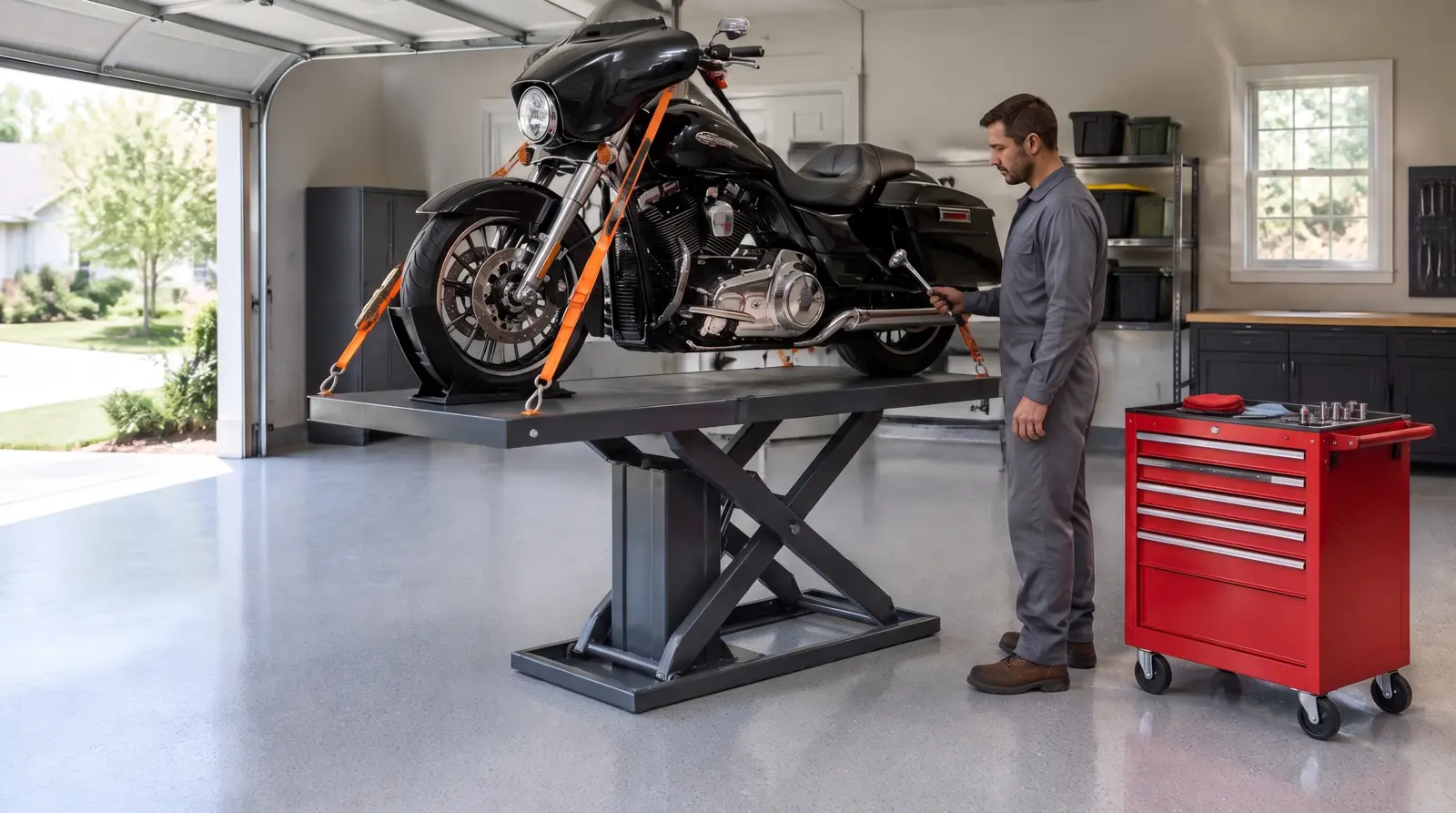
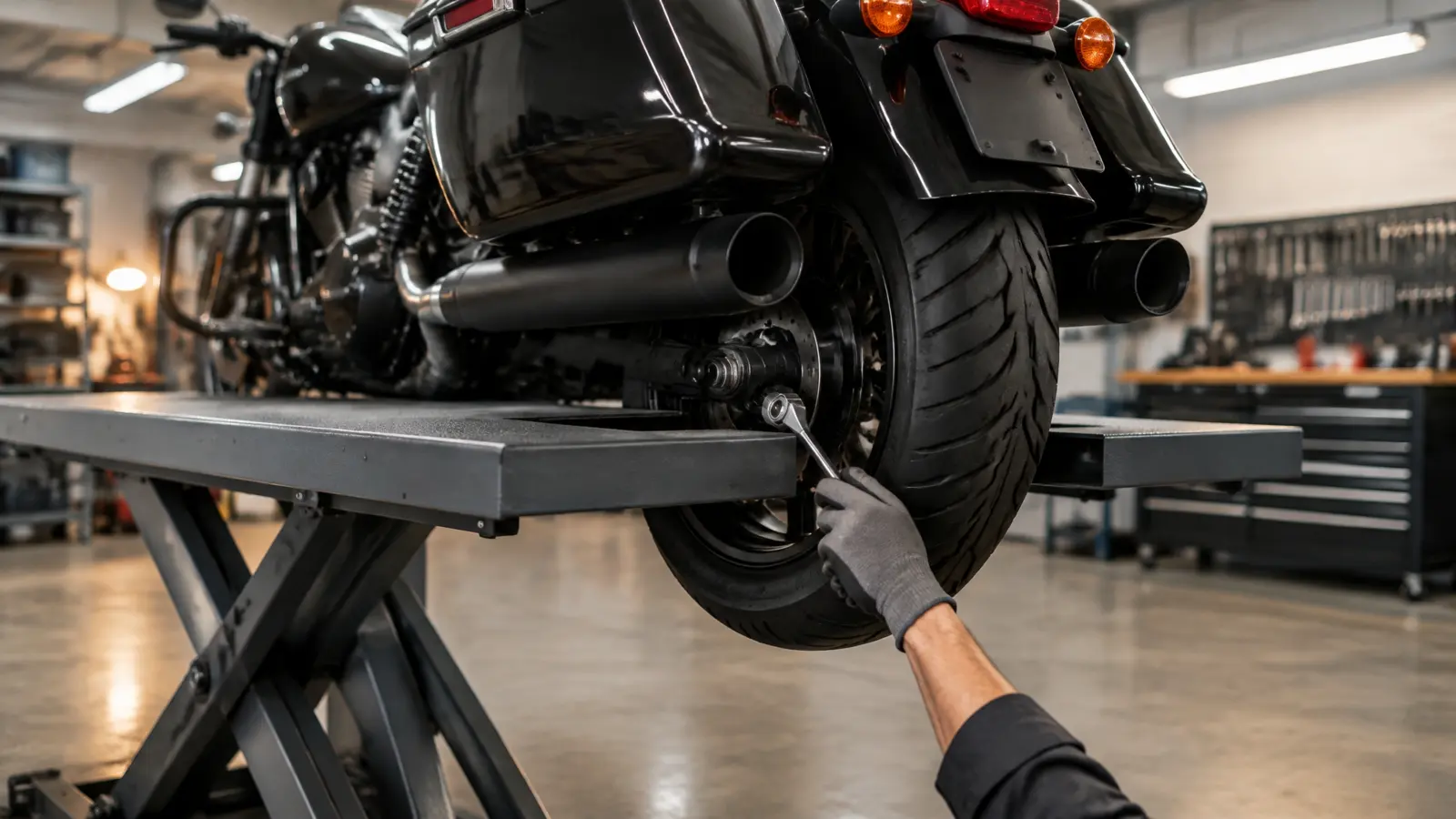
A motorcycle lift table is a powered platform you roll a bike onto, secure, and raise to work height. It carries the whole machine on a wide platform, so the wheels, engine and underside are all easier to reach and less stressful on your back and joints.
The majority of lift tables, when not raised, are low enough to push your motorbike onto. It will raise from air pressure or hydraulic pressure and a mechanical lock will hold it in place while you work.
You'll also hear it called a motorcycle lift, a bike lift or, in Canada, a motorcycle hoist. They all mean the same thing when people are talking about garage equipment.
Lift table vs motorcycle jack, paddock stand and center stand
Each of these tools gets a bike off the ground. Only a lift table changes your working height.
| Option | What it does | Your working height | Best for | Trade-off |
|---|---|---|---|---|
| Motorcycle lift table | Raises the whole bike on a platform | Standing | Regular maintenance, tire and brake work, detailing and storage | Needs floor space and a power source |
| Motorcycle jack | Lifts the frame a few inches | Floor level | Quick wheel removal | You still kneel or sit to work |
| Paddock stand | Lifts one wheel off the ground | Floor level | Chain cleaning and wheel spins | Supports one end only |
| Center stand | Built in on some bikes; lifts the rear wheel | Floor level | Roadside chain checks | Not every bike has one |
Bottom line: jacks and stands get a wheel off the ground. A table gets the whole job off the ground.
Is a motorcycle lift table worth it for a home garage?
For most riders who do their own maintenance, yes. If you change your own oil, tires, brakes or chain several times a year, a table saves your knees and your time. If a dealer does all your work, a good stand is enough.
The physical cost of floor work is real. OSHA's ergonomics guidance lists awkward postures and long periods in one position as risk factors for musculoskeletal disorders. The risk of working on a bike at floor level involves plenty of both.
By the numbers: backs and knees
In 2020, US automotive technicians had 9,940 injury cases serious enough to miss work. About 2,000 of them involved the back or knee, according to the Bureau of Labor Statistics. Those are pros, but the posture problem is the same in a home garage.
Who gets the most from a table? Riders with heavy touring bikes. Owners who do their own tire and brake work. Anyone with more than one bike, or a bike and an ATV. And small shops adding powersports service.
Who can skip it? If you only lube the chain and check tire pressure, a stand covers you.
There's a second payoff people don't expect. Jobs you used to put off, like a brake fluid flush or a full detail, stop feeling like a chore. When the bike is at chest height, you tend to look it over more often, and you catch small problems sooner.
How do you choose a motorcycle lift table? Use the WHEEL check
To choose a motorcycle lift table, check five things against your heaviest and widest machine:
- Weight: a capacity above your machine's wet weight plus gear, with headroom to spare.
- Height: a raised height near standing work height and a low lowered height for easy loading.
- Envelope: a platform long and wide enough for your tires, plus floor space around it.
- Energy: air, air-over-hydraulic or electric-hydraulic power that suits your garage.
- Locks and hold: a mechanical safety lock, a wheel chock or vise, and tie-down points.
Most buyer's guides start with a product list. We think you should start with your machine. The rest of this guide walks through each letter of the WHEEL check.
Which motorcycle lift table fits your kind of riding?
The right table depends on what you ride. A dirt bike, a full-dress tourer and a utility ATV each stress a different part of the WHEEL check. Find your row, then read the matching sections below.
| Rider type | Example machine and weight | What matters most | Watch for |
|---|---|---|---|
| Dirt bike and motocross | Honda CRF450R, 249 lb | A secure hold on a narrow front tire, and a center jack for suspension work | Tall seat height means you may not need full lift height for top-end work |
| Cruiser and standard | Honda Rebel 500, 414 lb | Low lowered height, a gentle ramp and a solid wheel chock | Low exhausts scraping the ramp |
| Full-dress touring | H-D Road Glide Limited, 919 lb | Capacity headroom, a wheel vise for solo loading and a rear drop-out | Long wheelbase; confirm it fits between the chock and the rear edge |
| Utility ATV | Honda FourTrax Rancher 4x4, 615 lb | Side extensions and adjustable side ramps for a wide stance | Tire-edge width against deck width |
| Mixed garage or small shop | Bikes and ATVs | Electric-hydraulic convenience, quick ATV conversion, drop-outs and a mobility kit | Matching tire and wheel equipment if you do tire work |
How much weight can a motorcycle lift table hold?
Capacity varies by model, so the real question is what your machine weighs with everything on it. Check the rated capacity on the spec sheet, then compare it with your total. Our LMATV, for example, is a 2,200 lb (998 kg) motorcycle lift.
Wet weight vs dry weight
Dry weight leaves out fuel, oil and coolant. Wet weight, often listed as curb weight or weight in running order, includes them. On a big tourer with a full tank, the difference adds up.
Then add what's bolted on: bags, a trunk, crash bars, a rack or a plow. That total is the number your lift has to carry.
For a real example, Harley-Davidson lists the 2026 Road Glide Limited at 919 lb in running order. Add a passenger backrest and a loaded tour pack, and it climbs further.
| Machine (2026 model) | Wet weight | Source | Left on a 2,200 lb rating |
|---|---|---|---|
| Harley-Davidson Road Glide Limited | 919 lb (417 kg) | Harley-Davidson | 1,281 lb |
| Honda Gold Wing Tour | 845 lb (383 kg) | Honda Powersports | 1,355 lb |
| Honda FourTrax Rancher 4x4 | 615 lb (279 kg) | Honda Powersports | 1,585 lb |
| Honda Rebel 500 | 414 lb (188 kg) | Honda Powersports | 1,786 lb |
| Honda CRF450R | 249 lb (113 kg) | Honda Powersports | 1,951 lb |
| Your machine | Curb weight plus gear | Owner's manual | 2,200 minus your total |
Common mistake: sizing to the brochure weight
The weight in an ad is often the dry weight. Size your lift to curb weight plus accessories. If a heavier bike is in your future, size to that one now.
How much headroom should you leave?
A common general guideline is to keep your loaded machine at or below about 75% of the table's rating. On a 2,200 lb table, that works out to 1,650 lb. Your lift's manual always has the final say.
Headroom covers what the spec sheet doesn't: luggage, a passenger seat, accessories and the bike you buy next. Never go over the rated capacity, even for a quick job.
How high should a motorcycle lift table go?
Pick a table that raises the bike close to standing work height, then make sure it lowers far enough to load easily. Raised height decides your posture. Lowered height decides your ramp angle.
A short table still leaves the engine and wheels near knee or thigh height, so you keep bending. A taller one, such as a table that raises to 48 in. (1,219 mm), brings the work much closer to eye level.
Think about your most common jobs. Tire, brake and chain work happen low on the bike, so extra height helps. For top-end engine work, you may stop the deck lower so you aren't reaching up.
Your own height matters too. A taller rider gets more out of a high-rise table. A shorter rider may work comfortably with the deck partway up. Either way, more range gives you more choice.
Our take: choose height before features
Vises, drop-outs and jacks are useful. But if a table tops out too low, you'll bend on every job anyway. We'd rather see you buy a taller table with a basic chock than a short one loaded with extras.
Lowered height and ramp angle
A low deck means a shorter, gentler ramp. That matters for anyone loading alone, and especially for bikes with little ground clearance.
For example, Honda lists the 2026 Gold Wing at just 5.1 in. (130 mm) of ground clearance. On a bike that low, a steep ramp can scrape the frame or exhaust as the wheels crest the deck.
Check the lowered height and ramp length on the spec sheet before you buy. Our LMATV lowers to 8 in. (203 mm) and includes a 45.5 in. (1,156 mm) center ramp.
Air, hydraulic or electric: which power type fits your garage?
Electric-hydraulic tables plug into an outlet. Air and air-over-hydraulic tables need a compressor. If you don't already own a shop compressor, that one fact often settles it.
Here's how the three common power types compare for air vs hydraulic motorcycle lift decisions.
| Power type | How it raises | What you need | Strengths | Watch for |
|---|---|---|---|---|
| Air (pneumatic) | Compressed air pushes the deck up | Compressor and air line | Simple; suits shops already running air | Compressor size and noise |
| Air-over-hydraulic | Air drives a hydraulic pump | Compressor and air line | Smoother travel than air alone | Still tied to a compressor |
| Electric-hydraulic | An electric motor drives a hydraulic pump | A suitable outlet | No compressor; push-button control | Needs power near the lift |
Do you need an air compressor for a motorcycle lift table?
Only if you buy an air or air-over-hydraulic model. An electric motorcycle lift table runs from an outlet, so there's no compressor to buy, run or drain. For a garage without air, a motorcycle lift without a compressor is usually the simpler path.
If you already run a good shop compressor, air is a fair choice. If you'd have to buy one just for the lift, factor in its cost, noise and floor space before you decide.
What does a 120V motorcycle lift need?
A 120V table runs on household voltage, but that doesn't mean any outlet will do. Our LMATV is an electric hydraulic motorcycle lift rated 120V / 1HP / 8A / 1PH / 60Hz.
Your licensed electrician sizes the breaker and wire from the lift's data plate, the manual and local code. Ask whether you need a dedicated circuit, and whether a permit is required for any new circuit.
Buying in Canada?
Many Canadian shops call any lift a hoist, so a motorcycle hoist is the same thing as a lift table. Electrical work follows the Canadian Electrical Code, CSA C22.1. In Ontario, the Electrical Safety Authority (ESA) oversees permits and inspections.
Ask your electrician and your local inspector what they expect to see before the lift goes into service. Daytona is Canadian owned, and our distributors serve customers coast to coast.
What size platform fits motorcycles and ATVs?
Your machine's tires must sit fully on the deck, and its wheelbase must fit between the wheel chock and the rear edge. For an ATV lift table, outside tire width usually decides it. For long tourers, length is the one to check.
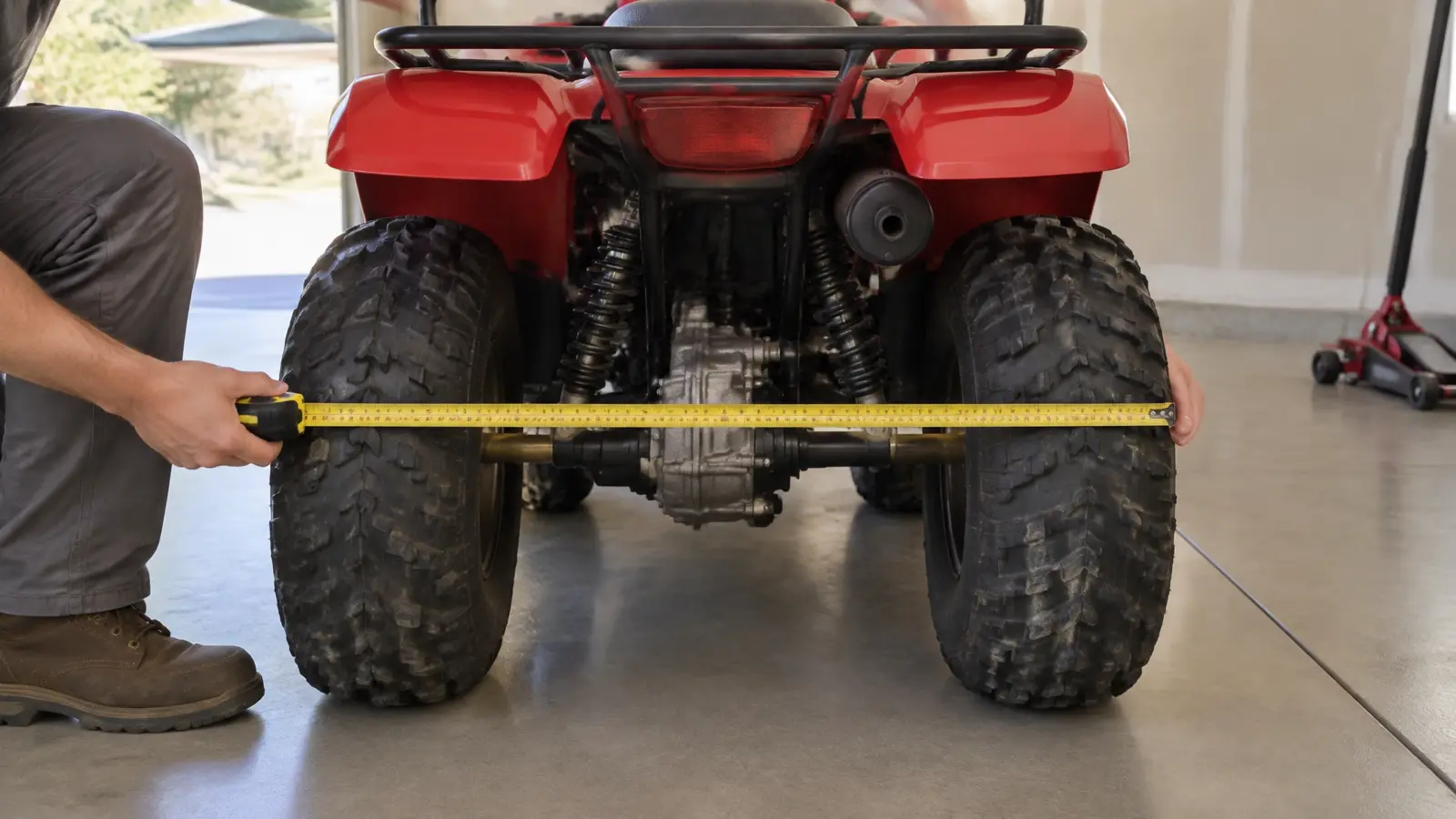
How to measure your machine
Grab a tape and write down four numbers. Then compare them with the motorcycle lift table dimensions on the spec sheet.
| Measurement | How to measure | Compare with | LMATV figure |
|---|---|---|---|
| Wheelbase | Axle center to axle center | Space between the front wheel chock and the rear of the deck | 86.5 in. (2,197 mm) platform; confirm chock spacing for long tourers |
| Width | Across the outside edges of the widest tires | Platform width | 29.5 in. (749 mm) center; 56.5 in. (1,435 mm) with side extensions |
| Weight | Curb weight plus accessories | Rated capacity | 2,200 lb (998 kg) |
| Ground clearance | Lowest point of the frame or exhaust | Lowered height and ramp length | 8 in. (203 mm) lowered; 45.5 in. (1,156 mm) center ramp |
Pro tip: measure tire edges, not fenders
On an ATV, measure across the outside sidewalls of the tires at their widest point. Racks and fenders can hang past the deck. Tires can't.
Worked example: a utility ATV
Honda lists the 2026 FourTrax Rancher 4x4 at 47.4 in. wide and 82.8 in. long overall. Both numbers fit inside the LMATV's 56.5 in. by 86.5 in. deck in ATV mode. Its 615 lb curb weight leaves plenty of capacity to spare.
Overall width includes fenders and racks, so the tire-edge width is narrower still. That's a comfortable fit. Run the same math on your own machine before you buy.
Side extensions and ATV mode
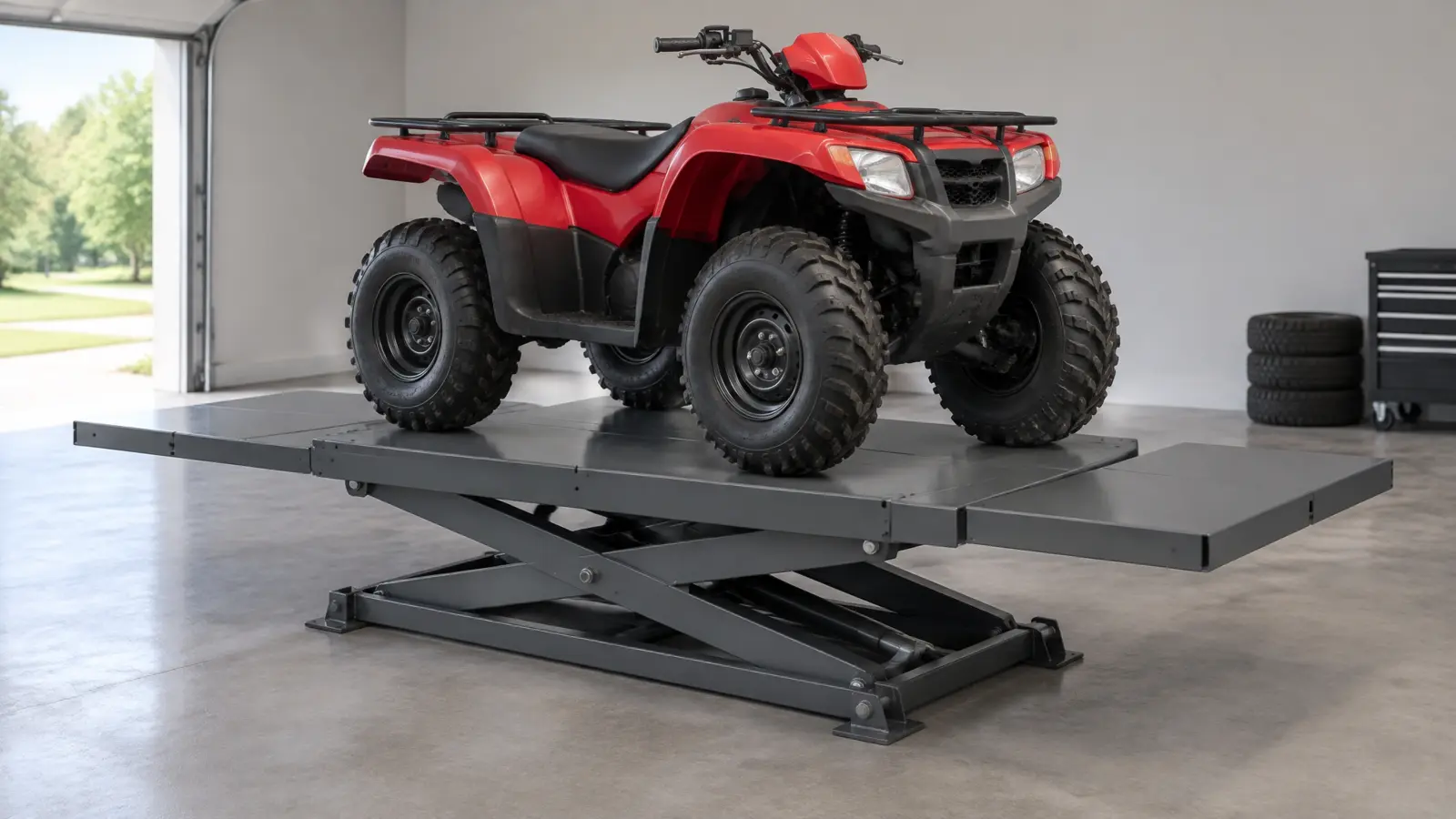
A motorcycle and ATV lift table usually has a narrow center deck plus removable side extensions. Take them off and you can stand right next to the bike. Put them on and you get a wide deck for four wheels.
The LMATV goes from a 29.5 in. (749 mm) center platform to 56.5 in. (1,435 mm) with its 13.5 in. (343 mm) side extensions. Its side ramps adjust for different ATV widths.
Side-by-sides and UTVs are a different story. Many are wider and heavier than ATV tables are built for. Check the spec sheet carefully, or compare the main types of vehicle lifts instead.
Which motorcycle lift table features matter most?
Start with the features that keep the bike secure. Then add the ones that save time on your most common jobs.
| Feature | What it does | Priority |
|---|---|---|
| Mechanical safety lock | Holds the deck at height without relying on air or hydraulic pressure | Must have |
| Wheel chock or vise | Holds the front wheel so the bike stands upright | Must have |
| Tie-down points | Anchor straps from the bike to the deck | Must have |
| Rear wheel drop-out | A removable panel lets the rear wheel hang free | High for tire and brake work |
| Front wheel drop-out | Same idea for the front wheel | Useful |
| Side extensions | Widen the deck for ATVs | Must have for ATV owners |
| Mobility kit | Wheels to reposition the lowered lift | Useful in shared garages |
| Center jack | Raises the frame off the deck to free both wheels | Useful for wheel and suspension work |
Wheel chock or wheel vise?
A motorcycle wheel chock cradles the front tire. A vise clamps it. The vise holds tighter, which helps when you work alone. Our LMATV includes a front wheel chock, with a front wheel vise (LPYON-056) available as an option.
Why a motorcycle lift with a drop-out saves time
With a drop-out, you remove the panel under a wheel and the wheel hangs free. You can pull the axle and lower the wheel without raising the whole bike. On tire and brake jobs, that adds up fast.
Not sure which table fits your bikes? Take your heaviest machine's weight, its tire width and your garage measurements to a local Daytona distributor. They quote, deliver and install, including single home-garage orders. Have a question first? Talk to our team.
Find a Daytona DistributorHow much floor space does a motorcycle lift table need?
Plan for the platform, the ramp, and room to walk and kneel all the way around. The deck is only part of your motorcycle lift table space requirements.
Start with the platform length and width from the spec sheet. Add the ramp in front and space behind to roll a wheel out. Leave room on both sides to kneel at the wheels with a tool cart nearby.
Mark the full footprint on the floor with painter's tape before you buy. Walk around it with the garage door closed and your car parked. If it feels tight on tape, it'll feel tighter with a bike on it.
Set the lift on a flat, level, sound concrete floor, indoors. Your lift's manual is the authority on floor condition and on whether, and how, to anchor it. Anchor requirements vary by model.
Plan the power and light, too. An electric table needs a suitable outlet within reach of its cord, without extension cords across the floor. Good overhead lighting matters more once the bike is up at eye level.
In a small garage, a lowered table can double as bike parking. If you plan to leave a bike raised, check overhead clearance for lights and the door track.
How do you use a motorcycle lift table safely?
Read the manual first. Then follow the same routine every time: load, secure, raise, lock, work, unlock, lower. Here's the checklist we'd tape to the garage wall.
- Check the weight. Confirm your loaded machine is well under the rated capacity.
- Clear the area. Move tools, cords, kids and pets away from the deck before it moves.
- Center the bike. Roll it straight up the ramp and seat the front wheel in the chock or vise.
- Strap it down. Run tie-down straps from both sides of the bike to the deck's tie-down points, pulled snug.
- Raise, then lock. Set the mechanical safety lock before you start work. Never work beside a deck held up by air or hydraulic pressure alone.
- Watch the balance. Pulling a wheel or a heavy part shifts the weight. Recheck straps and support as you go.
- Lower with care. Clear your tools, release the lock as the manual describes, and keep feet clear.
Many of the same habits apply to any lift. Our guide on how to use a car lift safely covers training, daily checks and annual inspection.
Safety note: indoor use only
Daytona equipment is built and warrantied for indoor use. Outdoor use, overloading and modifications void the warranty. Never use a lift for anything its manual doesn't cover.
How do you look after a motorcycle lift table?
A few minutes of checks keeps a lift table working smoothly for years. Your manual sets the schedule and the fluids. These are the habits worth building.
- Before each use. Look for hydraulic leaks, check that the safety lock engages cleanly, and inspect straps for fraying or cuts.
- Keep the deck clean. Wipe up oil, coolant and brake fluid right away. A slick deck makes loading harder.
- Check the fluid. On hydraulic tables, check the fluid level and use only the type the manual specifies.
- Replace worn parts. Straps, rubber pads and hoses wear out with use. Replace them before they fail.
- Stop if something changes. If the deck drifts, jerks or makes a new noise, stop using it and contact your distributor.
One warranty detail to know: wearing parts such as hoses, chains and rubber pads aren't covered under Daytona's warranty. Electronic parts are excluded too. Regular care is the best way to protect them.
What mistakes do buyers make with motorcycle lift tables?
Most regrets come from five avoidable mistakes. Each one is easy to catch with a tape measure and a spec sheet.
- Sizing to dry weight. The real load includes fluids, fuel and every accessory.
- Buying too short. A low maximum height saves little money and keeps you bending on every job.
- Forgetting the compressor. An air table without a capable compressor is a very heavy bench.
- Measuring the wrong thing. Fenders and handlebars don't matter for fit. Tire edges and wheelbase do.
- Skipping the footprint. The ramp and working space can double the floor area you need.
How does the Daytona LMATV stack up on the WHEEL check?
The LMATV 2,200 lb motorcycle and ATV lift is our electric-hydraulic table for riders who work on both bikes and ATVs. Here's how it scores on each point.
| WHEEL point | LMATV spec | What it means for you |
|---|---|---|
| Weight | 2,200 lb (998 kg) rated capacity | Capacity headroom for a dressed touring bike or a utility ATV with gear |
| Height | 48 in. (1,219 mm) raised; 8 in. (203 mm) lowered | Standing work height, low deck for loading |
| Envelope | 86.5 in. (2,197 mm) long; 29.5 in. (749 mm) center, 56.5 in. (1,435 mm) with extensions | One lift for bikes and ATVs |
| Energy | Electric-hydraulic, 120V / 1HP / 8A / 1PH / 60Hz | No compressor; two-button pendant control |
| Locks and hold | Front wheel chock included; front wheel vise (LPYON-056) optional | An upright, secure bike for solo work |
| Extras | Center front and rear drop-outs, adjustable side ramps, mobility kit, optional 1,100 lb (499 kg) center mini jack (LPYON-057) | Faster wheel, tire and brake jobs |
It's backed by our 5-2-1 warranty: 5 years structural, 2 years on power units and 1 year on parts. Electronic and wearing parts are excluded, and coverage applies to indoor use only.
When isn't it the right fit? If your machine is wider than 56.5 in. at the tires, or too heavy to leave headroom under 2,200 lb, you need a different lift. For long-wheelbase tourers, have your distributor confirm the wheelbase fits between the chock and the rear of the deck.
What else does a powersports service bay need?
A lift gets the bike up. Tire and wheel equipment finishes the job. If you do your own tires, pairing the table with a changer and a balancer saves trips to the dealer.
Our TC-806M motorcycle tire changer uses dedicated motorcycle clamping for rims from 6 to 24 in. and rim widths from 3 to 12 in.
The BL-630M motorcycle wheel balancer handles wheels up to 31 in. (787 mm) in diameter, with a 1 to 25 in. rim range.
Here's how the three work together. Raise the bike and drop the rear wheel out on the lift. Break the bead and mount the new tire on the changer. Balance the wheel, then reinstall it while the bike is still at standing height.
For heavier car and light-truck work, browse our full tire changer and balancer lineup.
What drives the cost of a motorcycle lift table?
Capacity, lift height, power type and included accessories drive most of the price difference. We don't list prices because Daytona lifts are sold through distributors on a quote basis.
- Capacity and build. Higher ratings call for heavier steel and larger cylinders.
- Power type. Electric-hydraulic tables include their own power unit. Air tables rely on a compressor you may also need to buy.
- Lift height. A taller lift range needs more structure.
- Accessories. Vises, side extensions, jacks and drop-outs add cost, but they save time on every job.
- Freight and setup. A lift table is heavy freight. Our LMATV ships at 720 lb (327 kg) with standard accessories.
Compare the full cost, not just the lift price. A cheaper air table plus a new compressor can cost more than an electric-hydraulic table that plugs straight in.
Third-party financing is available in the US and Canada, and approval is not guaranteed. See how lift financing works before you request a quote.
Planning a car lift for the same garage? Our car lift cost guide covers planning ranges for 2-post, 4-post and scissor lifts in 2026.
What should you check before buying a motorcycle lift table?
Answer these ten questions before you request a quote. Bring the answers to your distributor and you'll get a faster, more accurate recommendation.
Before-you-buy checklist
- What is my heaviest machine's curb weight plus accessories?
- What is the widest tire-edge width I will ever lift?
- What is the longest wheelbase in my garage?
- How much ground clearance does my lowest bike have?
- Do I own a capable compressor, or do I have a suitable outlet near the spot?
- Have I taped out the deck, ramp and working space on the floor?
- Is the floor flat, level, sound concrete, and indoors?
- Which jobs do I do most: tires, brakes, chain, suspension or engine?
- Do I need a vise, drop-outs, side extensions or a center jack?
- Who will deliver it, set it up and support it after the sale?
Build a garage you're proud of
Tell your local Daytona distributor about your heaviest machine, its tire width and your garage measurements. They will recommend a model, quote it and install it. Have a question first? Talk to our team.
- LMATV. 2,200 lb (998 kg), 48 in. lift height, 120V electric-hydraulic.
- 5-2-1 warranty. 5 years structural, 2 on power units, 1 on parts. Indoor use only.
- Since 1999. Canadian owned, serving the US and Canada.
About the author

The Daytona Team
Written by the team at Daytona Automotive Equipment, a Canadian-owned manufacturer of automotive lifts, tire changers and wheel service equipment since 1999.
- Specializations. Motorcycle and ATV lift tables, motorcycle tire changers and wheel balancers for home garages and shops.
- Product data. Specifications drawn from current Daytona product pages and manuals.
- Reviewed by. Daytona product and technical support staff, October 2026.
Daytona Automotive Equipment Inc. · Brighton, ON, Canada · Automotive lifts, tire changers and wheel service equipment since 1999.
References and sources
- Harley-Davidson. 2026 Road Glide Limited specifications. Harley-Davidson Motor Company, 2026.
- Honda Powersports. 2026 Gold Wing Tour specifications. American Honda Motor Co., 2026.
- Honda News. 2026 Honda Gold Wing specifications. American Honda Motor Co., 2026.
- Honda Powersports. 2026 FourTrax Rancher 4x4 specifications. American Honda Motor Co., 2026.
- Honda Powersports. 2026 Rebel 500 specifications. American Honda Motor Co., 2026.
- Honda Powersports. 2026 CRF450R specifications. American Honda Motor Co., 2026.
- U.S. Bureau of Labor Statistics. Occupational injuries and illnesses: automotive service technicians and mechanics, 2016 to 2020. BLS, February 2022.
- Occupational Safety and Health Administration. Ergonomics: identify problems. U.S. Department of Labor.
Figures in this article are representative for planning and are not quotations. Vehicle weights and dimensions are manufacturer figures and may change. Confirm requirements against the manual for your specific lift before purchase or installation. Daytona Automotive Equipment is not affiliated with Harbor Freight's Daytona tool brand.