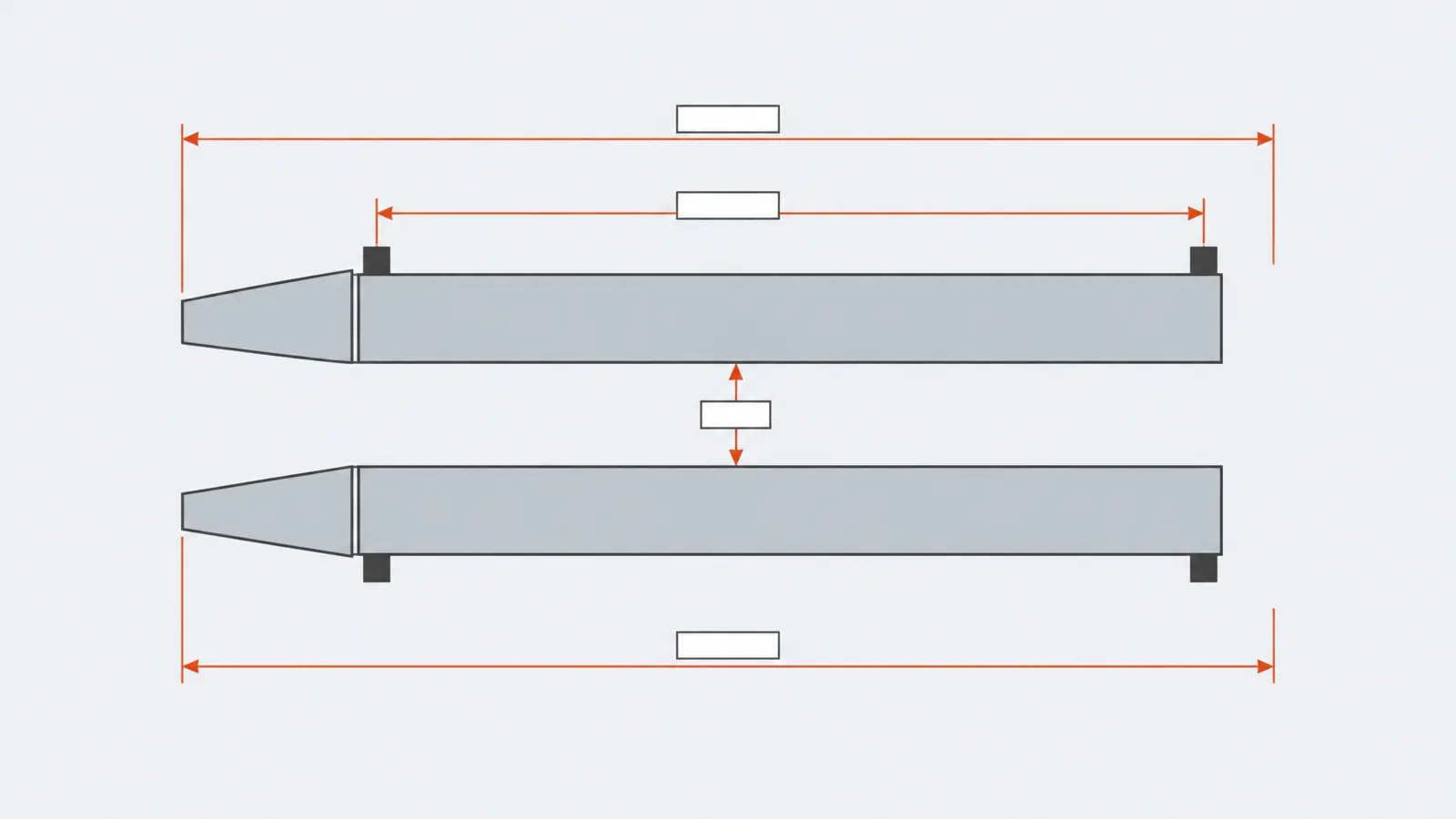
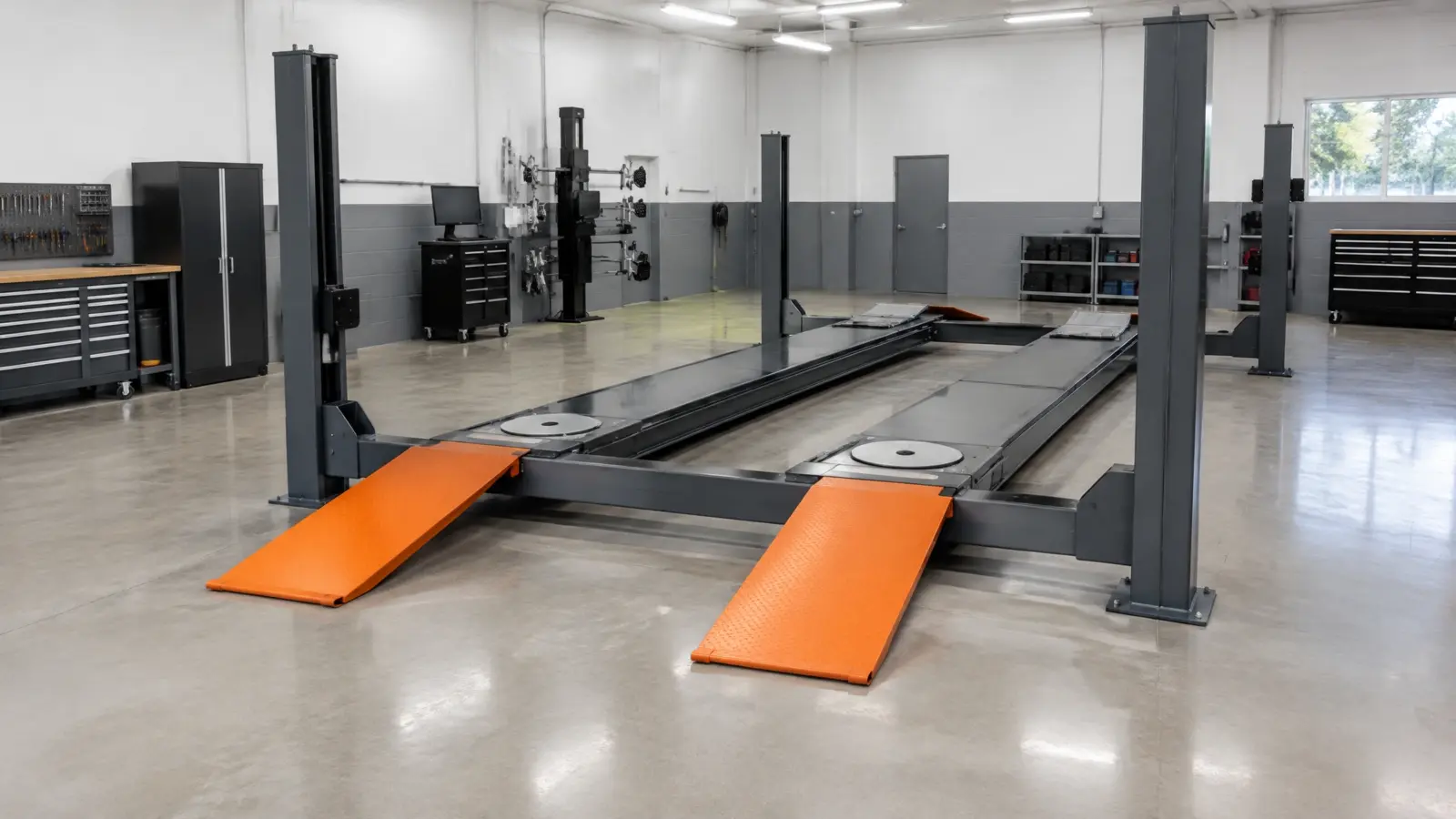
In general, 4 post lift dimensions fall into two size classes. Daytona storage lifts run about 15 to 20.5 ft long (4.6 to 6.2 m) and 8 ft 8 in. to 10 ft 2 in. wide. Alignment lifts run about 19.7 to 27.5 ft long and 12 to 13 ft wide.
For height, the most important number is the clearance under the runway. To stack two vehicles, add that clearance, the runway deck, the top vehicle's height and a safety margin. Then compare the total with the lowest point on your ceiling.
Last, add floor room around the lift for a straight approach and space to walk. A 4 post lift needs more floor than a 2 post lift, but less ceiling height for service work.
You've picked the kind of lift you want. Now comes the question that decides everything: will it actually fit? Spec sheets list a dozen numbers. Only four of them decide whether a 4 post lift works in your space.
This guide lays out the full 4 post lift dimensions for every current Daytona 4 post lift, in inches and millimeters. Then it shows you how to test those numbers against your room. We checked every figure against Daytona's published product specs in October 2026.
Key takeaways
- Daytona storage 4 post lifts measure 179.7 to 245 in. long and 104.1 to 122 in. wide.
- Daytona alignment 4 post lifts measure 236.5 to 330.5 in. long and 143.5 to 155.1 in. wide.
- Overall width includes the posts. Inside width limits how wide a vehicle can drive on or park under.
- Clearance under the runway decides stacking. Post height rarely decides anything.
- Measure to the lowest obstruction: the garage door, its track, the opener or a light.
- Run the 4 + 4 fit test below before you request a quote.
- Concrete, anchoring and wiring follow your lift's manual, a qualified installer and a licensed electrician.
What are standard 4 post lift dimensions?
A typical 4 post storage lift is about 15 to 20 ft long, 8.5 to 10 ft wide and 7.5 to 9 ft tall, with about 6 to 7 ft of clearance under the runway. Alignment lifts are wider and longer, at about 12 to 13 ft wide and up to 27.5 ft long. The table below uses Daytona's published ranges.
| Dimension | Storage or parking 4 post | Alignment 4 post |
|---|---|---|
| Overall length | 179.7 to 245 in. (4,565 to 6,224 mm) | 236.5 to 330.5 in. (6,007 to 8,395 mm) |
| Overall width | 104.1 to 122 in. (2,644 to 3,100 mm) | 143.5 to 155.1 in. (3,645 to 3,940 mm) |
| Overall height | 91.3 to 105.2 in. (2,320 to 2,672 mm) | 87.9 to 101 in. (2,233 to 2,565 mm) |
| Clearance under runway | 70.9 to 85 in. (1,801 to 2,159 mm) | 69 to 69.3 in. (1,753 to 1,760 mm) |
| Runway width | 18.6 to 19.3 in. (472 to 490 mm) | 25.5 to 25.6 in. (648 to 650 mm) |
| Runway length | 164.2 to 196.9 in. (4,171 to 5,001 mm) | 217.25 to 284.6 in. (5,518 to 7,229 mm) |
| Power | 120V, 1.5HP, 26A, single phase | 240V, 4HP, 15A, single phase |
Overall length vs runway length: which one do you plan around?
Plan around overall length. It runs from the outside of the front post bases to the outside of the rear ones. Runway length is the deck your tires sit on, and it tells you the longest wheelbase the lift can carry.
Approach ramps can add length too. Check whether the spec you're reading includes them, and ask your distributor if the sheet doesn't say.
How wide is a 4 post lift, and what is inside width?
Overall width is the outside of one post to the outside of the other. That's what has to fit between your walls. Inside width, sometimes called drive-through clearance, is the gap between the posts or crossbeam ends. It sets the widest wheel track you can drive onto the runways, and the widest vehicle you can park underneath.
Here's a useful bit of math from our published specs. On the LFPA14 and LFPA24, the 43.7 in. inner width plus two 25.6 in. runways spans about 94.9 in. from outer runway edge to outer runway edge. Your tires need to land inside that span.
Overall height vs clearance under the runway
Overall height is the top of the posts. Clearance under the runway is the open space beneath the raised deck at full lock height. For storage, the second number decides whether your lower vehicle fits. It also feeds the ceiling math later in this guide.
Daytona 4 post lift dimensions, model by model
Use this table as your starting point. These are the real 4 post car lift dimensions from our current spec pages, so you can compare models without digging through brochures.
| Model | Type and capacity | Overall length | Overall width | Overall height | Clearance under runway | Runway (W x L) |
|---|---|---|---|---|---|---|
| LFPP9 | Parking, 9,000 lb | 179.7 in. (4,565 mm) | 104.1 in. (2,644 mm) | 91.3 in. (2,320 mm) | 70.9 in. (1,801 mm) | 19.3 x 164.2 in. |
| LFPP10 | Parking, 10,000 lb | 197.6 in. (5,019 mm) with ramps | 122.03 in. (3,100 mm) | 98.31 in. (2,497 mm) | 79.5 in. (2,019 mm) | Ask your distributor |
| LFPP10-XLT | Parking, extra long and tall, 10,000 lb | 245.0 in. (6,224 mm) | 122.0 in. (3,099 mm) | 105.2 in. (2,672 mm) | 85.0 in. (2,159 mm) | 18.6 x 196.9 in. |
| LFPA12 | Alignment, 12,000 lb | 236.5 in. (6,007 mm) | 143.5 in. (3,645 mm) | 101 in. (2,565 mm) | 69 in. (1,753 mm) | 25.5 x 217.25 in. |
| LFPA14 | Alignment, 14,000 lb | 268.7 in. (6,825 mm) | 153.9 in. (3,909 mm) | 94.3 in. (2,395 mm) | 69.3 in. (1,760 mm) | 25.6 x 247.5 in. |
| LFPA24 | Alignment, 24,000 lb | 330.5 in. (8,395 mm) | 155.1 in. (3,940 mm) | 87.9 in. (2,233 mm) | 69.3 in. (1,760 mm) | 25.6 x 284.6 in. |
4 post lift dimensions in feet
Most garage tape measures read in feet, so here's the same data converted. Use these numbers when you mark out your floor.
| Model | Length | Width | Height | Clearance under runway |
|---|---|---|---|---|
| LFPP9 | 14 ft 11.5 in. | 8 ft 8 in. | 7 ft 7.5 in. | 5 ft 11 in. |
| LFPP10 | 16 ft 5.5 in. | 10 ft 2 in. | 8 ft 2.5 in. | 6 ft 7.5 in. |
| LFPP10-XLT | 20 ft 5 in. | 10 ft 2 in. | 8 ft 9 in. | 7 ft 1 in. |
| LFPA12 | 19 ft 8.5 in. | 11 ft 11.5 in. | 8 ft 5 in. | 5 ft 9 in. |
| LFPA14 | 22 ft 4.5 in. | 12 ft 10 in. | 7 ft 10.5 in. | 5 ft 9.5 in. |
| LFPA24 | 27 ft 6.5 in. | 12 ft 11 in. | 7 ft 4 in. | 5 ft 9.5 in. |
For most home garages, the 9,000 lb LFPP9 is the compact choice. At just under 15 ft long and under 9 ft wide, it's the smallest 4 post footprint we make.
The LFPP10 parking lift adds capacity for heavier vehicles. It measures 197.6 in. long with ramps and 122 in. wide, with 79.5 in. of clearance under the runway.
Need more height or a longer wheelbase? The extra tall LFPP10-XLT gives you 85 in. under the runway. That's 14.1 in. more than the LFPP9, and it's the reason to choose it for a tall SUV or pickup on the bottom.
You can compare all three on our 4 post parking lifts page. The 35,000 lb LFPA35 is coming soon, and we'll add its dimensions once they're published.
How much room do you need for a 4 post lift?
You need the lift's overall footprint, plus a straight approach to drive on and room to walk around it. That's the short version of 4 post lift space requirements. The long version is a simple test we call the 4 + 4 fit test: four lift numbers checked against four room numbers.
| Lift number | Room number to measure | It passes when |
|---|---|---|
| Overall length | Clear floor depth, door to back wall or bench | Depth covers the lift length, a straight approach and a walkway at the far end. |
| Overall width | Clear floor width between walls, posts or parked cars | Width covers the lift plus walking room on every side you use. |
| Overall height | Lowest fixed obstruction over the footprint | The tops of the posts sit below it. |
| Clearance under runway plus top vehicle | Lowest obstruction with the door open | The full stack height plus your safety margin fits underneath it. |
Pro tip: tape it out first
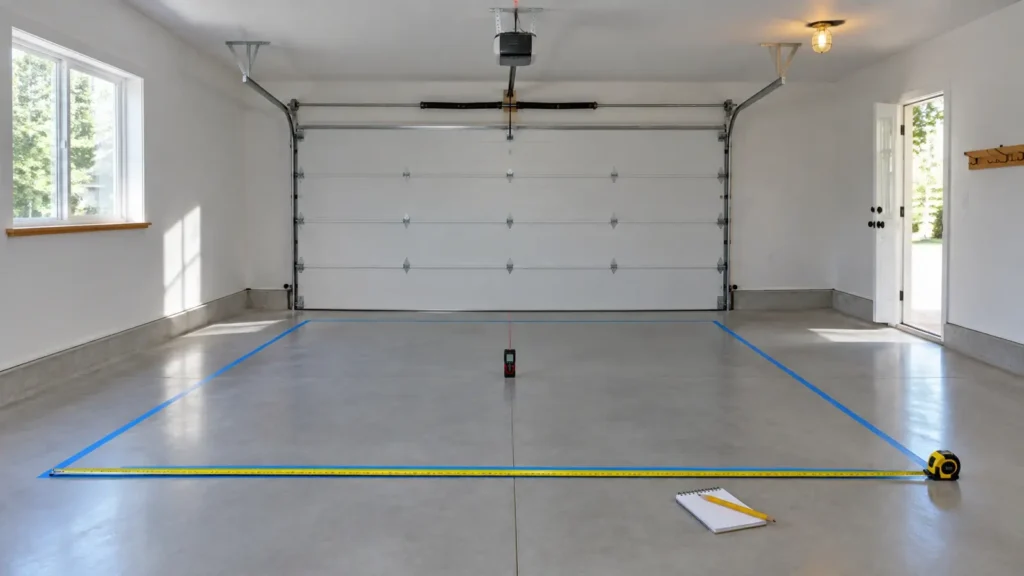
Mark the lift's overall length and width on the floor with painter's tape. Then park your car inside the rectangle, open every door and walk around it. Ten minutes with a roll of tape will tell you more than an hour with a spec sheet.
Approach and ramps
You drive onto a 4 post lift, so the vehicle needs to line up straight before it hits the ramps. In plain English: don't plan the lift tight against the garage door. We suggest at least one full vehicle length of straight run in front of the ramps. That keeps you from loading the lift at an angle.
Walkways, doors and storage
A lift that technically fits but blocks the side door or the freezer gets old fast. We recommend about 3 ft (0.9 m) of walking room on any side you use often. Check car doors too: a vehicle on the lower level has to open its doors between the posts.
Common mistake: measuring to the ceiling
Your ceiling height is the height of the lowest thing above the lift, not the drywall. That's usually the open garage door, its track or the opener rail. Lights, heaters and beams count too.
How to measure your garage for a 4 post lift
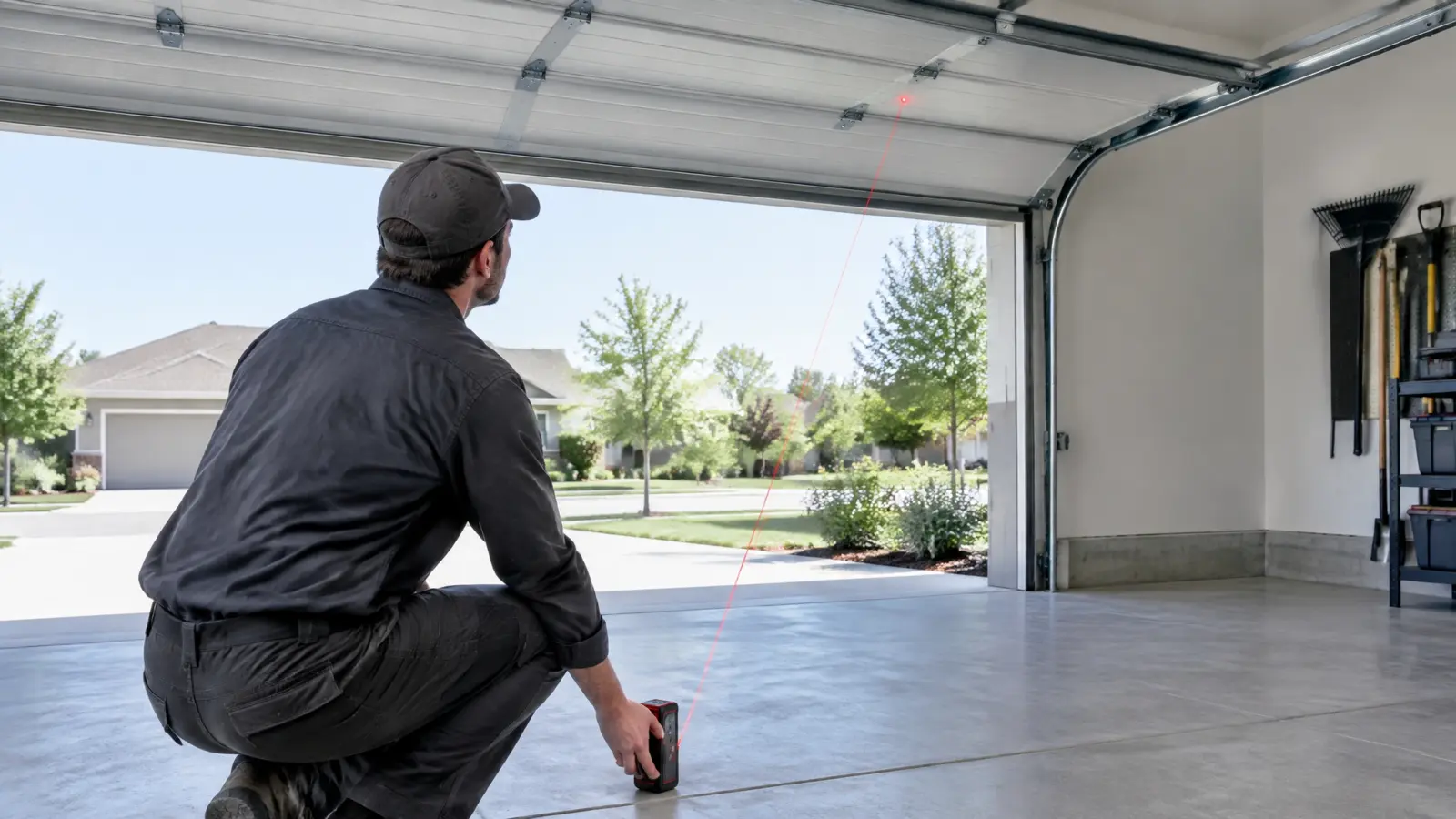
Take these measurements in this order and write each one down. They're the room numbers you'll need for the fit test above.
- Measure clear floor depth from the garage door opening to the back wall, bench or anything fixed.
- Measure clear floor width between the walls, or between a wall and where your other car parks.
- Open the garage door fully. Measure from the floor to the lowest point of the door, its track or the opener rail.
- Look for lights, heaters, beams and pipes over the lift area, and measure to the lowest one.
- Measure the height of each vehicle you plan to lift or park, including antennas, racks and light bars.
- Note where your outlets and electrical panel sit, so your electrician can plan the circuit.
Can a 4 post lift fit in a 2-car garage?
Often, yes. The LFPP9 is 104.1 in. wide, so it uses about 8 ft 8 in. of floor width. In a garage around 20 ft wide, that leaves room for a second car or a workbench beside it.
Depth is usually the tighter number. At 179.7 in., the LFPP9 needs about 15 ft of floor before you add approach and walking room. Measure yours rather than assuming a standard size, because garages vary a lot. The fit test above will tell you in minutes.
What ceiling height do you need for a 4 post lift?
For service work only, you need the lift's overall height plus clearance for whatever you raise. For stacking two vehicles, use this formula:
Ceiling needed = clearance under runway + runway deck thickness + top vehicle height + safety margin.
Runway deck thickness comes from your lift's manual. For the margin, we plan for at least 6 in. (150 mm) of air above the top vehicle's roof. Antennas, roof racks and light bars all count as roof.
Worked example: LFPP9 vs LFPP10-XLT
Here's the math for a 58 in. tall sedan on top. We assume a 5 in. deck for illustration only. Swap in your vehicle's height and the deck figure from your manual.
| Item | LFPP9 | LFPP10-XLT |
|---|---|---|
| Clearance under runway | 70.9 in. | 85.0 in. |
| Runway deck (assumed) | 5 in. | 5 in. |
| Top vehicle height (example) | 58 in. | 58 in. |
| Safety margin | 6 in. | 6 in. |
| Ceiling needed | 139.9 in. (about 11 ft 8 in., 3,553 mm) | 154 in. (about 12 ft 10 in., 3,912 mm) |
| Bottom vehicle must be under | 70.9 in., less your margin | 85.0 in., less your margin |
The bottom row is the one people forget. Most crossovers fit under 70.9 in. A lifted pickup or a tall van often won't. If your bottom vehicle is tall, the XLT is the safer bet, and it's worth the extra 14 in. of ceiling.
Our take: post height is the least useful height number
Buyers often compare post heights first. We don't. Every Daytona 4 post lift stands under 9 ft tall, so the posts rarely decide the fit. The stack height does. Start with clearance under the runway and your vehicles, then check post height last.
Working under the lift is a separate question. At 69 to 69.3 in. of clearance on our alignment lifts, a technician about 5 ft 9 in. or taller will need to duck or use a creeper. Follow ALI's guidance on how to use a car lift safely whenever you work under a raised vehicle.
Not sure what fits? Take your floor measurements, your lowest-obstruction height and the vehicles you plan to lift to a local Daytona distributor. They quote, deliver and install, including single home-garage orders. Have a question first? Talk to our team.
Find a Daytona DistributorHow are 4 post alignment lift dimensions different?
Alignment lifts are built wider and longer, and the difference is big. Our alignment models are 39.4 to 51 in. wider than the LFPP9, and up to 150.8 in. longer. So a shop bay that fits a storage lift can still fall short for alignment.
The wider runways (25.5 to 25.6 in.) leave room for the built-in slip plates and turntables, and the LFPA24 is built to fit dual rear wheel trucks. The LFPA12 is the shortest at 236.5 in. overall.
Fleet bays usually step up. The 14,000 lb LFPA14 runs 268.7 in. long. The 24,000 lb LFPA24 runs 330.5 in., which is about 27.5 ft before approach room.
Two more space items to plan for: the alignment machine and the rolling jack. Both are sold separately from the lift. The aligner's footprint comes from its maker, so leave room for the console and cameras in front of the bay. See all models on our alignment lifts page.
What else should you check before you place a 4 post lift?
Concrete and anchoring
Your slab has to suit the lift and the loads it carries. Requirements vary by model, so follow the installation manual and have a qualified professional check the floor, especially a post-tension slab. Our slab thickness guide explains how to assess concrete before any lift install.
Anchoring rules also come from the manual, not from rules of thumb. ALI's ANSI/ALI ALIS standard covers installation and service, and it expects a qualified installer to do the work.
Power
Our parking lifts run on 120V, 1.5HP, 26A, single phase. Our alignment lifts need 240V, 4HP, 15A, single phase. Have a licensed electrician confirm your circuit before install day, and leave the wiring to them.
Rolling jacks
Want wheels-free work on a parking lift? The RAJ5 rolling jack and RAJ6 are made for our 9K and 10K parking lifts. On alignment lifts, the RAJ8 fits the LFPA12 and LFPA14, and the RAJ12 fits the LFPA24.
Warning: fit and location limits
Daytona rolling jacks are designed for Daytona lifts and may not fit other brands. All Daytona equipment is for indoor use only. Outdoor installation voids the 5-2-1 warranty.
How does a 4 post lift footprint compare with a 2 post lift?
A 4 post lift trades floor for ceiling. It takes up more of the floor, but service work needs less height, and it's the lift you want for storage and alignment.
A 2 post lift is the opposite. It's compact on the floor, but overhead models need a tall ceiling. Our guide to 2 post lift dimensions has the same model-by-model breakdown. If you're still choosing between the two types, our 2 post vs 4 post comparison covers use, cost and safety.
Bottom line for 2026: if storage or alignment is the job, measure for a 4 post lift first. If the job is repair and the ceiling allows it, look at a 2 post lift.
Build a garage you're proud of
Tell your local Daytona distributor your floor measurements, your lowest-obstruction height and the vehicles you want to lift. They'll recommend a model, quote it and install it. Have a question first? Ask the Daytona team.
- LFPP9. 9,000 lb parking lift, 70.9 in. under the runway, 120V power.
- 5-2-1 warranty. 5 years structural, 2 on power units, 1 on parts. Indoor use only.
- Since 1999. Canadian owned, serving the US and Canada.
About the author

The Daytona Team
Written by the team at Daytona Automotive Equipment, a Canadian-owned manufacturer of automotive lifts, tire changers and wheel service equipment since 1999.
- Specializations. 4 post parking and alignment lifts, 2 post lifts, scissor lifts, tire changers and wheel balancers.
- Standards. Guidance aligned to ANSI/ALI ALIS installation practice and ANSI/ALI ALOIM operation, inspection and maintenance practice.
- Reviewed by. Daytona product and technical support staff, October 2026.
Daytona Automotive Equipment Inc. · Brighton, ON, Canada · Automotive lifts, tire changers and wheel service equipment since 1999.
References and sources
- Daytona Automotive Equipment. Product specification pages for the LFPP9, LFPP10, LFPP10-XLT, LFPA12, LFPA14 and LFPA24. Daytona Automotive Equipment, checked October 2026.
- Automotive Lift Institute. ANSI/ALI ALIS: Safety Requirements for Installation and Service of Automotive Lifts. ALI, current edition.
- Automotive Lift Institute. How to Safely Use a Car Lift or Truck Lift. ALI, accessed October 2026.
- Automotive Lift Institute. Lift Certification FAQ. ALI, accessed October 2026.
Figures in this article are representative for planning and are not quotations. Confirm requirements against the installation manual for your specific lift before purchase or installation. Daytona Automotive Equipment is not affiliated with Harbor Freight's Daytona tool brand.