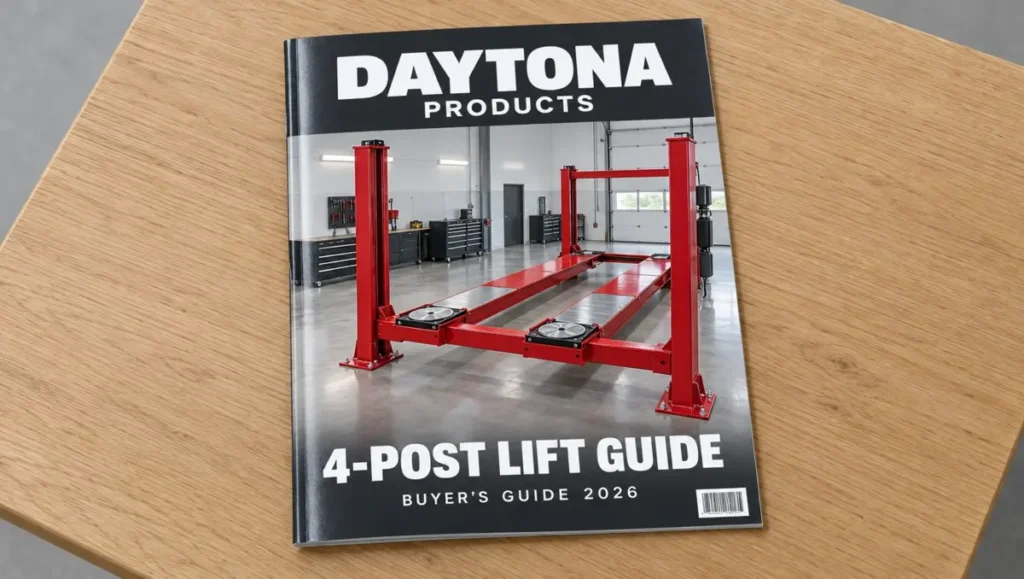
A 4 post car lift elevates vehicles by their tires on dual steel runways supported by four outer columns, making it the safest drive-on platform for home garage double-stacking and commercial wheel alignments. Daytona builds seven 4-post car lifts: 9,000 lb to 10,000 lb parking lifts (LFPP9, LFPP10, LFPP10-XLT) and 12,000 lb to 35,000 lb alignment racks (LFPA12–LFPA35).
Choosing a 4 post car lift solely by its weight rating can leave you with runways too short for a crew-cab truck, crossbeams that strike overhead garage door tracks or a 16-foot steel crate that a residential delivery truck cannot unload. Whether you are sizing a 4 post car lift for home garage storage or outfitting a commercial alignment bay, the right model depends on under-runway clearance, bay length, slab thickness and electrical supply.
Key takeaways
- Three home & prosumer parking models. Choose the 9,000 lb (4,082 kg) LFPP9 for sports cars and sedans, the 10,000 lb (4,536 kg) LFPP10 for heavier coupes and crossovers, or the 10,000 lb extra-tall LFPP10-XLT for pickups and tall SUVs.
- Four commercial alignment models. The LFPA12 (12,000 lb), LFPA14 (14,000 lb dually/EV), LFPA24 (24,000 lb) and LFPA35 (35,000 lb) integrate rear ball-bearing slip plates, front turntable pockets and pneumatic air locks.
- Standard vs extra-tall clearance. The LFPP9 provides 70.9 in. (1,800 mm) of under-runway headroom, while the LFPP10-XLT delivers 85.0 in. (2,159 mm) of clearance.
- Wheels-free service. Adding air-over-hydraulic rolling bridge jacks (RAJ5, RAJ6, RAJ8 or RAJ12) lifts all four tires off the tracks for brake, tire and suspension work.
- Certification status. All seven Daytona 4-post models are standard non-certified lifts; our 10,000 lb 2-post overhead BR10-2OH-33 is Daytona’s sole ALI Certified model (confirmed September 2026).
- 5-2-1 North American warranty. Covered for 5 years structural, 2 years power units and 1 year parts (indoor use only), with warranty parts freight included across Canada and the continental US.
How do all 7 Daytona 4-post car lift models compare?
Daytona’s 4-post lineup is divided into the LFPP series (9,000 lb to 10,000 lb flat-runway lifts for home storage, collector garages and DIY service) and the LFPA series (12,000 lb to 35,000 lb commercial alignment racks with built-in rear slip plates and front turnplate pockets). Compare all seven models side by side below.
| Model SKU | Rated capacity | Application & deck type | Max clearance / rise class | Lock release & safety locks | Power unit spec | Matching bridge jack |
|---|---|---|---|---|---|---|
| LFPP9 | 9,000 lb (4,082 kg) | Home garage & collector parking lift · Flat steel runways | 70.9 in. (1,800 mm) max under-runway clearance | Single-point manual release · Primary + secondary slack-cable locks | 120V / 1.5HP / 1PH / 60Hz | RAJ5 (5,000 lb) |
| LFPP10 | 10,000 lb (4,536 kg) | Heavy home garage & prosumer parking/service lift · Flat runways | Standard-rise wider & heavier-duty 10K platform | Single-point manual release · Primary + secondary slack-cable locks | Single-phase (see data plate) | RAJ5 (5K) or RAJ6 (6K) |
| LFPP10-XLT | 10,000 lb (4,536 kg) | Extra-long & extra-tall pickup/SUV storage & service lift | 85.0 in. (2,159 mm) extra-tall under-runway clearance | Single-point manual release · Primary + secondary slack-cable locks | Single-phase (see data plate) | RAJ5 (5K) or RAJ6 (6K) |
| LFPA12 | 12,000 lb (5,443 kg) | Commercial 4-wheel alignment lift · Rear slip plates & front pockets | Commercial alignment working height with leveling lock ladders | Pneumatic air-lock release · Multi-position leveling locks | 240V single-phase commercial | RAJ6 (6,000 lb) |
| LFPA14 | 14,000 lb (6,350 kg) | Dually pickup, EV & commercial alignment lift · Slip plates included | Full-rise commercial alignment deck for wide track widths | Pneumatic air-lock release · Primary + secondary mechanical locks | 240V single-phase commercial | RAJ8 (8,000 lb) |
| LFPA24 | 24,000 lb (10,886 kg) | Medium-duty commercial truck & fleet alignment lift | Heavy-duty fleet service & alignment runway geometry | Pneumatic air-lock release · Heavy-duty multi-stage locks | Commercial power (see manual) | RAJ12 (12,000 lb) |
| LFPA35 | 35,000 lb (15,876 kg) | Heavy-duty commercial fleet & Class 7 truck alignment lift | Maximum-tonnage 4-post commercial fleet runway system | Pneumatic air-lock release · Heavy-duty dual lock architecture | Commercial 3-phase / heavy feed | RAJ12 (12,000 lb) |
4 post car lift for home garage vs. commercial alignment bays: which fits your shop?
Select an LFPP parking lift (9,000 lb to 10,000 lb) when you want fast drive-on storage, drip protection and weekend DIY service in a residential garage, and select an LFPA alignment rack (12,000 lb to 35,000 lb) when your business performs four-wheel optical alignments or services heavy commercial fleets.
9000 lb 4 post lift vs. 10000 lb 4 post lift for home garages (LFPP9, LFPP10, LFPP10-XLT)
In a residential bay, drive-on convenience and lower-vehicle protection matter most. Unlike a two-post hoist where you kneel on the slab to align four swing arms under chassis pinch welds, a four-post platform lets you drive straight onto the steel runways. Our 9000 lb 4 post lift (LFPP9) operates on standard 120V / 1.5HP / 1PH / 60Hz household power and ships with removable poly drip trays, a steel jack/tool tray and lightweight removable aluminum approach ramps.
If your collection includes heavy classic muscle cars, full-size luxury sedans, battery-electric crossovers or half-ton pickups, stepping up to a 10000 lb 4 post lift (LFPP10 or the extra-long, extra-tall LFPP10-XLT) provides extra structural capacity, wider drive-thru clearance and longer runway footprints. If your bay is too narrow for four outer columns and you strictly need vertical parking, see how our 4-post series compares against the 6,000 lb (2,722 kg) LTPP6 stacker in our car storage lift: 4-post vs 2-post parking lift guide.
Commercial 4-wheel alignment & fleet bays (LFPA12, LFPA14, LFPA24, LFPA35)
Flat-deck storage lifts cannot perform accurate four-wheel alignments because the tires bind against the steel deck when camber, caster and toe are adjusted. The commercial LFPA12, LFPA14 (engineered with wide runways for dual-rear-wheel dually pickups and heavy EVs), LFPA24 and LFPA35 feature recessed front pockets for radius turntables and integrated full-floating rear ball-bearing slip plates. Precision-machined lock ladders keep the runways dead-level from side to side and front to back at every locking height so 3D alignment cameras read accurately. Explore bay layouts and payback math in our 4-post alignment lift guide.
How much ceiling height do you need for a standard or extra tall 4 post lift?
To find your minimum required garage ceiling height, add the bottom vehicle height, top vehicle height, 5 in. for steel runway deck thickness, 2.5 in. of vertical rise to disengage the mechanical safety locks and a 4 in. overhead buffer below lights and garage door tracks (Combined Vehicle Heights + 11.5 in.).
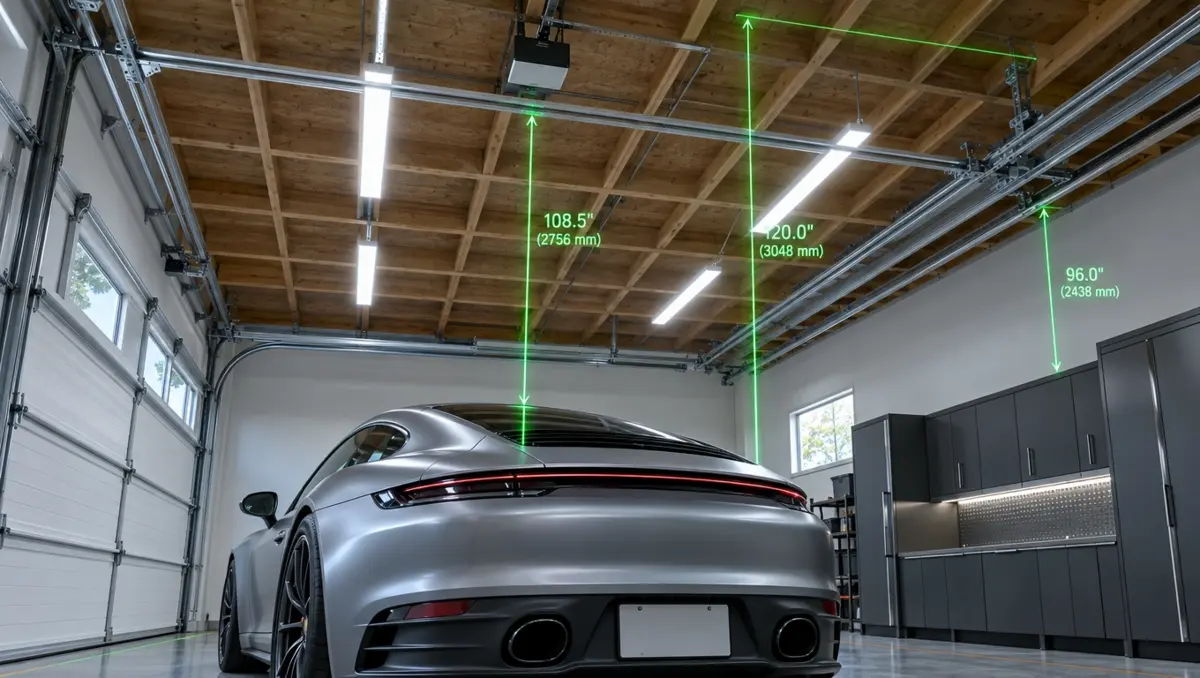
Because a vehicle parked on a 4-post lift sits on its tires at normal compressed curb suspension height (rather than hanging with wheels drooped like a 2-post hoist), you only need to raise the runways high enough to click into the mechanical lock notch that clears the roof of the lower car. Use this stacking reference table to match your ceiling height to the right model:
| Vehicle stacking combination | Typical vehicle heights (Bottom + Top) | Min. required ceiling height | Required under-deck clearance | Recommended Daytona model |
|---|---|---|---|---|
| Two low sports coupes (e.g., Corvette + 911) | 49 in. + 50 in. | 110.5 in. (9 ft 3 in.) | 53 in. (mid-level lock position) | LFPP9 (70.9 in. max clearance) |
| Daily sedan under classic muscle car | 58 in. + 55 in. | 124.5 in. (10 ft 5 in.) | 62 in. to 70.9 in. | LFPP9 (9,000 lb) or LFPP10 (10,000 lb) |
| Mid-size SUV under sports coupe | 67 in. + 51 in. | 129.5 in. (10 ft 10 in.) | 70.9 in. to 72.5 in. | LFPP10 or LFPP10-XLT |
| Full-size pickup or tall SUV underneath | 76 in. + 56 in. | 143.5 in. (12 ft 0 in.) | 79 in. to 85.0 in. (Extra-Tall) | LFPP10-XLT (85.0 in. max clearance) |
Buyers searching for an extra tall 4 post lift choose the LFPP10-XLT specifically for its 85.0 in. (2,159 mm) under-runway clearance and extended runway deck, which lets you park a full-size pickup underneath or lets a tall technician walk upright under the hoist. For complete column footprints, ramp lengths and drive-thru widths, read our 4-post lift dimensions and ceiling height guide.
What concrete thickness is required—and do you have to bolt down a 4-post lift?
Light-duty parking models (LFPP9, LFPP10 and LFPP10-XLT) typically require a minimum 4 in. (102 mm) thick, 3,000 PSI concrete slab cured for 28 days and can operate freestanding on level floors during static vehicle parking, whereas anchoring is recommended for service work and mandatory on all commercial alignment models (LFPA12 through LFPA35).
Concrete slab & post-tension safety rules
Even when a residential 4-post parking lift sits unanchored, each column baseplate transfers concentrated compression loads into the floor. Always confirm the exact slab thickness, PSI rating, anchor bolt size and minimum distance from cracks or expansion joints in the installation manual for your model. Never drill into a post-tensioned residential slab, radiant-heated slab or suspended garage floor without professional engineering sign-off and Ground Penetrating Radar (GPR) scanning.
Follow these three foundation rules when planning your bay:
- Home garage parking lifts (LFPP9, LFPP10, LFPP10-XLT). Require a level, crack-free 4 in. minimum poured concrete slab rated at 3,000 PSI (20.7 MPa) or higher. If you use an optional caster kit to roll an unloaded lift across your garage floor, never move the lift with a vehicle on the runways.
- Commercial alignment & heavy fleet racks (LFPA12, LFPA14, LFPA24, LFPA35). Must be permanently bolted into a reinforced commercial concrete foundation meeting the deeper slab thickness and 3,500 to 4,500+ PSI specifications listed in each model’s manual so the alignment deck stays locked in level calibration and absorbs dynamic rolling bridge jack forces.
- Seam and edge clearances. Keep all column baseplates and wedge anchors back from expansion cuts, control joints, floor drains and slab edges by the minimum distance stated in your manual to prevent corner shear.
Want to confirm whether the LFPP9, LFPP10-XLT or an alignment rack fits your floor and ceiling? Share your bay dimensions and vehicle heights with your local Daytona distributor. They quote, deliver and install across Canada and the US, including single home garages. Have a question first? Talk to our team.
Get a Quote From Your Local DistributorHow do hydraulic cylinders, aircraft cables and safety locks work together?
Every Daytona 4-post lift uses a single hydraulic cylinder concealed beneath the main runway to pull four pre-stretched, aircraft-quality galvanized steel cables over heavy-duty sheaves, while primary mechanical lock ladders and secondary slack-cable locks inside the four columns support the load once raised.
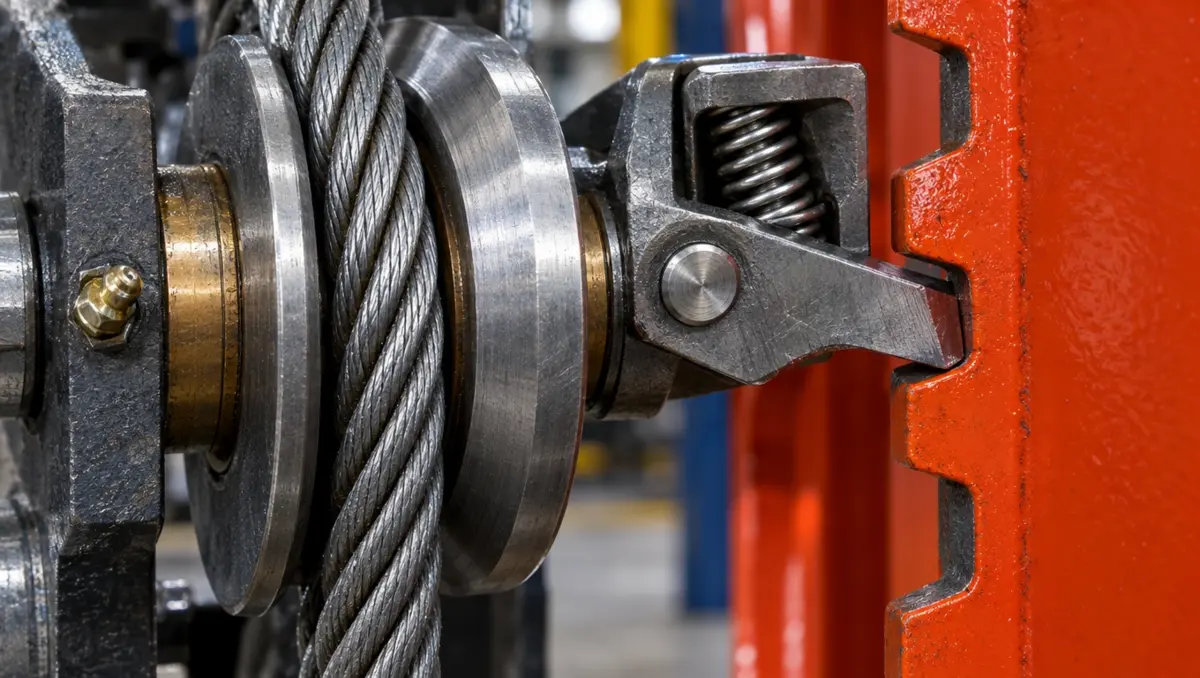
Understanding how hydraulic pressure, cable equalization and mechanical locks interact protects your vehicles and extends cable life:
- Always lower the runways onto the mechanical safety locks. The hydraulic cylinder and aircraft cables are designed strictly to raise and lower the platform. Once the deck reaches your target height, lower it slightly until all four primary mechanical locks sit solidly on their steel column lock blocks—relieving hydraulic pressure and cable tension.
- Primary lock ladders + secondary slack-cable locks. The LFPP9, LFPP10 and LFPP10-XLT use a single-point manual lock release lever, while the commercial LFPA12 through LFPA35 use pneumatic push-button air locks. Every corner also houses a spring-loaded secondary slack-cable latch that immediately locks into the column if a runway hits an obstruction during descent or if a cable ever loses tension.
- Acoustic lock synchronization. During installation and after initial break-in cycles, the threaded cable studs atop each post are adjusted so all four corners click into their mechanical locks simultaneously, keeping the runways level and preventing crossbeam twist.
How do rolling bridge jacks make a 4-post lift wheels-free for brake and tire service?
Mounting one or two air-over-hydraulic rolling bridge jacks along the inner runway rails lets you lift the vehicle by its factory frame or pinch-weld jacking points, raising the tires clear of the runways for brake service, tire swaps, wheel alignments and suspension repairs.
While the LFPP9 includes a steel jack/tool tray that supports bottle jacks for light maintenance, rolling jacks glide effortlessly along the inner runway channel on sealed roller bearings. Daytona builds four dedicated rolling jacks in our lift accessories catalog (designed specifically for Daytona lifts and may not fit other brands):
- RAJ5 (5,000 lb / 2,268 kg). Built for narrow-rail 4-post parking lifts (LFPP9, LFPP10 and LFPP10-XLT).
- RAJ6 (6,000 lb / 2,722 kg). Fits 10,000 lb and 12,000 lb service and alignment lifts (LFPP10, LFPP10-XLT and LFPA12).
- RAJ8 (8,000 lb / 3,629 kg). Pairs with the 14,000 lb LFPA14 alignment lift for heavy EVs and dually pickup axles.
- RAJ12 (12,000 lb / 5,443 kg). Heavy-duty commercial rolling jack built for the 24,000 lb LFPA24 and 35,000 lb LFPA35 fleet alignment racks.
For telescoping arm reach specs and air-line requirements, read our 4-post lift bridge jack and rolling jack buyer’s guide.
4 post lift Canada & US buyer rules: compliance, freight unloading and cost
Across North America, 4-post parking lifts (9,000 to 10,000 lb) typically run $3,200 to $7,500 for the lift equipment alone, with freight running $300 to $900 and professional 4-post parking lift installation typically running $400 to $900 (commercial 12,000 lb to 35,000 lb alignment projects are quoted by tonnage and site prep).
Canadian & US certification, inspection and electrical rules
Whether you are comparing a 4 post lift Canada package or outfitting a US shop, keep three regulatory distinctions in mind:
- Certification status & AHJ rules. All seven Daytona 4-post lifts (LFPP9 through LFPA35) are standard non-certified lifts. Daytona’s sole ALI Certified model is our 10,000 lb 2-post overhead BR10-2OH-33 (confirmed September 2026). Private residential garages are normally outside workplace safety rules, whereas commercial shops with employees must satisfy their local Authority Having Jurisdiction (AHJ), OSHA or provincial Ministry of Labour / WorkSafe rules, and commercial insurers. See our full breakdown of an ALI certified car lift vs non-certified.
- Annual commercial hoist inspections (ANSI/ALI ALOIM). Under ANSI/ALI ALOIM, every commercial lift should be inspected at least once a year by a qualified lift inspector regardless of whether the lift carries a certification label.
- Licensed electrical hookup (NEC & CEC CSA C22.1). A dedicated circuit and a licensed electrician are required under the NEC in the US and CEC CSA C22.1 in Canada (ESA in Ontario). Your electrician sizes the breaker and wire gauge from the lift’s data plate, the manual and local code (typically $300 to $900 near the panel).
Why LTL freight liftgates cannot unload a 4-post lift crate
A packaged 4-post car lift ships in a structural steel bundle measuring roughly 15.5 to 27 feet long and weighing 1,750 lb to over 6,000 lb. Standard residential LTL freight truck liftgates are only 8 feet wide and cannot unload a 16-foot runway crate in a driveway. Ordering through your local Daytona distributor solves this headache: your dealer receives the freight at their commercial dock, brings the lift to your garage on a rollback or equipment trailer and handles complete installation and cable leveling. For detailed Five F’s budgeting (Fixture, Freight, Floor, Feed and Fitting), see our car lift cost guide.
Ready to size a 4-post lift for your garage or alignment bay?
Bring your ceiling height, bay length and vehicle specs to an authorized Daytona distributor near you. They will confirm your fit, quote your lift and rolling bridge jacks, handle heavy crate offloading and install it in your bay.
- Home garage & collector storage. LFPP9 (9,000 lb, 70.9 in. clearance), LFPP10 (10,000 lb) and extra-tall LFPP10-XLT (10,000 lb, 85.0 in. clearance).
- Commercial 4-wheel alignment & fleet. LFPA12 (12,000 lb), LFPA14 (14,000 lb dually/EV), LFPA24 (24,000 lb) and LFPA35 (35,000 lb) with integrated rear slip plates.
- 5-2-1 warranty. 5 years structural, 2 years power units, 1 year parts, with warranty parts freight covered in Canada and the continental US. Indoor use only.
- Since 1999. Canadian-owned manufacturer serving shops and homeowners across the US and Canada through local dealers.
About the author

The Daytona Team
Written by the team at Daytona Automotive Equipment, a Canadian-owned manufacturer of automotive lifts, tire changers and wheel balancers since 1999.
- Specializations. 4-post parking and alignment lift specification, home garage stacking clearance math, rolling bridge jack pairing and distributor technical support across Canada and the United States.
- Standards. Guidance aligned to ANSI/ALI ALCTV construction and testing standards, ANSI/ALI ALIS installation practice and ANSI/ALI ALOIM operation, inspection and maintenance practice.
- Reviewed by. Daytona product and technical support staff, November 2026.
Daytona Automotive Equipment Inc. · Brighton, ON, Canada · Automotive lifts, tire changers and wheel service equipment since 1999.
References and sources
- Automotive Lift Institute (ALI). ANSI/ALI ALIS: Standard for Automotive Lifts: Safety Requirements for Installation and Service. Automotive Lift Institute, current edition.
- Automotive Lift Institute (ALI). ANSI/ALI ALOIM: Standard for Automotive Lifts: Safety Requirements for Operation, Inspection and Maintenance. Automotive Lift Institute, current edition.
- Automotive Lift Institute (ALI). ALI Lift Certification Program & ANSI/ALI ALCTV Overview. Automotive Lift Institute, current edition.
- Canadian Standards Association (CSA Group). CSA C22.1 Canadian Electrical Code, Part I: Safety Standard for Electrical Installations. CSA Group, current edition.
Figures in this article are representative for planning and are not quotations. Code and certification requirements depend on your local Authority Having Jurisdiction (AHJ). Confirm concrete, electrical and clearance requirements against the installation manual for your specific lift before purchase or installation. Daytona Automotive Equipment is not affiliated with Harbor Freight’s Daytona tool brand.