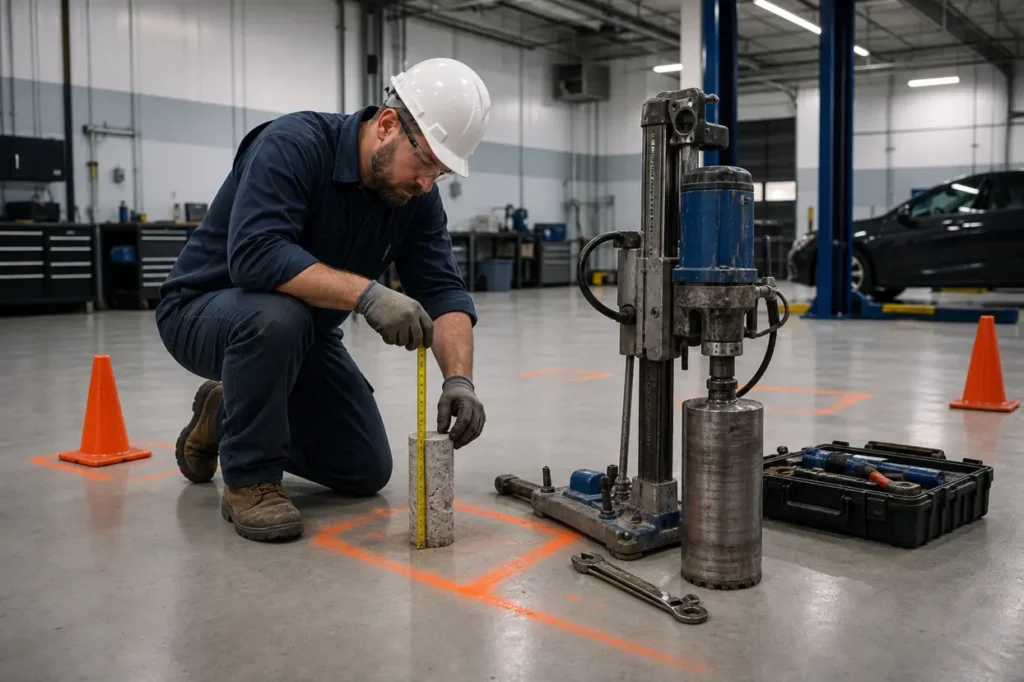
How thick of concrete for 2 post lift installation? Most 9,000 to 10,000 lb 2-post lifts need at least 4 to 4¼ inches of fully cured concrete rated at 3,000 PSI or higher. For a safer long-term install, plan around 6 inches of reinforced concrete. Heavy-duty 12,000 to 15,000 lb lifts may need 6 to 8 inches, depending on the model, anchor design, and slab condition.
This guide is for planning only. Always follow the installation manual for your exact lift model and consult a qualified concrete professional if your slab is unknown, damaged, unusually thin, or post-tensioned.
Direct Answer
For many light-duty 2-post lifts, 4 to 4¼ inches of 3,000 PSI concrete is the common minimum. For most shops, we recommend planning for 6 inches of reinforced concrete at 3,500 to 4,000 PSI where possible. For higher-capacity lifts, especially 12,000 to 15,000 lb models, 6 to 8 inches may be needed.
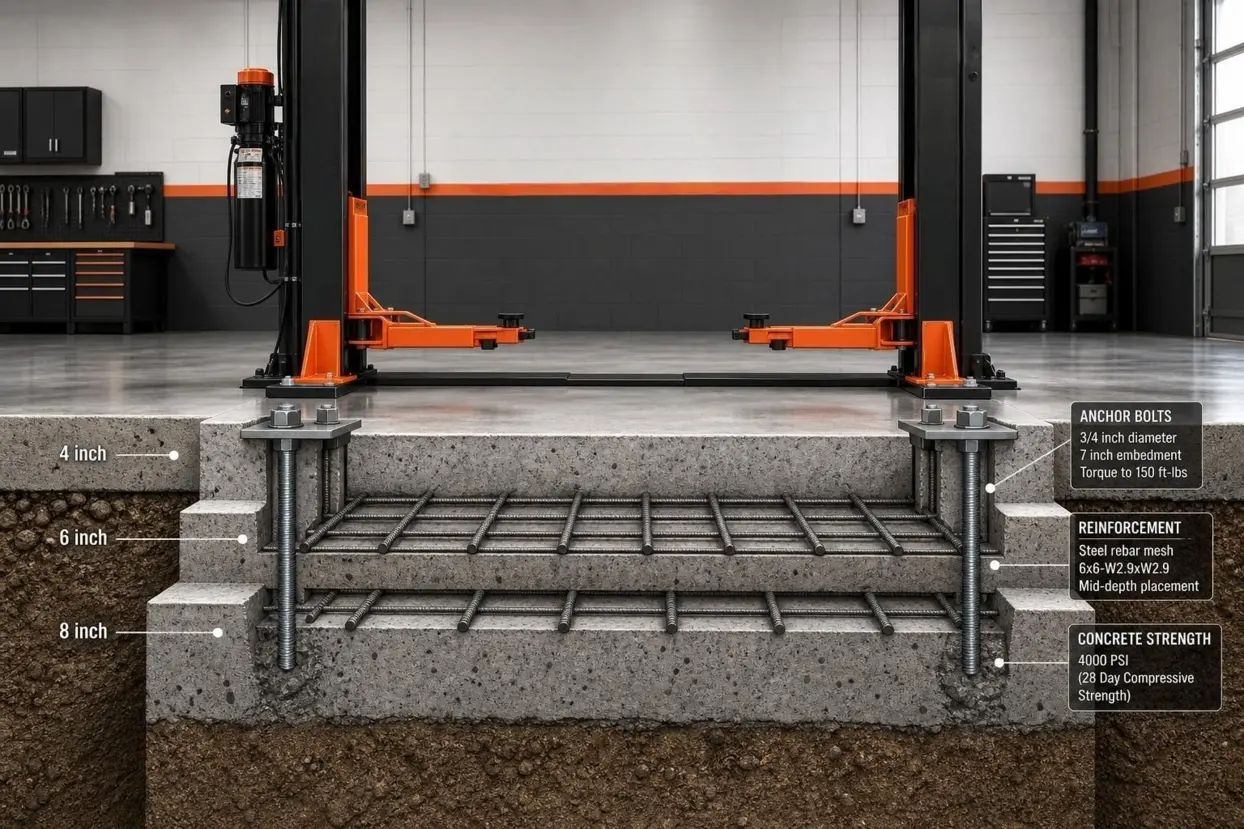
Minimum vs. Recommended Concrete for a 2-Post Lift
Here’s the thing: the minimum spec and the best shop spec are not always the same. A slab might technically meet the minimum, but still be a poor choice if it’s cracked, old, thin in spots, or poorly cured.
Use this table as a starting point before you look at your exact lift manual.
| Spec | Common Minimum | Better Recommendation | Why It Matters |
|---|---|---|---|
| Concrete thickness | 4 to 4¼ inches for some 9k–10k lifts | 6 inches reinforced for most new shop pours | Thicker concrete gives anchors more holding depth and adds safety margin. |
| Concrete strength | 3,000 PSI | 3,500 to 4,000 PSI | Higher PSI helps the slab resist cracking and anchor movement. |
| Cure time | Usually 28 days | 28 days or longer if curing conditions were poor | Concrete needs time to gain strength before drilling and loading. |
| Reinforcement | May vary by manual | Rebar or wire mesh for new pours | Reinforcement helps control cracking around load areas. |
| Slab condition | No major defects | Verified thickness, PSI, and condition | A good-looking slab can still be too thin or weak below the surface. |
Daytona Team Tip
“The most common mistake we see is assuming a garage slab is thick enough without testing it first. Before drilling anchors, confirm slab thickness, concrete strength, cracks, joints, and the exact lift manual requirements.”
— The Daytona Automotive Equipment Team
2-Post Lift Concrete Requirements by Capacity
The right concrete thickness for 2 post lift installation depends on lift capacity. A 9,000 lb lift and a 15,000 lb lift do not place the same demand on the floor.
| Lift Capacity | Common Minimum Thickness | Better Shop Recommendation | Concrete Strength | Planning Notes |
|---|---|---|---|---|
| 9,000 lb | 4 to 4¼ inches | 6 inches reinforced | 3,000 to 4,000 PSI | Good for many home garages and light repair bays if the slab is sound. |
| 10,000 lb | 4 to 4¼ inches on some models | 6 inches reinforced | 3,000 to 4,000 PSI | For 10k 2 post lift concrete requirements, verify the slab before drilling. |
| 12,000 lb | 6 inches | 6 to 8 inches reinforced | 3,500 to 4,000 PSI | Better suited for heavier trucks, vans, and frequent shop use. |
| 15,000 lb | 6 to 8 inches | 8 inches reinforced | 4,000 PSI preferred for new pours | Heavy-duty models need stronger slab planning and professional review. |
These are general planning ranges, not official requirements for every lift. Your model manual, local building code, soil conditions, anchor type, and slab condition all matter.
Why Are 2-Post Lift Concrete Requirements So Important?
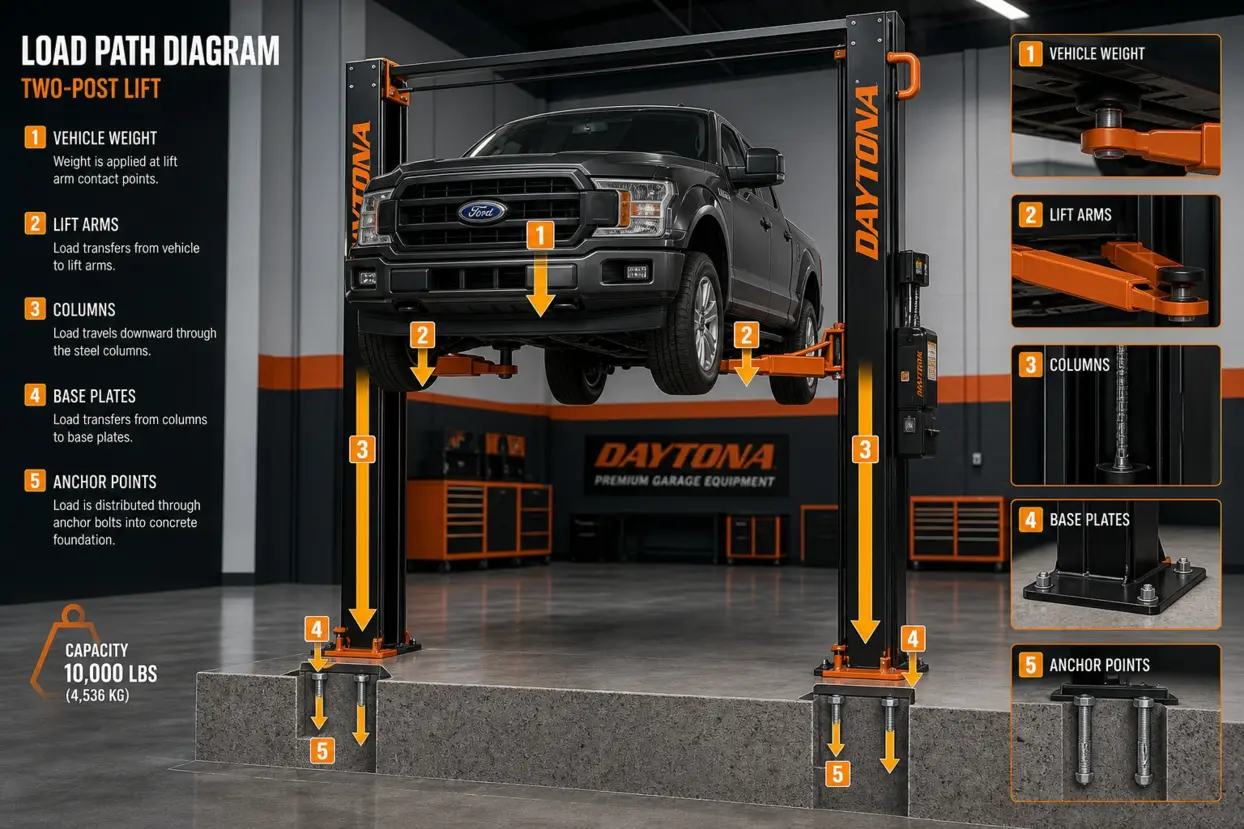
A 2-post lift raises a vehicle by its frame using swing arms. This gives you excellent access to the wheels, brakes, suspension, exhaust, and undercarriage.
But it also means the lift columns concentrate force into two areas of the floor. Each column is held down by anchors. Those anchors depend on the concrete around them.
If the slab is too thin or weak, the anchors can loosen. The concrete can crack around the base plates. In the worst case, 2 post lift concrete failure can create a serious safety risk.
The ANSI/ALI ALIS standard from the Automotive Lift Institute covers safety requirements for automotive lift installation and service. It’s a useful reference for professional installers and shop owners planning a safe lift bay.
For lift certification, the Automotive Lift Institute certification program explains how certified lifts are independently tested. Daytona’s BR10-2OH-33 10,000 lb overhead lift is Daytona’s ALI Certified 2-post lift option.
Why Do 2-Post Lifts Need More Concrete Care Than 4-Post Lifts?
A 4-post lift spreads the vehicle load across four columns and long runways. A 2-post lift concentrates the load at two columns and depends more heavily on anchor holding strength.
That does not make a 2-post lift unsafe. It just means the concrete for 2 post lift installation must be verified before installation.
If you need full wheel-free access for brake, suspension, and undercarriage work, a 2-post lift is usually the right tool. If you mainly need parking or storage, a 4-post lift may place the load differently and may be worth comparing.
You can review Daytona’s full 2-post lift lineup or compare other lift categories from the main shop equipment pages.
What PSI Concrete Do You Need for a 2-Post Lift?
PSI means pounds per square inch. For concrete, it describes compressive strength. In plain English, it tells you how much pressure the concrete can handle before failing in a test.
Many two post lift concrete requirements start at 3,000 PSI. For new pours, 3,500 to 4,000 PSI is a better target for many shops because it gives more strength and margin.
Concrete strength is not just about the mix. Base prep, drainage, reinforcement, weather, and curing all affect the final slab. The American Concrete Institute publishes concrete practice resources used across the construction industry.
How Long Should Concrete Cure Before Installing a Car Lift?
Most new concrete slabs should cure for at least 28 days before installing a car lift. This gives the slab time to gain strength before anchors are drilled and the lift is loaded.
Do not rush this step. If the concrete is too new, anchor holes can weaken the slab. Cold weather, hot weather, or poor curing conditions can also affect strength.
If your slab was recently poured, ask the concrete supplier or contractor when it is ready for anchor drilling and lift installation.
Do You Need Rebar or Wire Mesh for a 2-Post Lift?
For new concrete, rebar or wire mesh is strongly recommended. Reinforcement helps control cracking and gives the slab better support around high-load areas.
Rebar does not turn bad concrete into good concrete. It is part of a proper slab design, not a shortcut.
Also, reinforcement must be planned around the anchor locations. If rebar sits where an anchor hole needs to go, the installer may have to change the layout.
Can You Install a 2-Post Lift on an Existing Garage Slab?
Maybe. Many existing garage floors can support a 2-post lift, but you should never guess. A slab may look fine on top and still be too thin, weak, cracked, or uneven underneath.
Start with building drawings if you have them. If not, a contractor can test drill or take a small core sample to measure the actual concrete slab thickness for 2 post lift planning.
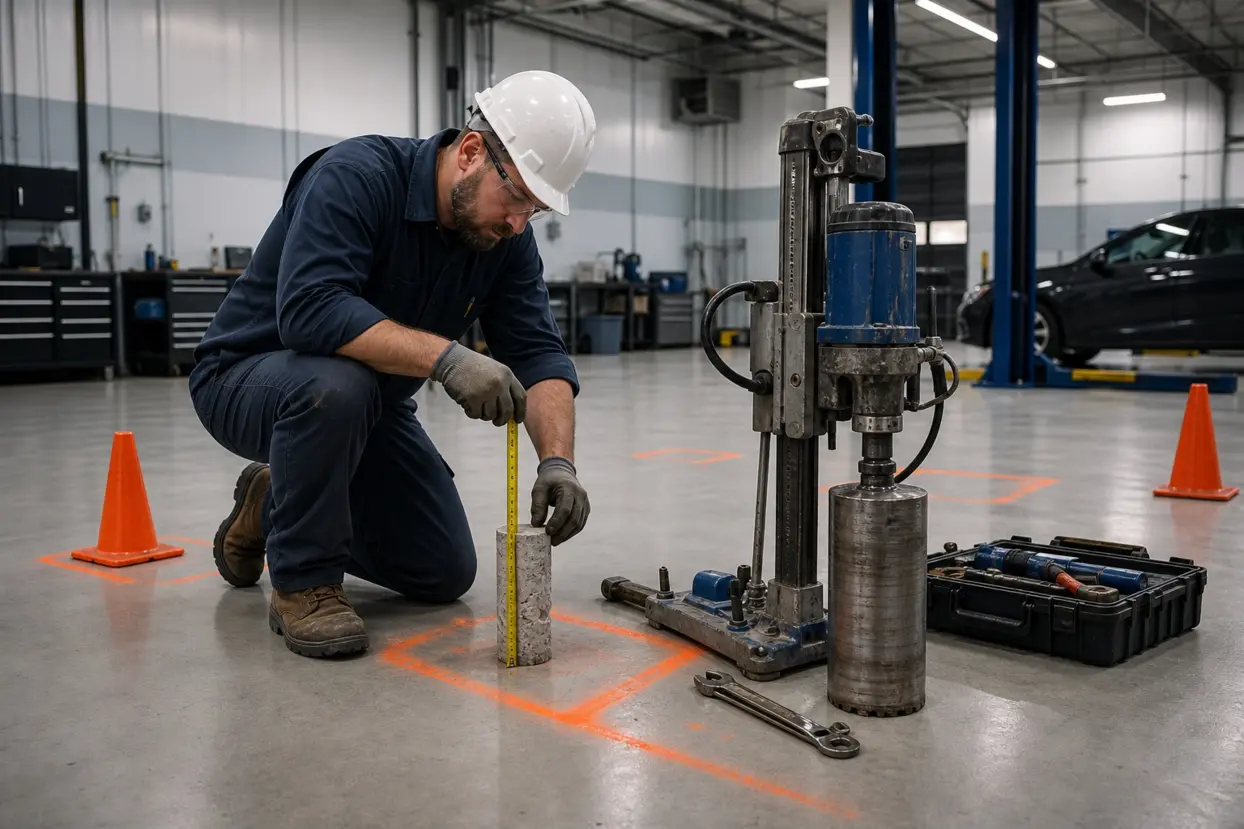
Existing slab inspection checklist
| Check | What to Look For | Why It Matters |
|---|---|---|
| Thickness | Measure the actual slab depth. | Anchors need enough depth to hold correctly. |
| PSI strength | Use records or testing if the slab is unknown. | Weak concrete can crack or let anchors loosen. |
| Cracks | Avoid large cracks, spalling, or broken areas. | Damaged concrete is not a safe anchor base. |
| Joints | Keep anchors away from expansion and control joints. | Joints are designed movement points in the slab. |
| Slope | Check that the lift area is level. | A sloped floor can make column alignment harder. |
| Post-tension signs | Look for stamped warnings or cable end patches. | Drilling into post-tension cables can be dangerous. |
Do Not Drill a Post-Tension Slab Blind
A post-tension slab contains steel cables under high tension. If you cut or drill into one, it can cause serious injury and expensive structural damage. If you suspect a post-tension slab, stop and bring in a qualified professional before drilling.
Do Not Install a 2-Post Lift If...
This is one of the most important parts of the guide. A failed install costs far more than a proper slab check.
- The slab is thinner than the lift manual requires.
- The concrete strength is unknown and cannot be verified.
- The concrete is cracked, broken, spalled, or uneven near the post locations.
- Anchors would land near an expansion joint, control joint, slab edge, or major crack.
- The slab is post-tensioned and cable locations have not been verified.
- The concrete is newly poured and has not cured long enough.
- The lift would be installed outdoors.
- The floor is above a basement or unsupported void without structural approval.
Daytona equipment is designed for indoor use only. Outdoor installation voids the warranty.
What If the Concrete Is Too Thin?
If the concrete is too thin, don’t install the lift yet. A larger washer, extra plate, or “close enough” approach is not a proper fix for weak concrete.
You have better options:
- Test the slab. A core sample can confirm thickness and condition.
- Cut and re-pour the lift area. A contractor may be able to pour deeper reinforced sections.
- Pour a new lift-ready slab. This is often best for new shops or major renovations.
- Change the lift plan. In some cases, a different lift type may fit the floor better.
- Bring in a qualified installer. Professional review is cheaper than a failed install.
A concrete pad for 2 post lift installation must be designed around the exact lift, anchor pattern, and vehicle load. Two small pads are not automatically safe unless they are properly engineered.
Concrete Readiness Scorecard
Use this quick scorecard before calling an installer. It won’t replace a manual or a concrete inspection, but it helps you spot obvious problems fast.
| Question | If Yes | If No |
|---|---|---|
| Is the slab at least the thickness required by the lift manual? | +1 point | Stop and verify or re-pour. |
| Is the concrete at least 3,000 PSI? | +1 point | Test the slab or consult a concrete professional. |
| Has new concrete cured for the required time? | +1 point | Wait before drilling anchors. |
| Are anchor locations away from cracks, joints, and slab edges? | +1 point | Move the lift or repair the floor. |
| Is the lift being installed indoors on a suitable floor? | +1 point | Do not install Daytona equipment outdoors. |
How to Read Your Score
5/5: You may be ready for installer review. 3–4/5: Verify the weak points before installation. 0–2/5: Do not install yet. Fix the concrete plan first.
Daytona 2-Post Lift Planning Table
Because exact concrete requirements must come from the model manual, the table below is a planning guide only. It helps you compare capacity and lift style before confirming installation details.
Only one Daytona lift model is ALI Certified: the BR10-2OH-33 10,000 lb overhead lift. Do not assume ALI certification applies to any other Daytona model.
| Daytona Model | Capacity | Lift Type | Concrete Planning Note |
|---|---|---|---|
| LTPF9 | 9,000 lbs | Floorplate | Lower-capacity 2-post option. Confirm slab thickness, PSI, and anchor requirements before installation. |
| LTPA10 | 10,000 lbs | Adjustable | Good fit for shops needing adjustable width settings. Review 10k 2 post lift concrete requirements before drilling. |
| BR10-2OH-33 | 10,000 lbs | Overhead | Daytona’s ALI Certified 2-post lift option. Use the model manual and ALI listing details during planning. |
| LTPA12 | 12,000 lbs | Adjustable | Higher capacity means stronger slab planning. Verify concrete thickness, PSI, and bay layout. |
| LTPF12 | 12,000 lbs | Floorplate | No overhead bar, useful for lower ceilings. Concrete requirements still need model-specific review. |
| LTPO15 | 15,000 lbs | Overhead | Heavy-duty 15,000 lb model. Must be assembled with its included height extension kit. |
Daytona’s 5-2-1 Limited Warranty covers 5 years structural, 2 years power units, and 1 year parts, with specific exclusions. Electronic parts and wearing parts such as cables, hoses, slider blocks, chains, gears, wedges, and rubber pads are excluded.
Pre-Installation Concrete Checklist
Use this checklist before you drill a single anchor hole.
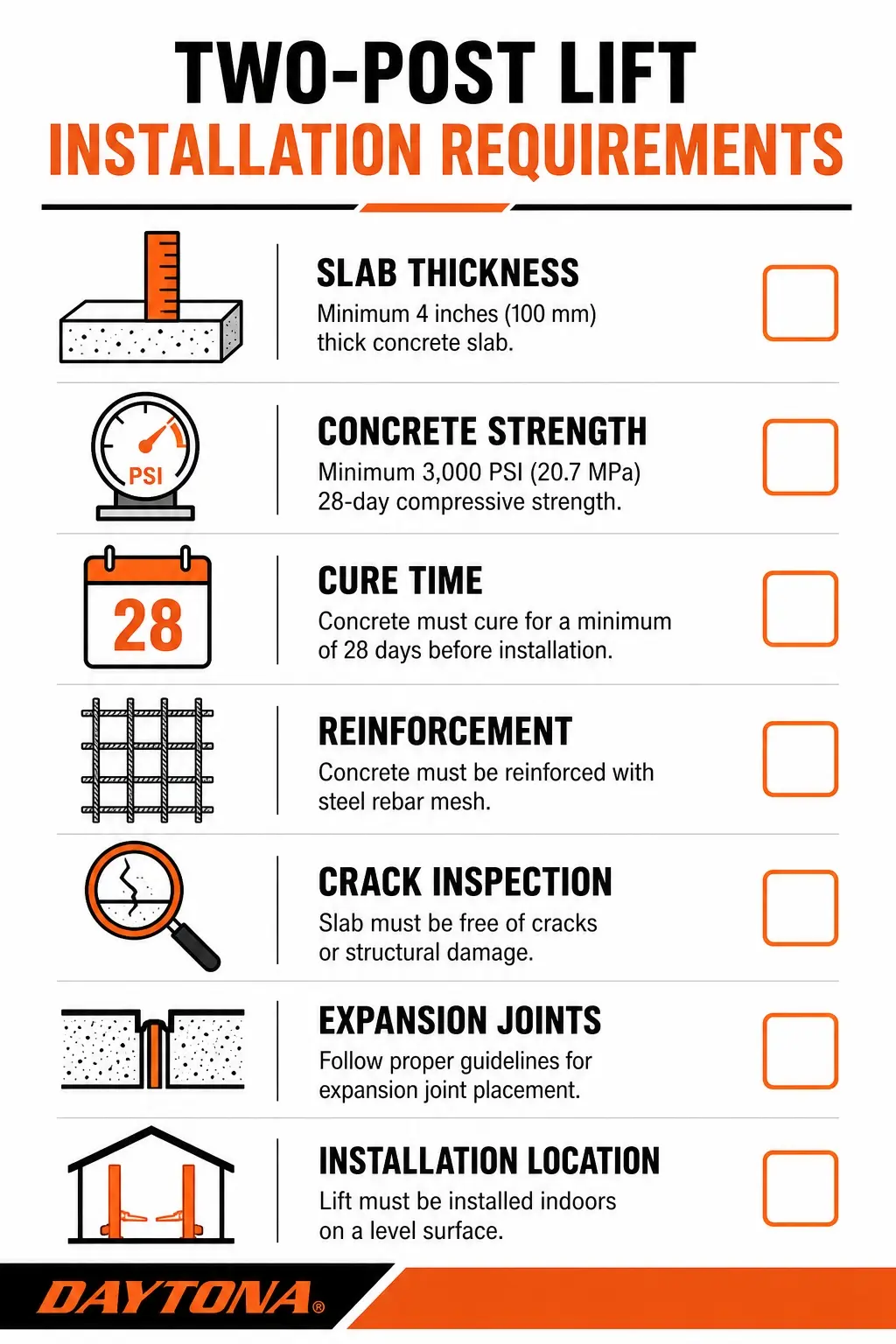
| Step | Pass Condition | If It Fails |
|---|---|---|
| Read the manual | You know the exact slab, anchor, and layout requirements. | Get the correct manual before planning the install. |
| Verify thickness | The slab meets or exceeds the model requirement. | Core test or re-pour the lift area. |
| Confirm PSI | The slab meets the required concrete strength. | Bring in a concrete specialist. |
| Check cure time | New concrete has cured for the required time. | Wait before drilling or loading. |
| Inspect damage | No major cracks, spalling, or broken areas near anchors. | Repair, re-pour, or move the lift location. |
| Confirm indoor use | The lift will be installed indoors in a suitable bay. | Do not install Daytona equipment outdoors. |
If you’re setting up a full bay, don’t stop at concrete. Confirm ceiling height, power, vehicle approach space, and door clearance too. You can download the Daytona brochure to compare lift dimensions and specifications.
Should You Choose a 2-Post Lift If Your Concrete Is Questionable?
Sometimes, yes. Sometimes, no.
A 2-post lift is the best choice for brake work, suspension repair, tire service, oil changes, and undercarriage access. But it needs a strong, verified slab.
If your concrete is unknown and you cannot test or replace it, another lift style may be a better fit. For vehicle storage, a 4-post lift may be worth comparing. For low-profile service, a scissor lift may be a better option.
Daytona has helped shops, distributors, installers, and garage owners across the US and Canada since 1999. If you’re unsure which lift fits your slab, ceiling height, and vehicle mix, contact Daytona for a quote and equipment recommendation.
Frequently Asked Questions
How thick of concrete do you need for a 2-post lift?
Many 9,000 to 10,000 lb 2-post lifts require at least 4 to 4¼ inches of fully cured concrete rated at 3,000 PSI or higher. For most new shop pours, 6 inches of reinforced concrete is a better planning target. Heavier 12,000 to 15,000 lb lifts may need 6 to 8 inches, depending on the model.
Can you install a 2-post lift on 4 inches of concrete?
Yes, some 2-post lifts can be installed on 4 inches of concrete if the slab meets the lift manual’s thickness, PSI, cure time, and condition requirements. The slab must be sound, level, and free from major cracks near the anchor points. If you’re unsure, have the slab tested before drilling.
Is 4 inches of concrete enough for a 10,000 lb 2-post lift?
Four inches may meet the minimum for some 10,000 lb lifts, but it depends on the exact model and slab condition. For 10k 2 post lift concrete requirements, many installers prefer 6 inches of reinforced concrete for better long-term safety and durability. Always follow the lift manual first.
What PSI concrete do you need for a 2-post lift?
A common minimum is 3,000 PSI concrete, but 3,500 to 4,000 PSI is often preferred for new pours. PSI measures concrete compressive strength, which helps the slab resist load and cracking. Higher-capacity lifts may require stronger concrete, so check the model manual.
Do you need rebar for a 2-post lift?
Rebar or wire mesh is strongly recommended for new concrete under a 2-post lift. Reinforcement helps control cracking and supports the slab around the anchor areas. It must be planned carefully so anchor holes do not hit reinforcement during installation.
How long should concrete cure before installing a car lift?
Most new concrete slabs should cure for at least 28 days before installing a car lift. This gives the concrete time to gain strength before anchors are drilled and the lift is loaded. Cold, hot, or wet curing conditions may require extra review from the concrete contractor.
Can you install a 2-post lift on a cracked garage floor?
A 2-post lift should not be installed over cracked, broken, spalled, or defective concrete. Cracks can reduce anchor strength and allow movement under load. If the best lift location has cracks, repair or replace the concrete before installation.
Can a 2-post lift be installed over an expansion joint?
No, a 2-post lift should not be installed over an expansion joint or control joint. The lift needs a solid, continuous slab under both columns. Joints are designed to move, which can weaken anchor support and cause alignment problems.
What happens if the concrete is too thin for a 2-post lift?
If the concrete is too thin, anchors may not hold properly and the slab may crack around the lift columns. This can create a serious safety risk. The right fix is usually testing, cutting and re-pouring reinforced lift pads, or pouring a new lift-ready slab.
Can you pour concrete pads for a 2-post lift?
Yes, but the pads must be designed for the exact lift model, anchor pattern, and vehicle load. Two small pads are not automatically safe if they are not engineered correctly or tied into a proper slab plan. A concrete specialist or qualified installer should review the design.
Can you install a 2-post lift on a post-tension slab?
Do not drill into a post-tension slab unless the cable locations have been verified by a qualified professional. Post-tension slabs contain steel cables under high tension. Cutting or drilling into those cables can cause serious injury and structural damage.
Are 4-post lift concrete requirements different from 2-post lift requirements?
Yes, 4-post lifts spread the load over four columns, while 2-post lifts concentrate load at two columns and anchor points. Some 4-post parking lifts may be less demanding on the slab, but each model is different. Always check the lift manual before installation.
Need Help Matching a Lift to Your Shop Floor?
Daytona Automotive Equipment builds 2-post, 4-post, alignment, parking, scissor, motorcycle/ATV, tire changing, and wheel balancing equipment for shops across the US and Canada.
- 2-post lifts from 9,000 to 15,000 lbs
- ALI Certified option available: BR10-2OH-33 only
- Floorplate options for low-ceiling shops
- 5-2-1 Limited Warranty with clear coverage terms and exclusions
- Canadian owned and operated since 1999
- Distributor and installer opportunities available in the US and Canada
Tell us about your slab, ceiling height, vehicle mix, and shop layout. We’ll help you choose the right equipment path.
Request a Lift Quote