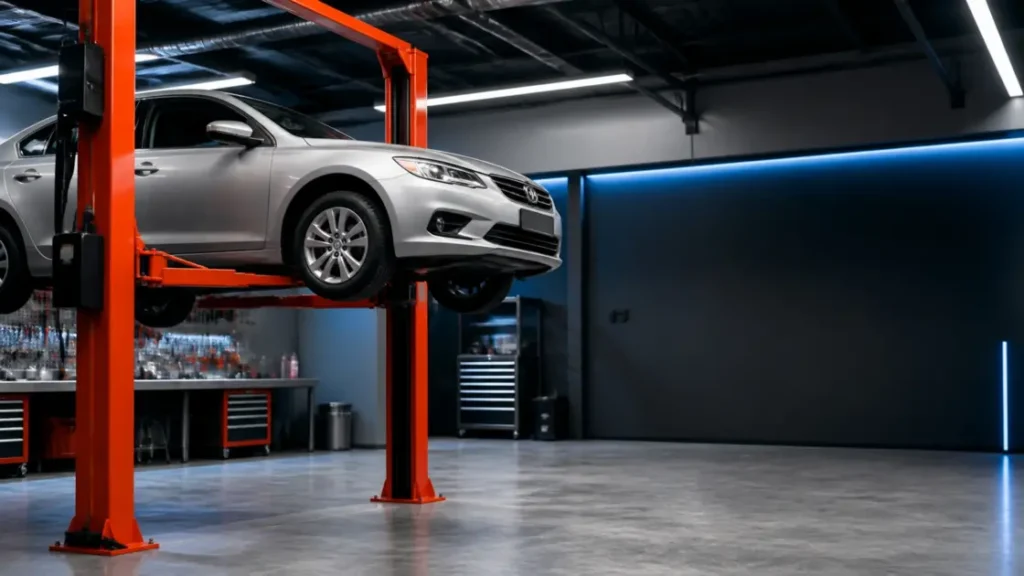
The best 2 post car lift for most shops and serious home garages in 2026 is a 10,000 lb dual direct-drive overhead model with automatic safety locks, single-point release, and ALI certification where it counts. For Daytona buyers, that means the ALI Certified BR10-2OH-33 for shops that need third-party safety validation, or the LTPA12 adjustable-width lift for mixed fleets that handle everything from compact cars to half-ton trucks.
Quick Answer (30-Second Version)
Pick your lift by capacity first, then arm geometry, then power, then safety features. For most home garages, a 9,000-10,000 lb overhead 2 post lift hits the sweet spot. Shops with low ceilings should look at floorplate models. Heavy trucks and EVs need 12,000-15,000 lb capacity. Always verify ALI certification if your insurance or local code requires it.
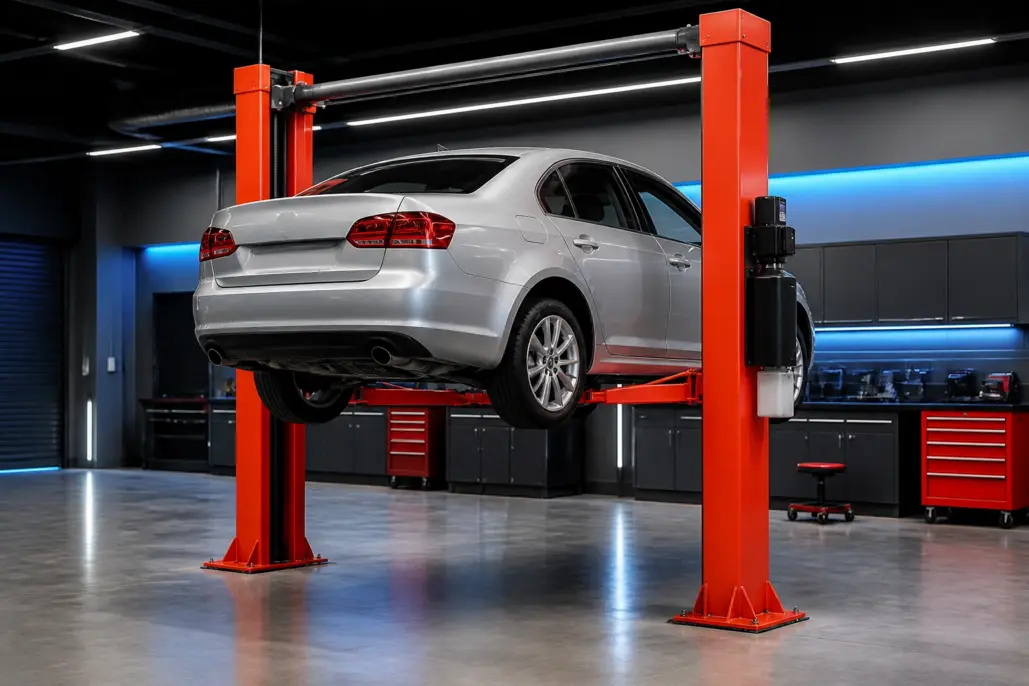
What Is the Best 2 Post Car Lift in 2026?
The honest answer: there's no single "best" model for everyone. The best 2 post car lift is the one that matches your ceiling height, your slab, your power supply, and the heaviest vehicle you'll lift. That's it.
Most North American buyers fall into one of three buckets. Home garage enthusiasts who want to swap transmissions and do brake jobs without crawling on a creeper. Independent shops doing daily service work. And heavy-duty fleet operators lifting diesel trucks and vans.
Each bucket needs a different lift. We'll walk through them all.
Daytona Automotive Equipment has been building lifts for US and Canadian shops since 1999. Our lineup runs from 6,000 lb shared-post parking lifts to 35,000 lb alignment lifts, so we see this question every week. Here's how we'd guide you.
Types of 2 Post Lifts: Which Design Fits Your Shop?
Before you pick a model, you need to know the three big design choices. Get these right and the rest is easy.
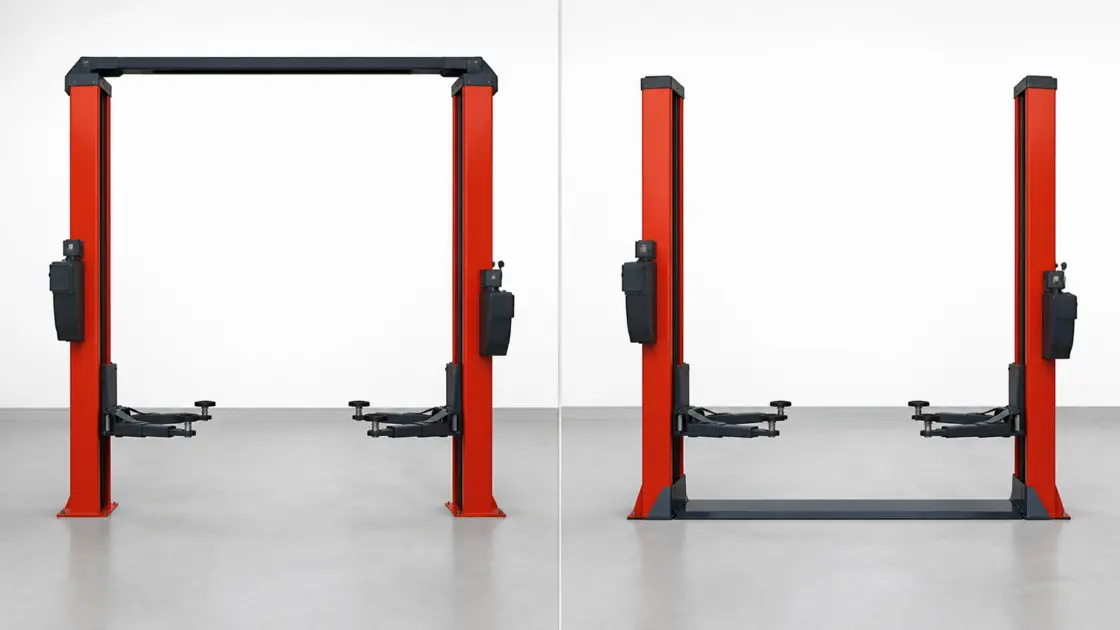
Overhead (Clear-Floor) Lifts
Overhead lifts connect the two columns with a beam across the top. Cables and hoses run through that beam, not the floor. This is the most common 2 post lift design in pro shops.
The big win: the floor between the posts stays totally flat. You can roll a toolbox, oil drain, or transmission jack straight through without hitting anything.
The catch: you need ceiling clearance. Most overhead models need at least 12 feet of ceiling. Daytona's LTPO15 15,000 lb overhead lift ships with an included 2-foot height extension kit for taller bays.
Floorplate (Base-Plate) Lifts for Low Ceilings
Floorplate lifts swap the overhead beam for a low steel plate on the ground. The cables run under that plate instead. No overhead bar means you can install in shorter garages, often as low as 10 feet of ceiling.
Daytona's LTPF9 floorplate lift stands just 110 inches tall overall. The 12,000 lb LTPF12 fits in 114 inches. If your garage door tracks or HVAC runs eat up vertical space, floorplate is the way.
The trade-off is the plate itself. It's a hump in the floor between your work area and the lift bay. Wheeled tools have to roll over it.
Symmetric vs Asymmetric vs Adjustable
This one trips up a lot of first-time buyers. It's about where the vehicle sits between the columns.
- Symmetric: Columns face each other directly. All four arms are equal length. Best for evenly balanced loads like trucks and vans.
- Asymmetric: Columns are rotated about 30 degrees. Front arms are shorter than rear arms. Pushes the vehicle backward so doors open without hitting the column. Best for passenger cars where you need to get inside.
- Adjustable: The column width itself adjusts. Daytona's LTPA10 and LTPA12 offer three width settings, so you can dial in the spacing for your most common vehicle.
Here's a contrarian take most "best of" lists miss. If you service a mixed fleet, a 3-width adjustable lift often beats a fixed asymmetric. Here's the worked example.
Say you have a Honda Civic in the morning and a Ford F-250 in the afternoon. On a fixed asymmetric lift, the Civic gets perfect door access. But the F-250's wheelbase is wider than the column spacing was set for. On a fixed symmetric lift, the F-250 fits fine. But you can't open the Civic's doors without hitting the column.
An adjustable lift lets you slide between two or three column widths in under a minute. One lift, both jobs. That's why we'd pick the LTPA12 over a fixed asymmetric for almost any general-service shop.
How to Choose the Best 2 Post Lift: The CAP-S Framework
We use a simple four-step framework with every customer who calls in for a quote. We call it CAP-S. It stands for Capacity, Arms, Power, Safety. Run any 2 post lift comparison through these four filters and you'll know quickly if it fits.
The CAP-S Framework, in Plain English
Capacity matches your heaviest vehicle plus a safety margin. Arms reach your lift points without stacking adapters. Power matches the voltage and amps you already have in the bay. Safety means automatic locks, single-point release, and a real warranty. Miss any one of these and the lift is wrong, no matter how cheap it is.
C — Capacity: Match Your Heaviest Vehicle
Don't buy for the average car you lift. Buy for the heaviest. Add a 25% safety margin for EVs, upfits, and cargo.
For most home garages, 9,000-10,000 lbs is plenty. A loaded half-ton pickup weighs around 6,000-7,000 lbs. You've got margin.
Pro shops doing fleet work, diesel trucks, or full-size vans should look at 12,000-15,000 lbs. Heavy commercial work pushes you into 15,000 lb territory or higher.
Pay extra attention if you service electric vehicles. The Insurance Institute for Highway Safety (IIHS) reports that EVs can weigh hundreds to thousands of pounds more than gas equivalents. A MotorTrend test measured the GMC Hummer EV at 8,976 lbs and the Ford F-150 Lightning at 6,781 lbs. According to the University of Tennessee's Center for Transportation Research, EVs often weigh 30% more than their gas counterparts. If your shop sees EVs regularly, size your lift accordingly.
A — Arms: Reach and Geometry
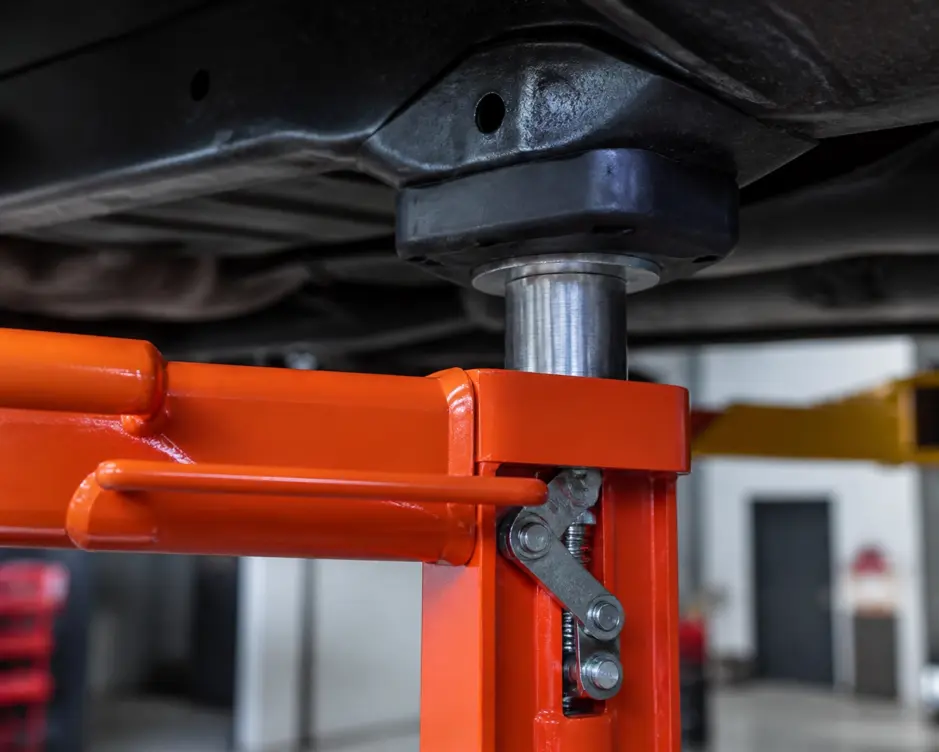
Modern arms are usually 3-stage telescoping. That means each arm extends in three sections to reach a wide range of lift points. Daytona's overhead and adjustable lifts all use this design.
Pad height matters too. Lower pad height means easier access to low-clearance vehicles like sports cars and EVs. The BR10-2OH-33 ships with drop-in pads plus 1.5", 3", and 6" extensions so you can dial in the right contact point.
One sharp take: if you only buy one accessory for a new lift, buy truck adapters. Not extra pad extensions. Frame-cradle truck adapters get used 10 times more often in a working shop, and most lifts don't include them out of the box.
P — Power: Voltage, Phase, and Amps
Most pro-grade 2 post lifts run on 240V single-phase, drawing 12-15 amps. That means a dedicated 30-amp 240-volt circuit, not a standard wall outlet. A licensed electrician should install it.
If you only have 110V available, your options narrow fast. Daytona's LTPP6 stackable parking lift runs on 110V, but for full service lifts plan on 240V.
Check this before you buy. Rewiring a garage adds hundreds of dollars to your install cost.
S — Safety: Locks, Certification, and Warranty
Every Daytona 2 post lift includes automatic safety locks with single-point release. That means when you raise the lift, mechanical locks engage every few inches. The release is one handle, not four separate levers. It's faster and safer.
Other safety features to look for: height limit switches, polyethylene slide blocks that resist wear, and powder-coated steel for corrosion resistance. Our lifts include all of these.
Then there's certification, which deserves its own section below.
2 Post Lift Comparison: Daytona's Lineup at a Glance
Here's the full Daytona 2 post lift lineup mapped to use case. Use this as a quick 2 post lift comparison reference.
| Model | Capacity | Type | Certification | Best For |
|---|---|---|---|---|
| BR10-2OH-33 | 10,000 lbs | Overhead | ALI Certified | Pro shops needing third-party safety validation |
| LTPO15 | 15,000 lbs | Overhead (extended height) | Standard | Heavy trucks, vans, fleet work, taller bays |
| LTPA12 | 12,000 lbs | Adjustable (3 widths) | Standard | Mixed fleets, trucks and cars in one bay |
| LTPA10 | 10,000 lbs | Adjustable (3 widths) | Standard | Home garages and small shops with varied vehicles |
| LTPF12 | 12,000 lbs | Floorplate | Standard | Low-ceiling shops needing higher capacity |
| LTPF9 | 9,000 lbs | Floorplate | Standard | Home garages with ceiling clearance under 11 ft |
Best 2 Post Car Lift for the Money: Matching Budget to Bay
Daytona uses a quote-based B2B model, so we won't quote prices here. But we can tell you how the picks line up by use case.
One opinion before we get into specifics: we'd skip any 2 post lift sold under about $1,500 USD. At that price point, something is being cut. Usually it's the cables, the locks, or the warranty fine print. The savings disappear the first time a part fails.
Best 2 Post Lift for Home Garage Use
For most home garages and pro-sumer shops, the LTPA10 hits the sweet spot. You get 10,000 lbs of capacity, three width settings to handle everything from a Miata to a half-ton truck, and dual direct-drive cylinders with cable equalization. The optional 2-foot height extension covers taller vehicles.
If your ceiling is under 11 feet, switch to the LTPF9 floorplate model. Same capacity range, no overhead bar.
Best 2 Post Car Lift for Pro Shops
For independent service shops, the BR10-2OH-33 is our pick. It's the only ALI-certified lift in the Daytona lineup, which matters if your insurance carrier or local code requires third-party certification. Dual direct-drive, 3-stage arms, three column width settings (140.43", 146.34", 152.24"), and a full pad/extension kit included.
Best Rated 2 Post Car Lift for Heavy-Duty Work
For diesel trucks, vans, and fleet operators, the LTPO15 is the workhorse. 15,000 lb capacity with the 2-foot height extension already included in the box. Note that the height extension must be assembled with the lift. The cables and hoses are sized specifically for that configuration.
Site Requirements: Concrete, Ceiling, and Power
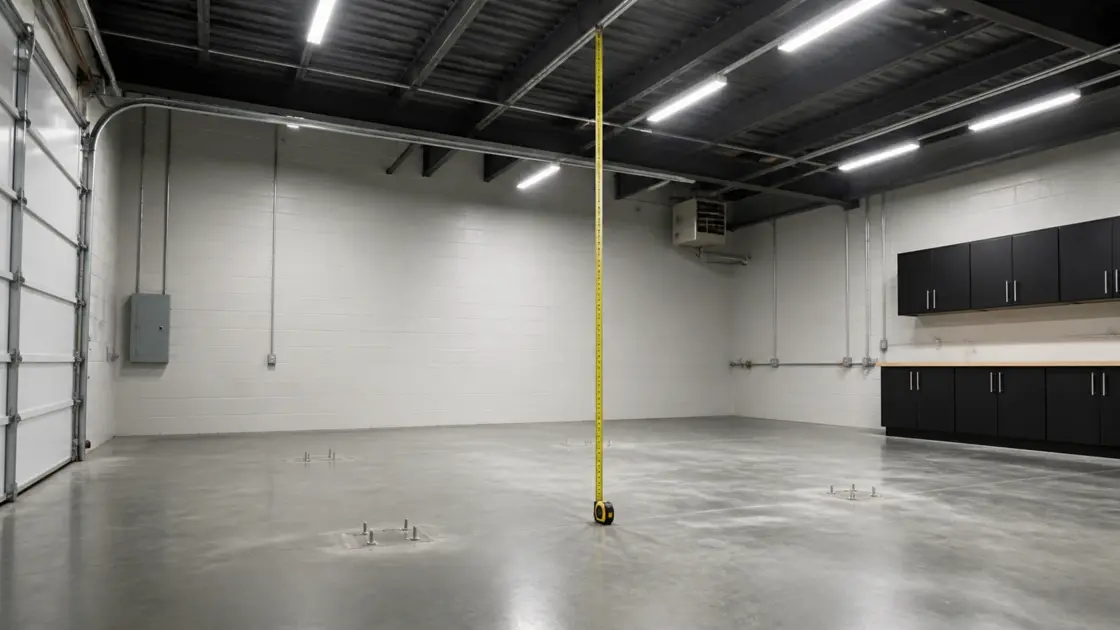
Even the best 2 post car lift fails if your slab can't hold it. Here are the baseline requirements every buyer should verify.
Concrete Slab
For 9,000-10,000 lb lifts, you need at least 4 inches of concrete rated at 3,000 PSI. PSI is just a measure of how much pressure the concrete can take before it cracks. Higher is stronger.
For 12,000 lbs and up, plan on 6 inches minimum. For 15,000-18,000 lb heavy-duty lifts, some manuals call for 6 to 8 inches of reinforced concrete.
Always check the specific install manual for your model. The numbers are not optional.
Pro Tip: Check Before You Drill
If you live in a newer home or commercial building, your floor may be post-tension concrete. That means steel cables are stretched tight inside the slab to keep it strong. Drilling into one of those cables can be dangerous. Have the floor scanned with ground-penetrating radar before you anchor.
Ceiling Height
Most overhead 2 post lifts need 12 feet of ceiling to clear the overhead beam at full rise. Extended-height models like the LTPO15 need 14 feet. Floorplate lifts can fit in 10-11 feet depending on the model.
Measure from the floor to the lowest obstruction. That includes garage door tracks, light fixtures, HVAC ducts, and ceiling fans. The lowest point is your real ceiling.
Power Supply
Most Daytona 2 post lifts run on 240V single-phase at 12-13 amps. That's a dedicated 30-amp circuit. A licensed electrician should handle the wiring. Don't run lifts on extension cords.
What Is ALI Certification and Why Does It Matter?
ALI stands for the Automotive Lift Institute. It's the only independent body in North America that tests vehicle lifts to a published safety standard.
The relevant standard is called ANSI/ALI ALCTV. A certified lift has been physically tested to hold 150% of its rated capacity, according to published ANSI/ALI ALCTV requirements. So a 10,000 lb certified lift was proven in a lab to hold 15,000 lbs without failure.
Why it matters: many commercial insurance providers require ALI certification on shop lifts. Some municipal codes do too. The OSHA General Duty Clause doesn't mandate ALI specifically, but a certified lift is much easier to defend in any safety audit.
There's also a separate ALI standard, ANSI/ALI ALOIM:2020, which says every lift in operation should be inspected at least once a year by a qualified lift inspector. That applies whether your specific lift is certified or not. Keep the inspection records on file.
Daytona and ALI Certification
Only the BR10-2OH-33 in our lineup carries ALI certification. Our other lifts include the same built-in safety features (automatic locks, single-point release, height limit switches, aircraft-quality cables) but are not third-party certified. If certification is a hard requirement for you, the BR10-2OH-33 is the model to pick.
Common Mistakes to Avoid When Buying a 2 Post Lift
From 25+ years of selling to shops across the US and Canada, here are the mistakes we see most often.
- Buying on price alone. The cheapest lift on the market is usually missing safety locks, has thin cables, or comes with a "warranty" that excludes everything that actually breaks.
- Ignoring ceiling height. Measuring the ceiling, then forgetting about door tracks and lights. The lowest point is your real ceiling.
- Under-sizing capacity. "It'll be fine, I only lift sedans." Until a buddy brings over his Ram 2500.
- Skipping the slab check. Anchoring a 10,000 lb lift to 3-inch concrete is asking for a serious accident.
- Mismatched arms. Buying an asymmetric lift to save money, then realizing you can't fit a one-ton dually between the columns.
- No warranty research. Read the fine print. What's covered? What's excluded? For how long?
- DIY install. Lifts must be installed level, with proper anchor torque, by someone who knows what they're doing. This is not a weekend project.
One quick story on mistake #5. We had a fleet customer in Alberta a couple of seasons back. They'd bought a generic asymmetric lift with 2-stage arms to save a few hundred dollars. Then they added a batch of new F-350 Super Dutys to the fleet. The arms couldn't reach the factory lift points on the new trucks without stacking three adapters on each pad. Their techs hated it. They eventually swapped to an LTPA12 with 3-stage arms and three width settings. The problem went away in a week.
The lesson: buy for the fleet you'll have in three years, not just the one you have today.
What to Look For in a 2 Post Lift Vendor
Picking the right lift is only half the job. Picking the right company to buy from is the other half. Use these criteria for any vendor you're evaluating, not just Daytona.
- Years in market. Lift companies that have been around for two or three decades have figured out parts availability, warranty processes, and service networks. Newer brands are still working that out. Daytona has been doing this since 1999.
- Warranty depth. Look for multi-year structural coverage, plus separate coverage for power units and parts. Daytona's 5-2-1 warranty covers 5 years structural, 2 years power, 1 year parts, with freight included in the US and Canada.
- Freight terms. Lifts are heavy. Cross-border freight on a single replacement cylinder can run hundreds of dollars. Make sure the vendor covers freight on warranty parts within your region.
- Distributor network. Local install and service support beats a 1-800 number every time. Find a Daytona distributor if you want hands-on help in your region.
- Product range. Vendors that only sell one or two lift types tend to push you into whatever they stock. A broad lineup means you get the right lift, not just the available one. Daytona's full 2 post lift category spans 6,000 lb parking duty up to 15,000 lb heavy commercial.
The Daytona 2 Post Lift Buyer Scorecard
Run any 2 post car lift you're considering through these 10 criteria. If it fails three or more, keep looking.
| Criteria | What to Look For |
|---|---|
| 1. Capacity | Heaviest vehicle weight + 25% safety margin |
| 2. ALI Certification | Required by your insurance or code? Verify the model is listed. |
| 3. Automatic Locks | Mechanical locks engage every few inches during rise |
| 4. Single-Point Release | One handle to release all locks, not four |
| 5. Arm Reach | 3-stage telescoping arms reach all lift points |
| 6. Pad System | Multiple pad heights included (not sold separately) |
| 7. Power Match | Voltage and amps match your existing wiring |
| 8. Ceiling Fit | Overall height clears your lowest obstruction |
| 9. Cables and Sheaves | Aircraft-quality cables, large protected sheaves |
| 10. Warranty | Multi-year structural coverage with freight included |
Frequently Asked Questions
What is the best 2 post car lift for a home garage?
For most home garages, a 9,000-10,000 lb adjustable-width 2 post lift like the Daytona LTPA10 hits the best balance of capacity, flexibility, and ceiling fit. If your ceiling is under 11 feet, switch to a floorplate model like the LTPF9. Always confirm your slab is at least 4 inches of 3,000 PSI concrete before installing.
How much does a 2 post car lift cost?
Pricing varies widely based on capacity, certification, and brand. Daytona uses a quote-based B2B model, so contact us or a local distributor for a current quote tailored to your model and shipping location. Be wary of any lift priced far below the market average. It usually means missing safety features or a weak warranty.
What ceiling height do I need for a 2 post car lift?
Most overhead 2 post lifts need at least 12 feet of ceiling to clear the overhead beam at full rise. Extended-height models for trucks and vans need 14 feet. Floorplate models like the Daytona LTPF9 can fit in 10-11 feet depending on the specific configuration. Always measure to the lowest obstruction, including door tracks and lights.
How thick does my concrete slab need to be?
For 9,000-10,000 lb lifts, the minimum is 4 inches of concrete at 3,000 PSI. For 12,000 lb and higher capacity, plan on 6 inches. Heavy-duty 15,000-18,000 lb lifts may require 6 to 8 inches of reinforced concrete. Always follow the specific install manual for your model.
Is a 2 post or 4 post lift better for a home garage?
A 2 post lift is better for active service work because it leaves the wheels free for brake jobs, suspension work, and tire rotations. A 4 post lift is better for long-term storage and alignment work because the vehicle sits on runways. For most home garages doing maintenance, a 2 post lift is the right pick. For storing a project car or stacking vehicles, choose a 4 post parking lift.
What is the difference between symmetric and asymmetric 2 post lifts?
Symmetric lifts have columns facing each other directly with equal-length arms, making them ideal for evenly balanced loads like trucks and vans. Asymmetric lifts have rotated columns and shorter front arms, which pushes the vehicle backward so doors can open without hitting the column. Adjustable lifts like the Daytona LTPA10 let you switch between widths to handle both styles in one machine.
Are overhead or floorplate 2 post lifts better?
Overhead lifts leave the floor flat between the posts but need at least 12 feet of ceiling clearance. Floorplate lifts have a low steel plate on the ground that lets them fit in shorter garages, but tools and equipment must roll over that plate. Pick overhead if you have ceiling height, floorplate if you don't.
What is ALI certification and does it matter?
ALI certification is a third-party safety validation from the Automotive Lift Institute, the only independent body in North America that tests lifts to a published standard. A certified lift has been physically tested to hold 150% of its rated capacity. It matters when your insurance carrier or local code requires it. Daytona's BR10-2OH-33 is the only ALI-certified model in our lineup.
Can a 2 post lift handle electric vehicles (EVs)?
Yes, but the lift must be matched to the EV's weight and lift point geometry. According to IIHS and University of Tennessee research, electric vehicles often weigh 30% more than gas equivalents because of the battery pack. Low-profile pads and long 3-stage arms help reach reinforced frame points without contacting sensitive battery housings. A 10,000 lb adjustable lift handles most consumer EVs safely.
What power supply does a 2 post car lift need?
Most pro-grade 2 post lifts, including Daytona's overhead and adjustable models, run on 240V single-phase power drawing 12-13 amps. That requires a dedicated 30-amp circuit installed by a licensed electrician. Don't run lifts on standard 110V outlets or extension cords.
Ready to Find the Right 2 Post Lift for Your Shop?
Tell us your ceiling height, slab spec, and the vehicles you lift most. We'll match you with the right Daytona model and connect you with a distributor in your area.
- 5-2-1 Limited Warranty (5 years structural, 2 years power, 1 year parts)
- ALI Certified option available on the BR10-2OH-33
- Canadian-owned and operated since 1999
- Freight included on warranty parts in the US and Canada
- Active distributor network across North America