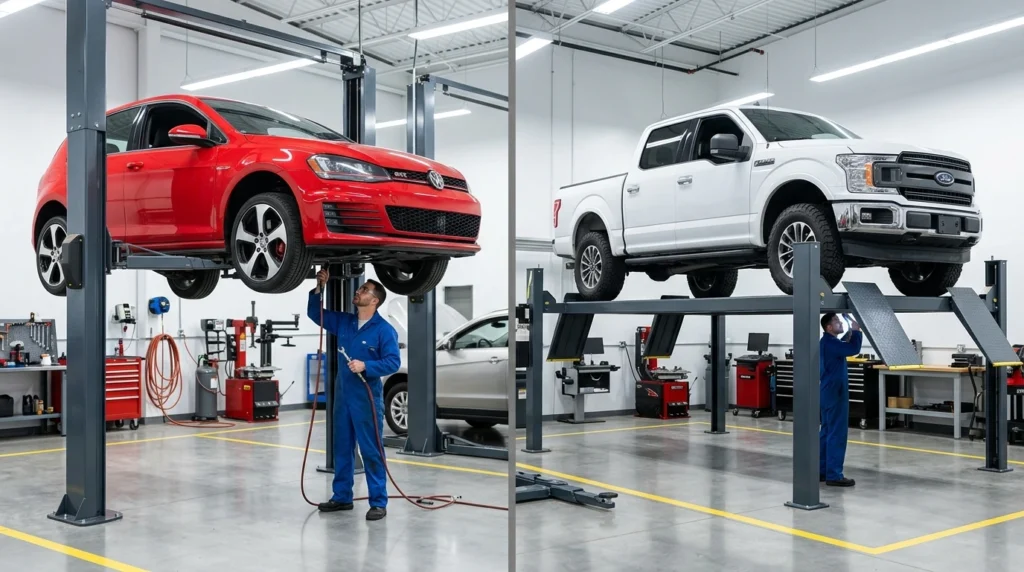
Choose a 2-post lift if your work is repair: it raises the vehicle by its frame so all four wheels hang free, giving you unobstructed access to brakes, suspension, exhaust and drivetrain. Choose a 4-post lift if you need storage, wheel alignment, or capacity above 15,000 lbs: the vehicle drives onto runways and sits on its tires, which is why it stacks cars safely and supports loads up to 35,000 lbs.
The constraint that decides it for most shops is not preference, it is the building. Overhead 2-post columns typically stand 140 to 152 inches tall (11 ft 8 in to 12 ft 8 in), while a floorplate 2-post has no crossbar at all and can stand as low as 110 inches. A 4-post needs less height for service work — roughly 9 to 10 feet — but far more floor: about 22 to 28 feet of depth once you allow for approach ramps.
The mistake people make is assuming a 4-post is the "do everything" option because it is bigger. It is not. Wheels sit on the runways, so any wheel-off job needs a separate rolling jack. Budget for that jack at the same time as the lift, not afterwards.
Choosing between a 2-post lift and a 4-post lift comes down to one question: what do you need the lift to do? Neither type is universally better. They solve different problems, and shops that own both use them for genuinely different jobs.
The decision has four real inputs: the work you do, the vehicles you service, the ceiling you have, and the floor you have. Get those four straight and the answer usually becomes obvious. Get them wrong and you end up with a lift that either cannot reach the work or cannot fit the bay.
We have been building and selling both types at Daytona Automotive Equipment since 1999. Below we work through access, space, safety, capacity, installation and cost, then finish with an interactive tool that weighs your situation for you. If you are still deciding between lift categories more broadly, start with our guide to the different types of car lifts and come back here to narrow it down.
Key takeaways
- Lifting method decides access. A 2-post lifts by the frame so wheels hang free; a 4-post lifts by the tires, so the runways stay under the vehicle.
- Repair work favours 2-post. Brakes, suspension, exhaust and drivetrain jobs are faster with nothing underneath the car.
- Storage and alignment favour 4-post. Weight rests on the tires, so cars can sit raised for months without loading the suspension.
- Height is the 2-post constraint. Overhead columns run 140 to 152 inches; floorplate models like the LTPF9 stand 110 inches with no crossbar.
- Floor area is the 4-post constraint. Expect 22 to 28 feet of depth once approach ramps and drive-on space are counted.
- Capacity diverges sharply. Daytona 2-post models run 6,000 to 15,000 lbs; 4-post models run 9,000 to 35,000 lbs.
- A 4-post needs a rolling jack for wheel-off work. Sold separately, and capacity must match the lift.
- Anchoring differs. Every 2-post must be bolted to concrete; several 4-post parking lifts are freestanding.
What is the difference between a 2-post lift and a 4-post lift?
A 2-post lift raises the vehicle by its frame so the wheels hang free, while a 4-post lift raises it by its tires on drive-on runways. Every other practical difference between the two flows from that single mechanical distinction.
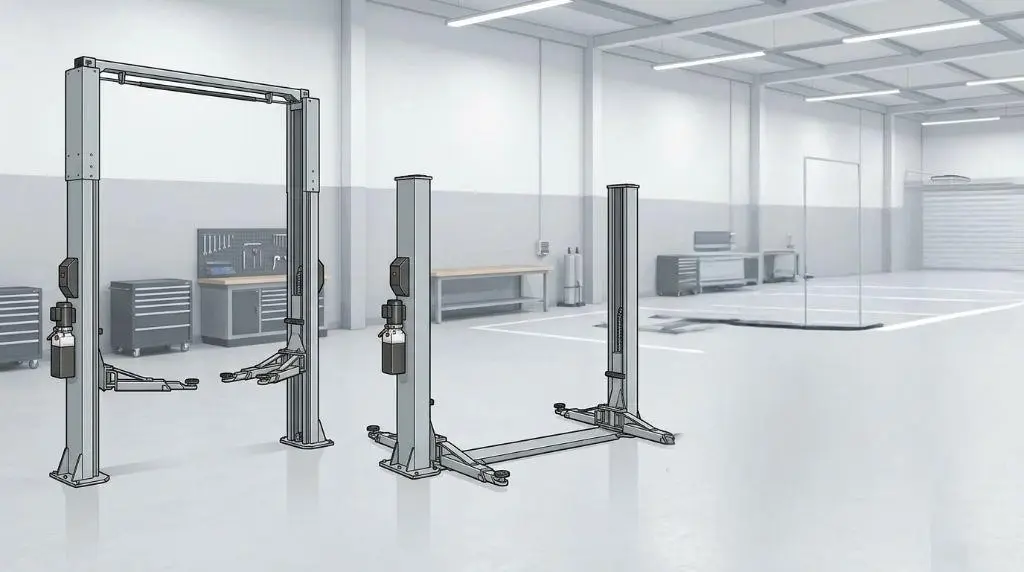
A 2-post car lift — also called a 2-post car hoist in Canada — uses two vertical columns with swing arms that contact the vehicle at its manufacturer-specified lift points. The car comes off the ground entirely, with nothing beneath it but the arms. That gives technicians unobstructed access to brakes, suspension, exhaust, drivetrain and everything else underneath, from any direction.
A 4-post car lift uses four columns connected by two long runways. You drive the vehicle on and raise the whole platform. Because the vehicle rests on its tires, its weight is distributed the way the chassis was designed to carry it. That makes 4-post lifts the default for vehicle storage, parking capacity and wheel alignment.
There is a second-order consequence worth understanding early. On a 2-post lift, the load path runs through specific frame points, so correct positioning matters every single time you load a vehicle. On a 4-post, positioning is close to foolproof — but the runways stay in the way, which is exactly why they support the car so evenly.
How do 2-post and 4-post lifts compare side by side?
A 2-post wins on access, footprint and cost; a 4-post wins on storage, alignment, loading speed and capacity. The table below covers the core differences at a glance, and the sections that follow go deeper on each.
| Factor | 2-Post Lift | 4-Post Lift |
|---|---|---|
| How it lifts | By the vehicle's frame — arms contact the lift points | By the tires — vehicle drives onto runways |
| Undercarriage access | Full: wheels hang free, open from all sides | Partial: runways block some access; rolling jack needed for wheel-off work |
| Best for | Brake, suspension, exhaust and drivetrain repair | Storage, parking, alignment, tire service |
| Floor space required | Smaller footprint; fits tighter shop bays | Larger footprint; runways need more length and width |
| Ease of loading | Requires positioning arms under the correct lift points | Drive on and go; minimal setup |
| Long-term storage | Not recommended — suspension hangs under load | Ideal — weight rests on the tires naturally |
| Capacity range (Daytona) | 6,000 to 15,000 lbs | 9,000 to 35,000 lbs |
| Anchoring | Must be bolted to the concrete floor | Recommended; some parking models are freestanding |
| Ceiling height needed | 140–152 in for overhead; from 110 in for floorplate | 9–10 ft for service; 12+ ft for stacking |
| Relative cost | Lower — fewer materials and components | Higher — more structure, runways and capacity |
When should you choose a 2-post lift?
Choose a 2-post lift if repair work is your primary use and you need to get wheels off the vehicle regularly. Two-post lifts are the workhorse of general auto repair, and for brake jobs, suspension work, oil changes, exhaust repairs and transmission service they are almost always the right call.
Full undercarriage access
On a two-post lift the vehicle is raised completely clear of the ground with nothing beneath it except the lift arms. You can slide underneath from any direction. There are no runways in the way and no platform to work around, which means no repositioning a creeper to get at a component that happens to sit above a runway.
For jobs where the wheels have to come off — brake rotors, tire swaps, hub bearings, control arms — a 2-post lift lets you get straight to work. A four-post lift would need a separate rolling jack to raise the vehicle off the runways before the wheels come free, adding a step to every single job of that type. Over a week of brake work, that adds up.
Smaller shops and low ceilings
Two-post lifts take up less floor space than four-post models. If you are setting up a single-bay shop or a home garage, the smaller footprint is a real advantage. A typical 10,000 lb 2-post might need a bay width as narrow as 88 inches between columns, while a four-post lift in a two-car garage can consume the entire usable width.
Low ceilings are where 2-post lifts become genuinely flexible. Floorplate models have no overhead bar, so they fit in buildings where an overhead model would not clear. Daytona's LTPF12 floorplate lift has an overall height of 114 inches — 9 ft 6 in — and the 9,000 lb LTPF9 stands at 110 inches.
Overhead, floorplate or adjustable: which 2-post subtype?
Here is something most comparison guides skip entirely: not all 2-post lifts are the same. There are three configurations, and each solves a different building problem rather than a different mechanical one.
The three 2-post configurations
Overhead (closed-top). Hydraulic lines and equalizer cables run through a crossbar at the top of the columns, leaving the floor between the posts completely clear. Best when you want an unobstructed floor and your ceiling can carry the extra height. Daytona models: the ALI-certified BR10-2OH-33 and the 15,000 lb LTPO15.
Floorplate (open-top). Lines run through a low-profile plate on the floor instead, so there is no overhead bar at all and tall vehicles fit without hitting anything above. Ideal for low ceilings or for shops servicing vans and trucks with roof racks. Daytona models: LTPF12 and LTPF9.
Adjustable. Column width changes across three settings so the lift can be matched to different bay sizes or vehicle widths. The LTPA12 offers 107", 113" and 119"; the LTPA10 offers 88.6", 94.5" and 100.4".
Most competitors sell only one or two of these styles. Daytona builds all three, in capacities from 9,000 to 15,000 lbs, plus the 6,000 lb LTPP6 two-post parking lift, which uses a shared-post design on 110V power and is one of the few models combining a compact 2-post footprint with parking functionality. You can browse the full 2-post lineup here, or work through our 2-post lift buyer's guide if you have already settled on this type.
When should you choose a 4-post lift?
Choose a 4-post lift if you need to store vehicles, offer wheel alignment, or handle loads above 15,000 lbs. Four-post lifts are less common in high-volume general repair bays, but for those three jobs they are difficult to beat.
Vehicle storage and parking
If you need to stack cars — whether that is a collector doubling garage capacity or a dealership maximising lot space — a four-post lift is the only practical option. The vehicle drives on, gets raised, and another car parks below.
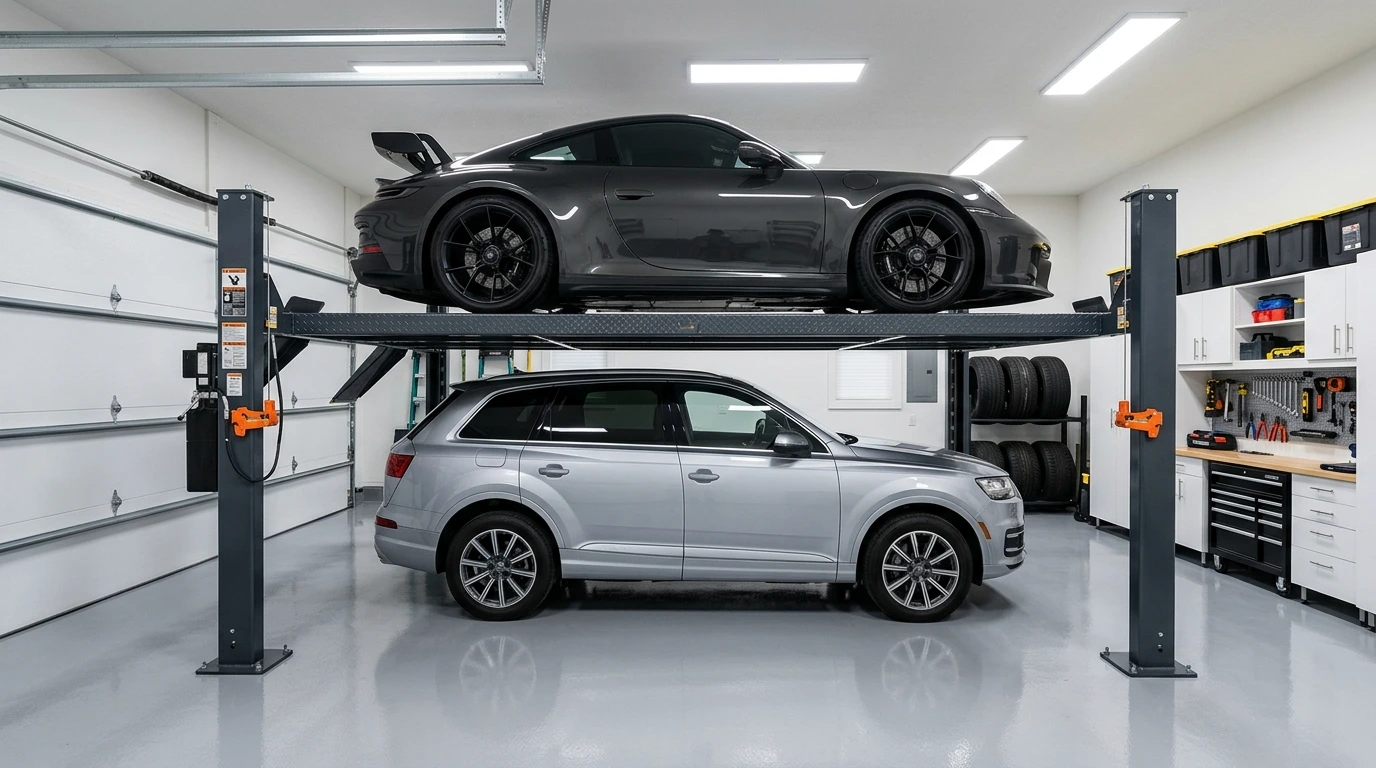
Leaving a car on a 2-post lift for months is not a good idea. The suspension components hang under constant load, which can stretch bushings and fatigue shocks over time. A four-post avoids this entirely, because the weight sits on the tires exactly as it does on the ground. Daytona's parking lifts, including the LFPP10-XLT with 85 inches of clearance, the LFPP10 and the LFPP9 with 70.9 inches of clearance, are built specifically for long-term storage. See all Daytona parking lifts.
Alignment work
Wheel alignment requires the vehicle's wheels to rest on turntables and slip plates so a technician can measure and adjust camber, caster and toe. That is only possible on a four-post lift with built-in alignment features. You cannot align on a standard 2-post lift, because the wheels are off the ground and the suspension is unloaded.
Daytona's alignment lifts run from the 12,000 lb LFPA12 and the 14,000 lb LFPA14 with its 25.6-inch ultra-wide runways for dually trucks, up through the 24,000 lb LFPA24 to the heavy-duty 35,000 lb LFPA35. Every model includes built-in slip plates and adjustable turntables. If alignment service is part of your business, a 4-post alignment lift is non-negotiable. Explore Daytona alignment lifts.
Heavy-duty and commercial applications
Four-post lifts handle bigger loads. Most 2-post lifts top out around 15,000 lbs, which comfortably covers cars, SUVs and light trucks. But if you are servicing commercial vans, duallys, box trucks or fleet vehicles, you need capacity that only a four-post can deliver — up to 35,000 lbs in Daytona's lineup.
The broader weight distribution across four columns and two long runways also creates a more stable platform, which matters when the vehicle on the lift weighs 20,000 lbs or more. On the LFPA24, ladder locks engage every 3.5 inches, so the platform can be set close to whatever working height suits the job.
Is a 4-post lift safer than a 2-post lift?
Both types are safe when correctly installed and properly used, but a 4-post is inherently more stable and is the safer choice for long-term storage. The difference is not that one design is dangerous — it is that they fail differently when things go wrong.
Lift safety by the numbers
As reported by Underhood Service, citing U.S. Consumer Product Safety Commission data, roughly 15,000 workers are treated in hospitals each year for injuries related to automotive lifts, jacks and jack stands. The Automotive Lift Institute (ALI) operates the third-party certification programme that independently validates lifts against ANSI/ALI standards.
A 4-post lift does offer more inherent stability. Four contact points, a wider footprint and weight spread across the full length of the runways mean less chance of a vehicle shifting once raised. Parking models add primary and secondary mechanical lock systems specifically because vehicles may sit raised and unattended for long periods.
A 2-post lift requires more attention to vehicle placement. You need to align the lift arms with the manufacturer's recommended lift points, and every vehicle is different. Incorrect positioning creates an unbalanced load, and unbalanced loads are the root of most 2-post incidents. That said, a quality 2-post lift with automatic safety locks, single-point release and height-limit switches is absolutely safe for daily professional use — and on a 2-post you can see all four wheels and the entire underside, which makes a developing problem easier to spot.
Whichever type you choose, look for ALI-certified lifts where available. ALI certification means the lift has been independently tested and validated against ANSI/ALI safety standards. Daytona's BR10-2OH-33 is our ALI-certified 2-post model, with dual direct-drive cylinders and 3-stage arms. Other Daytona models are not ALI certified and instead carry built-in safety systems: automatic locks with single-point release, height-limit switches, polymer wear blocks, and on 4-post models aircraft-quality lifting cables and ladder locks every 3.5 inches.
For ongoing safety, the industry follows the ANSI/ALI ALOIM standard for operation, inspection and maintenance. It sets out how lifts should be inspected and maintained across their service life, and it is the standard your shop's safety programme should reference regardless of which lift type you buy. Local permitting and inspection rules vary, so check with your local building department before installation.
How much space and ceiling height do you need?
A 2-post is constrained by ceiling height, a 4-post by floor depth. Space planning makes or breaks a lift installation, and it is the single most common reason a buyer has to change their choice late in the process.
| Requirement | 2-Post Lift (typical) | 4-Post Lift (typical) |
|---|---|---|
| Minimum ceiling height | 140–152 in overall for overhead; from 110 in for floorplate | 9–10 ft for service; 12+ ft for stacking |
| Bay width | ~88 to 152 in between columns, varies by model | ~130 to 170 in — full runway span plus posts |
| Bay depth | ~16 to 18 ft | ~22 to 28 ft including approach ramp space |
| Concrete | Minimum 4 in at 3,000+ PSI; anchoring mandatory | Minimum 4 in for anchored models; some parking models freestanding |
| Electrical | Usually 240V single phase (LTPP6 is 110V) | 120V for parking lifts; 240V for alignment lifts |
If ceiling height is your binding constraint, a floorplate 2-post is the answer. Without an overhead crossbar, the LTPF9 stands 110 inches and the LTPF12 stands 114 inches. For adjustable-width options that let you tune the lift to an awkward bay, the LTPA10 adjusts across 88.6", 94.5" and 100.4". We cover the low-clearance case in detail in our guide to a 2-post car lift for an 8-foot ceiling.
Thinking about fitting a 4-post lift in a two-car garage? Measure carefully. You need clear depth for the runways plus another 10 to 15 feet in front for the vehicle to drive on. Most standard two-car garages are 20 to 24 feet deep, which can work, but it will be tight — and a tight approach makes loading awkward every single time.
Concrete is the other gate. Both types need a minimum of 4 inches at 3,000 PSI or better, and because a 2-post transfers the entire load into anchor bolts, slab quality is critical rather than merely important. Verify your slab thickness before ordering anything. Our post on how thick concrete needs to be for a 2-post lift walks through how to check, and the 2-post lift installation guide covers anchoring and shimming step by step.
Not sure whether your bay will take the lift you want? Send us your ceiling height, bay dimensions and slab thickness and we will tell you which models actually fit — before you commit to anything.
Check my bay dimensionsHow much does a 2-post lift cost compared with a 4-post lift?
A 2-post lift generally costs less than a comparable 4-post, because there is less steel, fewer components and a simpler drive system. The honest caveat is that capacity, features and certification move the number far more than post count does.
Across the market in 2026, industry reporting puts 2-post lifts in the 9,000 to 15,000 lb range at roughly $2,000 to $6,000, with budget units at the low end and ALI-certified or heavy-duty models at the top. Four-post lifts sit at roughly $3,000 to $10,000 or more, depending on whether the unit is a parking lift, an alignment lift or a heavy-duty commercial platform. Alignment lifts with built-in turntables and slip plates occupy the top of that band. Treat both ranges as planning figures, not quotations.
Installation cost is where the two types diverge in a way the sticker price hides. A 2-post lift must be anchored into concrete, so you may need a slab assessment, anchor drilling and 240V electrical work. A 4-post parking lift on 120V power — the LFPP9 and LFPP10 both run on 120V — plugs into a standard outlet and may not require anchoring at all, which can meaningfully reduce the installed total even though the lift itself costs more.
Two accessory costs are easy to miss. First, if you buy a 4-post and intend to do any wheel-off work, budget for a rolling jack at the same time. Daytona's air-powered rolling jacks run from the RAJ5 and RAJ6 for 9K and 10K parking lifts, through the RAJ8 for the LFPA12 and LFPA14, to the RAJ12 for the LFPA24. They are designed specifically for Daytona lifts and may not fit other brands, so match the jack to the lift rather than to the vehicle. Second, if you are close on ceiling clearance, height extension kits are available for the LTPA10, LTPA12, LTPO15 and BR10-2OH-33 — and the LTPO15 ships with its 2 ft extension kit included and must be assembled with it.
Daytona uses a quote-based pricing model, so exact pricing depends on your configuration and distributor. Request a quote, find a local distributor for installed pricing, or download the full brochure to compare specs across the lineup. Third-party financing is available through NewLane Finance in the US and Active Growth Financial in Canada — see financing options.
Which lift fits your shop?
If more of the statements below describe your situation on one side than the other, that is your answer. We built this tool around the questions shop owners actually ask us. Check every box that applies and the recommendation updates as you go.
Quick-pick lift selector
Check every box that applies to you. Your result appears below.
Points toward a 2-post lift
Points toward a 4-post lift
Still undecided? Our team has helped shops across the US and Canada find the right setup since 1999. Contact Daytona for a free consultation and we will match a lift to your space, your vehicles and your workflow.
And if you are looking beyond these two categories, Daytona also builds scissor lifts for shops that need a low-profile alternative — the LMS6 mid-rise reaches 54 inches with 5.5 inches of lowered clearance, and the LHS7 high-rise reaches 74.5 inches — plus motorcycle and ATV lifts for powersports work. The full range sits on our automotive lifts hub.
Not sure which lift is right for your shop?
Daytona Automotive Equipment builds 2-post, 4-post, alignment, parking and scissor lifts from 2,200 to 35,000 lbs, plus tire changers, wheel balancers and accessories to outfit your entire shop.
- 25+ years serving shops across the US and Canada
- 5-2-1 warranty — 5 years structural, 2 years power units, 1 year parts
- ALI Certified option available on the BR10-2OH-33
- Canadian owned and operated since 1999
- Actively recruiting distributors and installers across North America
Tell us about your shop, your vehicles and your ceiling height. We will recommend the right lift and send you a quote.
Get a Free QuoteReferences and sources
- Automotive Lift Institute. Automotive Lift Certification Program. ALI, accessed September 2026.
- Automotive Lift Institute. ANSI/ALI ALOIM — Safety Requirements for Operation, Inspection and Maintenance. ALI, current edition.
- Underhood Service. New OSHA Program Targets Fatalities, Injuries Associated With Automotive Lifts, citing U.S. Consumer Product Safety Commission injury data. Underhood Service.
Figures in this article are representative for planning and are not quotations. Confirm requirements against the installation manual for your specific lift before purchase or installation.