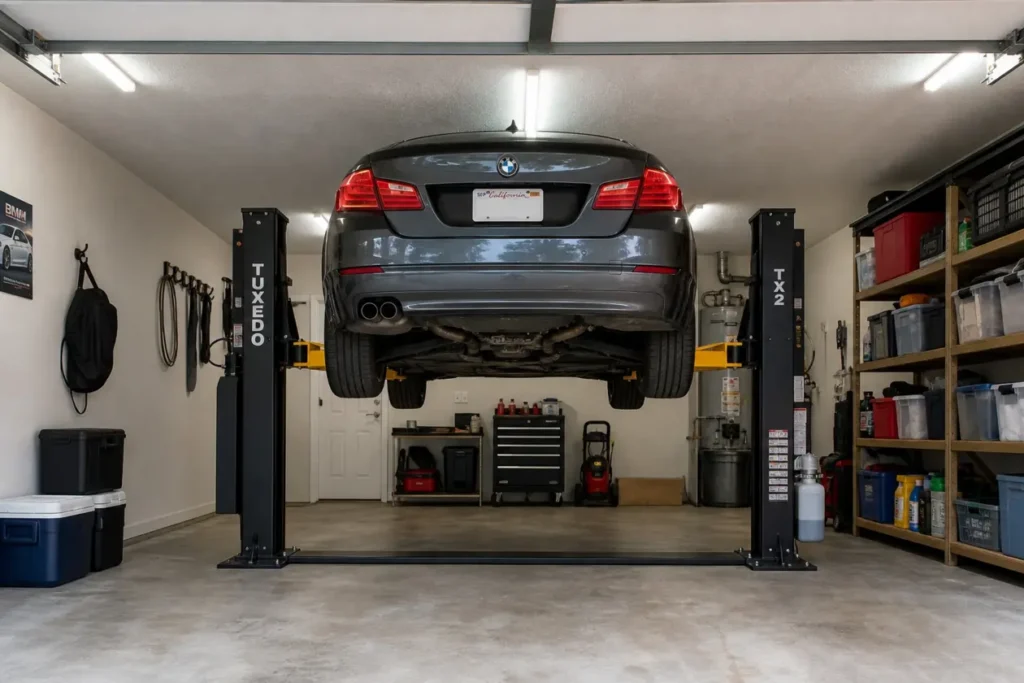
A standard 2-post car lift for an 8-foot ceiling won't work. Most full-size overhead 2-post lifts stand between 140 and 152 inches tall, and an 8-foot ceiling only gives you 96 inches. But you're not out of options. Floorplate 2-post lifts, mid-rise scissor lifts, and portable two-post systems can all fit under lower ceilings, depending on your exact measurements and the vehicles you plan to service.
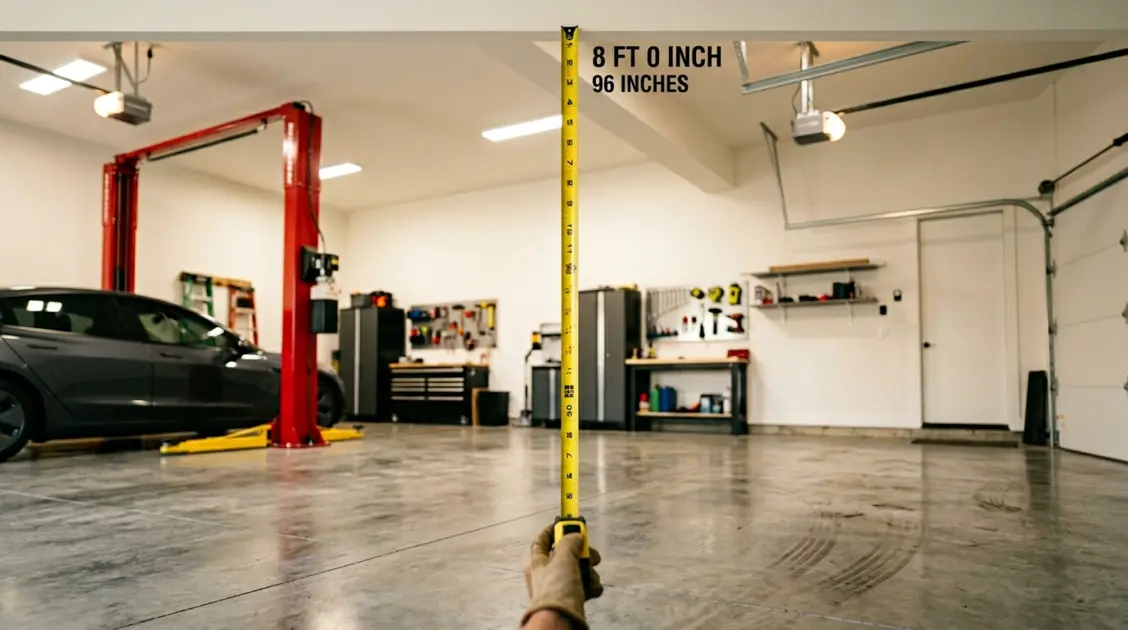
Here's the honest truth: 8 feet (96 inches) is very tight. You won't be standing upright under a raised truck. But if your goal is to lift cars and smaller SUVs high enough to do brake, suspension, and exhaust work, the right equipment can make it happen.
Key Takeaway
An 8-foot ceiling rules out standard overhead 2-post lifts. Your realistic options are floorplate 2-post lifts (starting around 9.5 feet of ceiling clearance), mid-rise scissor lifts, and portable two-post systems. Always measure to the lowest obstruction in your garage, not just the drywall ceiling.
How to Calculate the Ceiling Height You Need for a Car Lift
Before you shop for any car lift, you need one simple formula. This tells you how high of a ceiling you actually need for a given lift and a given vehicle.
The Ceiling Height Formula
Minimum Ceiling Height = Lift Height at Top Lock + Vehicle Height (from lift point to roof) + 6-Inch Safety Buffer
That 6-inch buffer protects you from hitting light fixtures, garage door tracks, and opener motors. Some installers recommend more, but 6 inches is the commonly accepted minimum.
For example, a mid-rise scissor lift with a 54-inch max lift height, raising a sedan that measures 48 inches from its frame to its roof, needs 54 + 48 + 6 = 108 inches. That's 9 feet. Too tall for a strict 8-foot ceiling, but it works if you don't raise the lift to its maximum lock position.
Pro Tip: Measure to the Lowest Obstruction
Don't just measure floor to ceiling. Open your garage door and check the height of the door tracks, the opener rail, and any hanging light fixtures. The lowest of these is your real available height. Many garages lose 6 to 18 inches to door hardware alone.
Common Vehicle Heights to Know
Your vehicle's height from the lift point (frame or rocker panel) to the roof is what matters most, not the total height from the ground. That said, here's a general reference. Subtract roughly half the tire diameter if you're lifting by the frame on a 2-post lift.
| Vehicle Type | Typical Total Height | Approx. Height from Frame to Roof |
|---|---|---|
| Sports cars | 47 - 54 inches | 33 - 40 inches |
| Sedans | 54 - 60 inches | 40 - 46 inches |
| Compact SUVs | 60 - 67 inches | 46 - 53 inches |
| Full-size SUVs | 67 - 75 inches | 53 - 61 inches |
| Pickup trucks | 68 - 78 inches | 54 - 64 inches |
These numbers tell you something important. Even a sedan at 46 inches from frame to roof, plus a 54-inch lift height, plus a 6-inch buffer, puts you at 106 inches. That's 8 feet 10 inches. This is exactly why 8-foot ceilings are so limiting for standard lifts.
What Types of Car Lifts Work in Low-Ceiling Garages?
So how tall of a ceiling for a car lift do you actually need? It depends entirely on the lift type. Here's a full breakdown of every major lift style and the car lift minimum ceiling height each one requires.
| Lift Type | Overall Height | Min. Ceiling Height | Best For |
|---|---|---|---|
| Low-rise scissor lift | 4 - 5 in. (lowered) | 8 feet | Tire, brake, and oil change work |
| Mid-rise scissor lift | 5 - 6 in. (lowered) | 8 - 9 feet | Undercar access on sedans and sports cars |
| Portable two-post lift | ~89 inches | 8 feet | Home garages needing a removable setup |
| Floorplate 2-post lift | 109 - 114 in. | 9.5 - 10 feet | Full wheels-free service in low-ceiling shops |
| Standard overhead 2-post lift | 140 - 152 in. | 12+ feet | Full-service auto repair shops |
| 4-post storage/parking lift | 82 - 96 in. | 9 - 10 feet | Vehicle storage and parking |
| Standard 4-post service lift | 96+ inches | 12 - 14 feet | Drive-on service and alignment work |
The bottom line: if you're asking how high of a ceiling for a car lift, the answer ranges from 8 feet for basic scissor lifts all the way to 14 feet for full-size 4-post alignment lifts. Your garage height narrows the list fast.
Floorplate 2-Post Lifts: The Low-Ceiling Champion
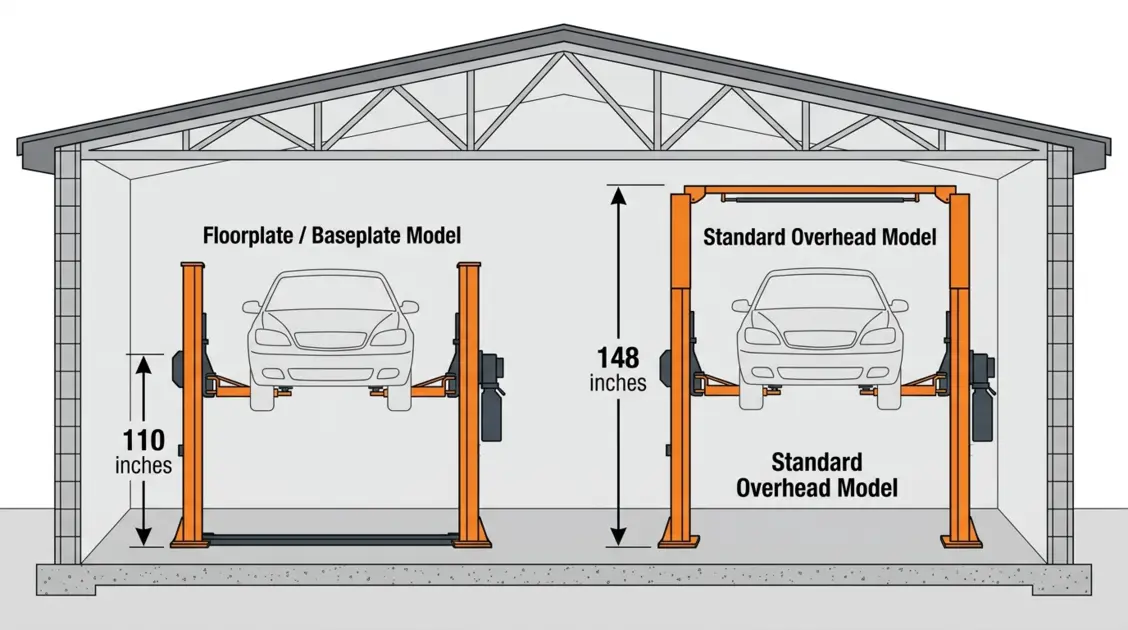
A floorplate 2-post lift is the closest thing to a full-size 2-post lift that fits in a low-ceiling space. Instead of an overhead bar connecting the two columns, a floorplate lift uses a steel base plate at floor level to connect and stabilize the posts.
This eliminates the overhead crossbar entirely. The result? Overall car lift heights around 110 to 114 inches (roughly 9 feet 2 inches to 9 feet 6 inches), compared to 140+ inches for standard overhead models. That's a full 2 to 3 feet shorter.
You still get wheels-free access, which means brake jobs, suspension swaps, exhaust work, and full undercar service are all on the table. The tradeoff is a small floor-level plate (usually about 2 inches tall and 8 to 9 inches wide) running between the posts. Most technicians don't find it to be a problem.
Mid-Rise Scissor Lifts
If you truly have only 8 feet to work with, a mid-rise scissor lift is one of your strongest options. These lifts sit nearly flush with the floor when lowered (around 5 to 6 inches) and can raise a vehicle 40 to 54 inches off the ground.
The downside? You won't stand upright under the car. You'll work from a creeper or a stool. Some mid-rise lifts also have a center platform that partially blocks undercar access, though open-center designs solve this problem.
Portable Two-Post Lifts
Products like the MaxJax series offer a portable two-post design with an overall height around 89 inches. They fit under 8-foot ceilings and can be removed when not in use. Lifting capacity is typically 6,000 to 7,000 lbs, with a max lift height around 48 inches.
These are a solid choice for home garages where the space does double duty as a parking spot and a workshop. The compromise is lower capacity and less lift height compared to permanent floorplate models.
Low-Rise Scissor Lifts
For the most height-restricted spaces, low-rise scissor lifts max out at about 24 to 26 inches of lift. That's enough for tire rotations, oil changes, and brake pad swaps, but not much else. They're the easiest to fit under an 8-foot ceiling and often run on standard 110V power.
The Daytona Low-Ceiling Advantage: Floorplate Lifts Built for Tight Spaces
At Daytona Automotive Equipment, we've spent over 25 years designing lift equipment for shops across the US and Canada. We hear the ceiling height question constantly, and it's exactly why we built our floorplate lift line.
The Daytona LTPF9 is a 9,000 lb capacity floorplate 2-post lift with an overall height of just 110 inches. That means it fits in shops and garages with ceilings as low as 9 feet 6 inches (after accounting for a buffer). It features chain-over hydraulic cylinders, automatic safety locks with single-point release, high-polymer polyethylene slide blocks, and three-stage front arms.
For heavier vehicles, the Daytona LTPF12 bumps capacity to 12,000 lbs with an overall height of 114 inches. It uses dual chain-drive hydraulic cylinders and the same safety lock system. Both models run on 240V single-phase power.
Both lifts are covered by our 5-2-1 warranty: 5 years structural, 2 years on power units, and 1 year on parts. Freight is covered within Canada and the continental US for warranty parts.
If your ceiling is under 9 feet 6 inches, our LMS6 mid-rise scissor lift offers 6,000 lbs of capacity with a max lift of 54 inches, a 45-second rise time, and a lowered height of just 5.5 inches. It runs on 120V power, making it friendly for most residential and small shop electrical setups.
If neither a floorplate 2-post nor a scissor lift meets your needs, Daytona also builds the LHS7 high-rise scissor lift with 6,600 lbs capacity and a max locking height of 71 inches. It does require a 240V circuit and more ceiling room, but it's worth considering for shops with 10-foot ceilings that want a flush-floor lift without columns.
Explore Daytona's full 2-post lift lineup to compare overhead, adjustable, and floorplate models side by side.
What If You Have a 9- or 10-Foot Ceiling?
If your height of garage for a car lift is closer to 9 or 10 feet, your options open up significantly. Here's what becomes available at each range.
9-foot ceiling (108 inches): Portable two-post lifts fit comfortably. Some specialty overhead models (like BendPak's GrandPrix GP-7LCS at 106.5 inches) can work. Mid-rise scissor lifts are easy to fit. You'll be limited to sedans and sports cars at the top lock position on most lifts.
10-foot ceiling (120 inches): This is where floorplate 2-post lifts become a strong option. At 110 to 114 inches overall, Daytona's LTPF9 and LTPF12 fit with room to spare. A car lift for a 10-foot ceiling gives you enough clearance for sedans, most SUVs, and light trucks. You can also consider compact 4-post parking lifts if vehicle storage is your goal. Daytona's LFPP9 runs on 120V power and offers 70.9 inches of under-lift clearance, making it practical for stacking two sedans in a 10-foot garage.
11+ foot ceiling (132+ inches): Standard overhead and adjustable 2-post lifts start to fit. Models like Daytona's LTPA10 and LTPA12 adjustable lifts offer three width settings and optional height extension kits for added versatility. The 4-post car lift ceiling height requirement of 12 to 14 feet means full-size 4-post service lifts still need more room.
Garage Prep Checklist Before Installing a Low-Ceiling Lift
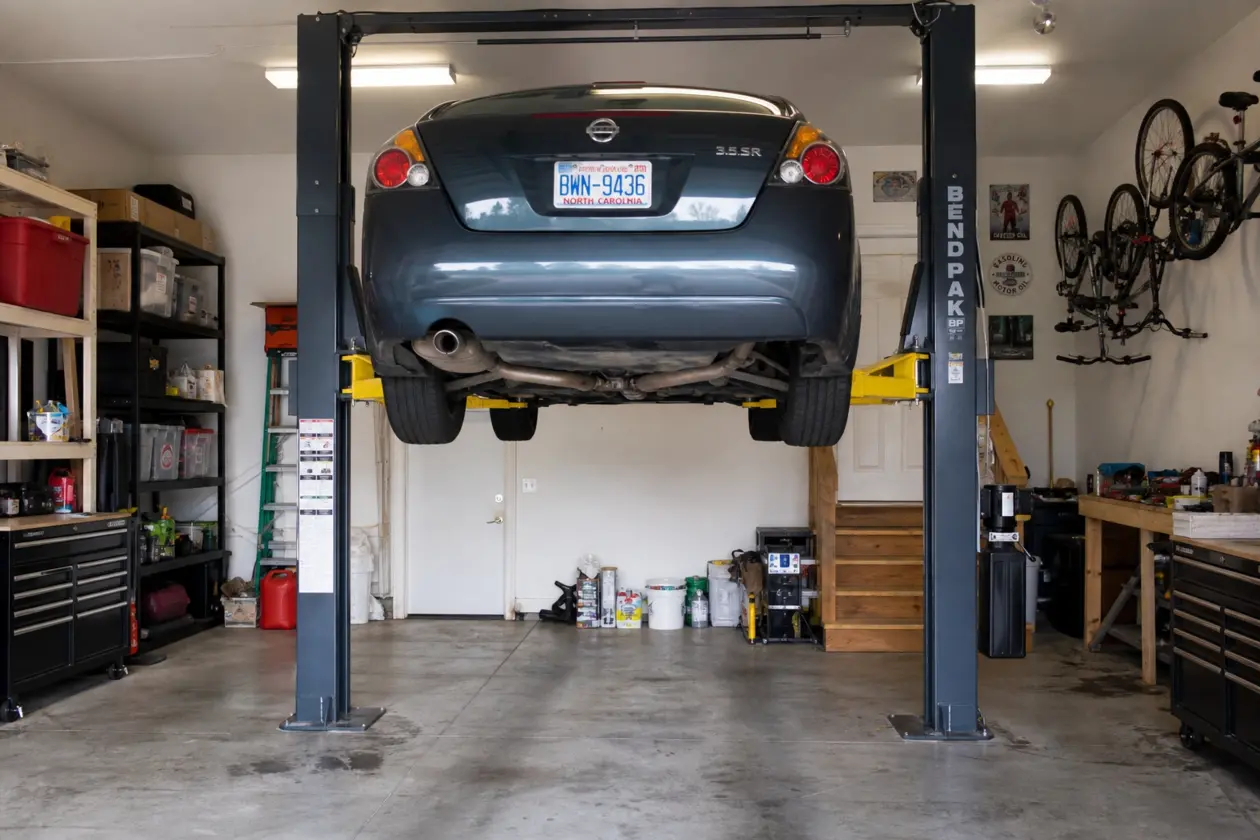
The ceiling height for a 2-post lift gets all the attention, but it's only one piece of the puzzle. Here's what else you need to check before buying a lift for a low-ceiling garage.
Concrete Slab Requirements
Most 2-post lifts need a minimum of 4 inches of reinforced concrete rated at 3,000 PSI. Six inches is better, especially for lifts rated over 10,000 lbs. The concrete should be cured (at least 28 days old), free of major cracks, and reasonably level where the posts will sit.
Scissor lifts spread the load more evenly, so they're more forgiving on thinner slabs. Still, always check the manufacturer's installation manual for exact requirements.
Electrical and Power Needs
Low-rise and some mid-rise scissor lifts run on standard 110V/120V household circuits. That's a big advantage for home garages. But most 2-post floorplate lifts, including Daytona's LTPF9 and LTPF12, require 240V single-phase power on a dedicated circuit.
If your garage doesn't have a 240V outlet, budget for an electrician to run one. It's typically a few hundred dollars and well worth the investment.
Garage Door and Opener Modifications
What Is a High-Lift Track Conversion?
A high-lift conversion modifies your garage door's track system so the door hugs the ceiling more closely when open. Combined with a wall-mounted jackshaft opener (instead of a ceiling-mounted rail), this can recover 6 to 18 inches of overhead clearance. Based on reports across industry forums, a professional high-lift conversion typically costs between $2,000 and $5,500 per door, depending on the garage and region.
In many low-ceiling garages, the door tracks and ceiling-mounted opener are the real height bottleneck. Swapping to a high-lift track and a wall-mounted jackshaft opener is one of the most effective upgrades you can make. Even replacing hanging fluorescent fixtures with flush-mount LEDs can buy you a couple of extra inches.
Safety Considerations for Any Lift Installation
Regardless of what lift you choose, safe installation and operation are non-negotiable. The Automotive Lift Institute (ALI) publishes 13 key safety tips that apply to every lift type, covering proper vehicle positioning, lock engagement, and routine inspections. It's worth reading before your first lift arrives.
On the regulatory side, OSHA does not have a specific standard for automotive lifts, but it does enforce the General Duty Clause, which requires employers to keep the workplace free of recognized hazards. That means proper training, regular inspections, and following the manufacturer's manual aren't optional for commercial shops.
For operation and inspection guidance, the industry follows the ANSI/ALI ALOIM standard, which outlines safety requirements for lift use, inspection, and maintenance. If you're running a professional shop, this is the document your safety program should reference.
How to Decide Which Lift Fits Your Garage
We've talked to hundreds of shop owners and garage builders over 25 years in business. Based on that experience, here's a simple framework we recommend. We call it the Ceiling-to-Lift Match decision path.
Step 1: Measure your ceiling to the lowest obstruction. Not the drywall. The lowest thing hanging from the ceiling, whether that's a door track, opener rail, light fixture, or beam. Write this number down in inches.
Step 2: Subtract 6 inches for a safety buffer. This is your usable height.
Step 3: Match your usable height to a lift category:
| Your Usable Height | Recommended Lift Type | Daytona Option |
|---|---|---|
| Under 90 in. (under 7.5 ft) | Low-rise scissor lift only | - |
| 90 - 102 in. (7.5 - 8.5 ft) | Mid-rise scissor lift or portable 2-post | LMS6 (5.5" lowered, 54" max lift) |
| 103 - 114 in. (8.5 - 9.5 ft) | Floorplate 2-post lift | LTPF9 (110" overall, 9,000 lbs) |
| 115 - 120 in. (9.5 - 10 ft) | Floorplate 2-post or compact 4-post | LTPF12 (114" overall, 12,000 lbs) |
| 132+ in. (11+ ft) | Standard overhead or adjustable 2-post | Full 2-post lineup |
Step 4: Check the tallest vehicle you'll lift. Run the ceiling height formula (lift height + vehicle height from lift point to roof + 6" buffer). If the total exceeds your ceiling, you'll need to use a lower lock position or choose a shorter lift.
Step 5: Verify concrete, power, and door clearance. These are the three deal-breakers that have nothing to do with the lift itself.
Need help choosing the right lift for your space? Request a free quote from Daytona and include your garage dimensions. Our team can help you match a lift to your exact setup. You can also download our full product brochure to compare specifications across the entire lineup, or find a Daytona distributor near you for installed pricing and local support.
Frequently Asked Questions
Can you put a 2-post lift in an 8-foot garage?
A standard overhead 2-post lift will not fit in an 8-foot garage. These lifts typically stand 140 to 152 inches tall, far exceeding the 96 inches available in an 8-foot space. However, portable two-post systems and mid-rise scissor lifts can work in 8-foot garages, and floorplate 2-post lifts can fit in garages with ceilings of about 9.5 feet or higher.
What is the minimum ceiling height for a 2-post car lift?
Standard overhead 2-post lifts need at least 11 to 12 feet of ceiling height. Floorplate (baseplate) 2-post models need roughly 9.5 to 10 feet because they eliminate the overhead crossbar. Always check the specific model's overall height and add 6 inches for a safety buffer above the lift columns.
How high of a ceiling do you need for a car lift?
It depends on the lift type. Low-rise scissor lifts work with 8-foot ceilings. Mid-rise scissor lifts need 8 to 9 feet. Floorplate 2-post lifts need 9.5 to 10 feet. Standard 2-post lifts need 12 feet or more. Standard 4-post service lifts need 12 to 14 feet. Always use the formula: lift height + vehicle height (from lift point to roof) + 6-inch buffer.
What type of car lift works best for low ceilings?
For ceilings under 9 feet, mid-rise scissor lifts and portable two-post systems are the best options. For ceilings between 9.5 and 10 feet, floorplate 2-post lifts offer the best combination of lifting capacity, undercar access, and low overall height. The Daytona LTPF9 stands just 110 inches tall and lifts up to 9,000 lbs.
What is a floorplate 2-post lift?
A floorplate 2-post lift connects its two columns with a steel base plate at floor level instead of an overhead crossbar. This design dramatically reduces the overall height of the lift, typically to 109 to 114 inches compared to 140+ inches for overhead models. The floorplate is usually about 2 inches tall and does not significantly interfere with technician movement.
Can you use a car lift with a 10-foot ceiling?
Yes. A 10-foot ceiling (120 inches) opens up several lift options. Floorplate 2-post lifts with overall heights of 110 to 114 inches fit well. Compact 4-post storage lifts can also work for vehicle parking. You'll still need to verify clearance using the formula: lift height + vehicle height + 6-inch buffer. Sedans and most SUVs can typically be serviced at this ceiling height.
Do I need to modify my garage door for a car lift?
Possibly. In many low-ceiling garages, the door tracks and ceiling-mounted opener are the real height bottleneck. A high-lift track conversion repositions the door to hug the ceiling, and a wall-mounted jackshaft opener removes the ceiling rail entirely. Together, these modifications can recover 6 to 18 inches of usable overhead clearance.
How much concrete do you need for a 2-post lift?
Most 2-post car lifts require a minimum of 4 inches of reinforced concrete rated at 3,000 PSI. For lifts over 10,000 lbs capacity, 6 inches is recommended. The concrete should be fully cured (at least 28 days old), structurally sound, and level where the posts will be anchored. Always refer to the manufacturer's installation manual for exact requirements.
Is a scissor lift better than a 2-post lift for low ceilings?
A scissor lift fits under lower ceilings, which is its biggest advantage. However, a 2-post lift provides better undercar access because it lifts by the vehicle frame and leaves the wheels hanging free. If your ceiling allows a floorplate 2-post, that's typically the better choice for repair work. If you're limited to 8 feet, a mid-rise scissor lift may be your only practical option.
What is the tallest vehicle I can lift with an 8-foot ceiling?
It depends on the lift's maximum height. With a mid-rise scissor lift maxing out at 54 inches, you'd have about 42 inches of remaining clearance for the vehicle (96 minus 54). That's enough for most sports cars and low-profile sedans measured from the lift point. Taller vehicles like SUVs and trucks would need to be raised to a lower lock position or serviced in a taller space.
Need a Lift That Fits Your Low-Ceiling Garage?
Daytona Automotive Equipment builds floorplate 2-post lifts and mid-rise scissor lifts designed for exactly this situation.
- LTPF9: 9,000 lbs capacity, 110" overall height for floorplate 2-post lifting
- LTPF12: 12,000 lbs capacity, 114" overall height for heavier vehicles
- LMS6: 6,000 lbs mid-rise scissor lift with 54" max lift on 120V power
- 5-2-1 Warranty: 5 years structural, 2 years power units, 1 year parts
- Canadian owned and operated, serving the US and Canada since 1999
Tell us your ceiling height, bay dimensions, and the vehicles you service. We'll recommend the right lift for your space and send you a quote.
Get a Free Quote