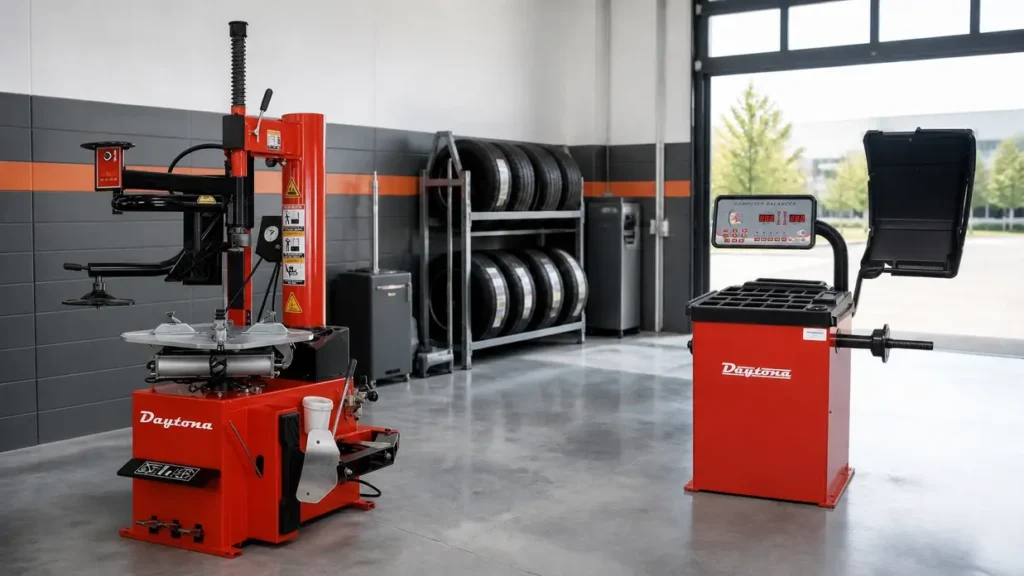
Tire shop equipment is the set of machines a shop uses to remove, install, and balance tires safely and fast. The two machines you cannot run a tire bay without are a tire changer, which pulls the old tire off the rim and mounts the new one, and a wheel balancer, which spins the wheel to find heavy spots and tells you exactly where to add small weights. Get those two right and you can service most cars and light trucks that roll through your door.
This guide walks you through every piece of tire service equipment a shop needs, how to pick the right tire changer and balancer for your volume, and a few things competitors rarely explain, like road force balancing and what really causes brake pulsation. Daytona has supplied tire equipment to shops across the US and Canada since 1999, and the advice below reflects what we see working in real bays in 2026.
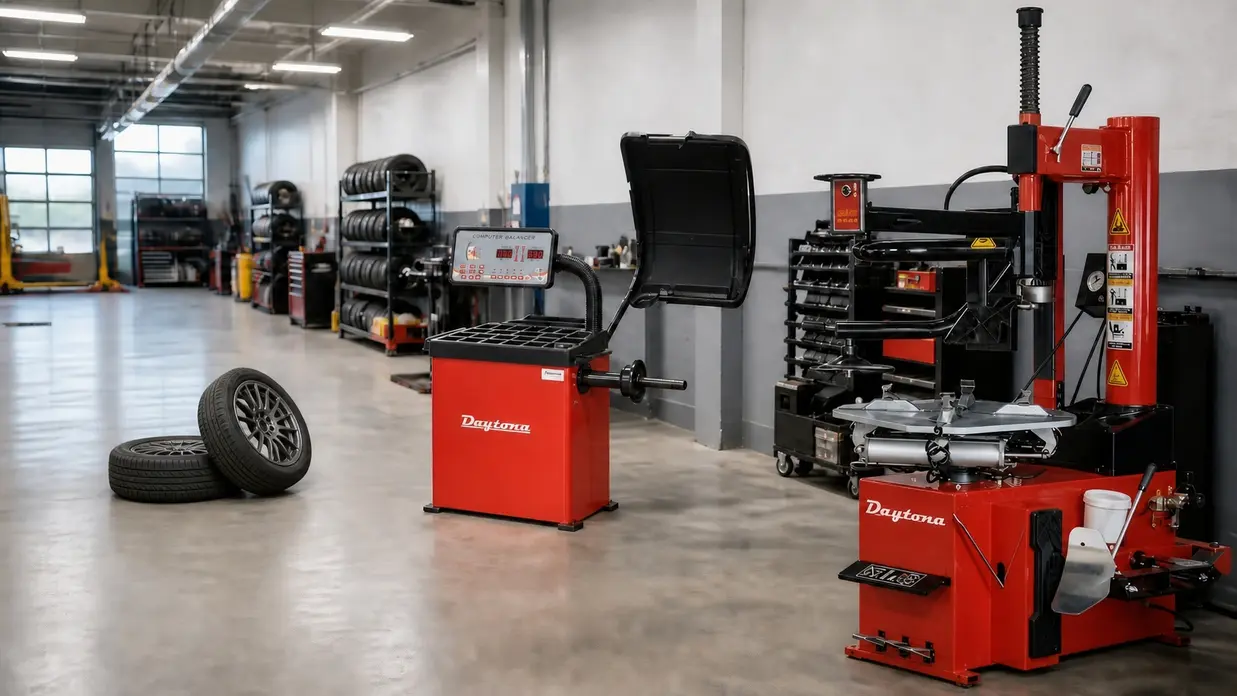
What Counts as Tire Shop Equipment?
At its core, tire shop equipment means a tire changer plus a wheel balancer. A full bay also adds an air compressor, a torque wrench, a bead seater, and small tools like valve stem and TPMS tools. But the two big machines decide how fast and how professional your tire service feels.
What Equipment Does a Tire Shop Actually Need?
Here's the thing: you don't need a wall of machines to run a solid tire bay. You need the right two big ones, plus a short list of support tools.
Most shops build around a tire changer and balancer pair. The changer handles mounting and demounting. The balancer makes sure the finished wheel spins smooth so the customer doesn't feel a shake at highway speed.
Around those two, you'll want an air compressor sized to your changer, a calibrated torque wrench so lug nuts go on right, a bead seater for stubborn tires, and the small stuff: valve stem tools, TPMS tools, a tread depth gauge, and a good tire pressure gauge.
In our experience, where new shops go wrong is buying the cheapest big machine and the most support gadgets. Flip that. Spend on the changer and balancer, because those are what your techs touch all day. You can group both of our core machines on one page: the tire equipment hub lists every Daytona changer and balancer in one place.
The Full Tire Bay Equipment List
If you're starting from scratch, it helps to see the whole list in order of importance. Buy from the top down as your budget allows.
| Equipment | What It Does | Priority |
|---|---|---|
| Tire changer | Removes and mounts tires on rims | Essential |
| Wheel balancer | Spins the wheel to find and fix heavy spots | Essential |
| Air compressor | Powers pneumatic tools and bead seating | Essential |
| Calibrated torque wrench | Tightens lug nuts to the carmaker's exact spec | Essential |
| Bead seater / inflator | Seats stubborn tire beads onto the rim | High |
| TPMS tools | Reads and resets tire pressure sensors | High |
| Valve stem tools | Replaces valve stems during a tire swap | Medium |
| Tread depth and pressure gauges | Checks wear and sets correct pressure | Medium |
Notice the pattern. The first four items are non-negotiable, and the changer and balancer are the heart of it. Everything below them supports those two machines.
Tire Changer vs Wheel Balancer: What's the Difference?
People mix these up all the time, so let's keep it simple.
A tire changer takes the tire on and off the metal rim. A wheel balancer doesn't touch the tire-to-rim job at all. It spins the finished wheel to find heavy spots and tells you where to clip on small weights so the wheel rides smooth.
You need both. A perfectly mounted tire that isn't balanced will still shake the steering wheel. A perfectly balanced wheel that was mounted badly can leak air or sit crooked. They're a team, and skipping either one shows up in the customer's hands at 70 mph.
One more point worth making. Tire and wheel service is genuinely a skilled trade, not a button-press job. The Tire Industry Association runs technician training and certification programs precisely because doing this work safely takes know-how. Good machines make a trained tech faster; they don't replace the training.
How to Choose a Tire Changer for Your Shop
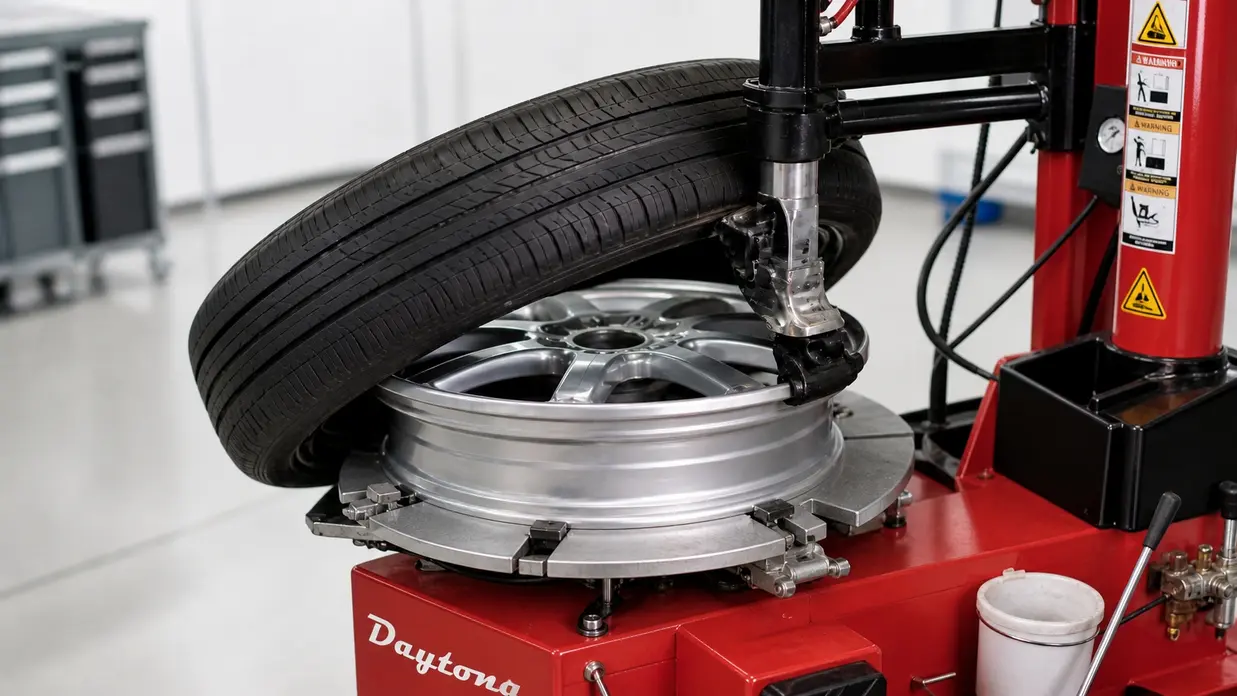
The tire changer is the workhorse of the bay, so this is the machine to get right first. A professional tire changer is judged on a few simple things: the rim sizes it can grip, the biggest tire it can handle, how strong its bead breaker is, and how much it protects the wheel from scratches.
Before you shop, answer three questions. What's the biggest wheel you'll service? How many tires do you change in a busy day? And how fancy are the wheels, meaning low-profile, run-flat, or expensive alloy rims that scratch easily?
Your answers point you to a tier. A light passenger-car shop is fine with a base swing-arm machine. A busy shop with big trucks and pricey rims wants a tilt-back or leverless machine that's faster and gentler on wheels.
Daytona's lineup covers the full range: the swing-arm TC-880 for lower-volume bays, the low-profile specialist TC-890 for mid-volume work, and the heavy-duty tilting TC-890T for high-volume shops. We go deeper on each in our full tire changers guide.
The Specs That Actually Matter on a Tire Changer
It's easy to drown in spec sheets, so focus on the handful that change your day-to-day work.
Look at the clamping range first. Outside clamping range tells you the smallest and largest rims the jaws grab from the outside; inside clamping range does the same from the inside. A wider range means more wheels you can service without swapping setups. The TC-890T, for example, clamps from 13 to 26 inches outside and up to 28 inches inside.
Next, check the maximum tire diameter, which is the tallest tire the machine can swallow. A heavy-duty machine handling 42-inch tires opens you up to big trucks and SUVs that a base machine can't touch.
Then look at bead breaker force, measured in tons. A strong bead breaker pops stubborn beads loose without a fight. All of Daytona's car changers carry a 2.75-ton bead breaker, which is plenty for passenger and light-truck work.
Finally, look for wheel protection features like rim protectors, plastic jaw covers, and air bead-assist. These small things keep you from scratching a customer's $1,500 set of wheels, which is the kind of mistake that erases a day's profit in one swipe.
Rim Clamp vs Center Post Clamping
There are two ways a changer grips a wheel. A rim clamp machine uses a tabletop with four adjustable jaws that grab the rim from the edge. A center post (or center clamp) machine holds the wheel by the center hub instead.
Rim clamp is the most common style and very fast. Center clamping holds tight and never slips, which is great for delicate aftermarket wheels, though it can need adapters, as Hunter Engineering notes. Most shops do fine with a quality rim clamp machine, and that's what the vast majority of changers on the market use.
Swing-Arm vs Tilt-Back vs Leverless Tire Changers
Once you've picked a clamping style, the next choice is the tool-head design. These are the three main types of tire changers you'll compare, and each suits a different shop.
A swing arm tire changer has a mount/demount arm that swings out of the way so you can load the wheel. It's the most affordable style and great for steady, lower-volume work. The trade-off is the tech adjusts the head by hand for different tire sizes, which costs a few seconds each wheel.
A tilt back tire changer has a column that tilts backward, opening up more room to work. It's faster and easier on big or wide tires, which is why busy shops like it. It costs more than a swing-arm, but you make that back in speed.
A leverless tire changer uses bead lifters instead of a pry bar. That means less chance of scratching a wheel or pinching a bead, and it shines on run-flats and low-profile tires. It's the priciest option and takes some training, but it's the gentlest and fastest for skilled techs.
| Changer Type | Best For | Speed | Wheel Protection | Relative Cost |
|---|---|---|---|---|
| Swing-Arm | Low to mid-volume shops, standard passenger tires | Good | Good | $ |
| Tilt-Back | Busy shops, larger and wider tires | Faster | Better | $$ |
| Leverless | High-volume shops, run-flat and low-profile, alloy wheels | Fastest | Best | $$$ |
Our Take
For most general repair shops, we recommend a tilt-back over a base swing-arm. It costs a bit more upfront, but the time saved on every wheel and the lower risk of scratching a customer's expensive rim usually pays for itself faster than owners expect.
This is a topic worth its own deep dive, and we cover each head design, the training curve, and which shops should jump straight to leverless in our dedicated tire changer buying guide. For most readers here, the table above is enough to point you to the right tier.
Wheel Balancer Buying Guide
A balanced wheel is the difference between a smooth highway ride and an annoying shake at 70 mph. That's why the wheel balancer is the second machine no tire bay can skip.
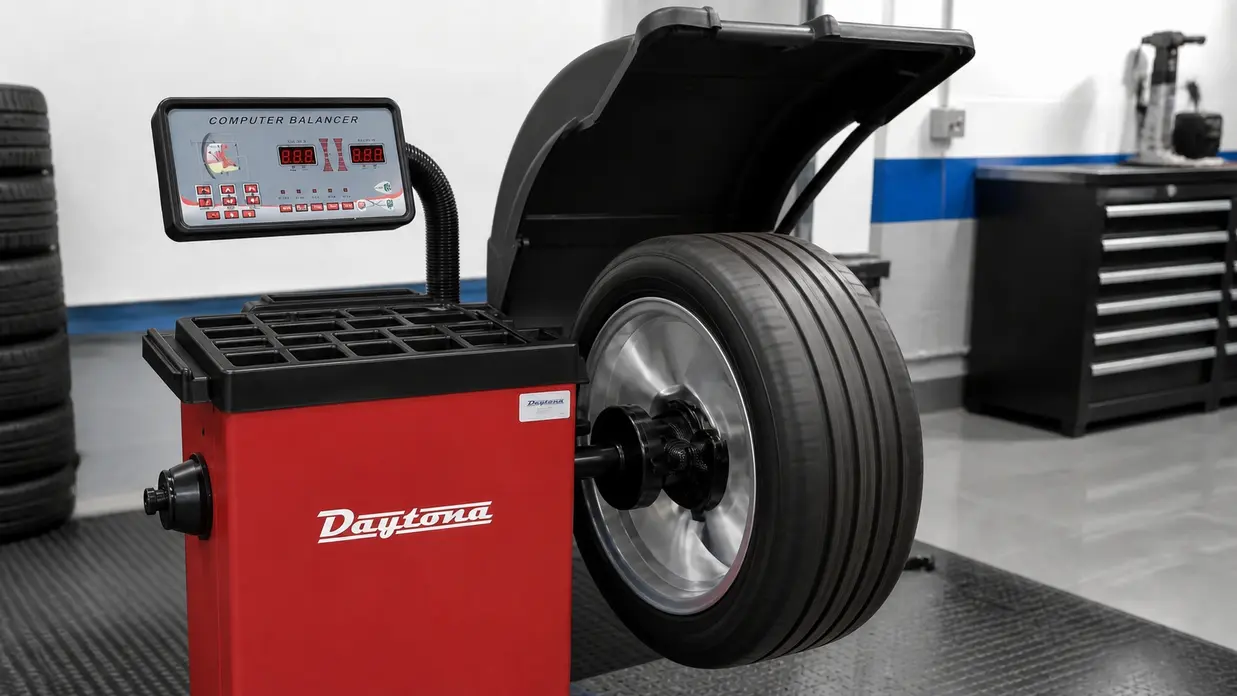
When you shop, look at four specs: the biggest wheel diameter and weight it handles, the rim range it fits, how accurate it reads (down to the gram is ideal), and how fast each spin cycle runs. A faster cycle moves more cars through the bay each day.
Daytona offers a clean three-tier lineup. The base BL-917 suits smaller shops, the mid-size BL-950 steps up speed, and the BL-956 heavy duty wheel balancer handles wheels up to 44 inches and 165 pounds with a 5 to 7 second cycle. All three read down to 1 gram. See them all on the wheel balancers page.
How Does a Wheel Balancer Work?
Wondering how to use a wheel balancer? The basic flow is the same on almost every machine.
You mount the wheel on the balancer's shaft and lock it tight. You enter the wheel's size, or the machine measures it for you. Then you spin it. The balancer's sensors find the heavy spots and the screen tells you exactly where to clip on small weights and how heavy each one should be. You add the weights, spin again to confirm, and you're done.
It sounds simple, and on a good machine it is. But two small habits separate clean work from comebacks. First, make sure the wheel sits dead center on the shaft, because a wheel mounted a hair off-center will never read right. Second, always do a confirmation spin after adding weights. If it still reads heavy, recheck the centering before you blame the tire.
Static vs Dynamic Balancing
There are two balancing methods: static and dynamic. Static balancing fixes the wheel in one plane using weight in a single spot. A computer wheel balancer does dynamic balancing, spinning the wheel and adding weight to both the inside and outside, which is far more precise for everyday cars.
Static balancing still has a place, mainly for big truck tires and some wheels that can't take weight on the outside. But for the cars and light trucks most shops see, dynamic balancing on a computer machine is the modern standard. It catches side-to-side wobble that static balancing simply can't measure.
| Balancer Tier | Method | Best For | Daytona Model |
|---|---|---|---|
| Base | Dynamic (computer) | Small shops, standard passenger wheels | BL-917 |
| Mid-Size | Dynamic (computer) | Steady mid-volume shops | BL-950 |
| Heavy Duty | Dynamic (computer) | High volume, large wheels up to 44 in | BL-956 |
| Motorcycle | Static | Bike and powersports wheels | BL-630M |
For a busy shop, a heavy duty wheel balancer with a fast cycle and gram-level accuracy is worth every dollar. Shaving even two seconds off each spin adds up to real time over hundreds of wheels a week.
Road-Force vs Standard Wheel Balancing
This is where most buying guides go quiet, so let's break it down. Standard balancing only fixes weight imbalance. Road force balancing goes a step further and copies the load of the road.
So what is road force balancing? A road force machine presses a large roller against the spinning tire to mimic the weight of the car on the road. It measures how stiff and how round the tire and wheel really are. Standard spin balancing can't catch a tire that's slightly egg-shaped or a wheel with too much runout, but road force can.
| Feature | Standard Balancing | Road Force Balancing |
|---|---|---|
| What it fixes | Weight imbalance only | Weight imbalance plus stiffness and roundness |
| Simulates the road? | No | Yes, with a load roller |
| Catches egg-shaped tires? | No | Yes |
| Best for | Most everyday wheels | Hard-to-fix vibrations and high-end vehicles |
| Cost of machine | Lower | Higher |
Bottom line on road force vs standard balancing: standard balancing handles the vast majority of cars. Road force is the tool you reach for when a vibration won't go away after a normal balance, or for premium vehicles where the customer expects a perfectly smooth ride. It's a great upsell, but it's not something every small shop needs on day one.
When Road Force Earns Its Keep
If a car comes back twice with a vibration you can't kill, road force balancing usually finds the hidden problem fast. For a high-volume shop that hates comebacks, it pays for itself in saved labor and happier customers. For a small shop, a quality dynamic balancer plus careful work is enough to start.
Should You Buy a Tire Changer and Balancer Combo?
A tire machine and balancer combo is simply buying both core machines together, often from one supplier, sometimes at a package discount. For a new or growing shop, it's usually the smart move.
Why? You save space by planning both machines into the bay layout at once. You save time because the two work as a pair every single day. And buying from one source means one warranty conversation and one set of parts, instead of chasing two brands.
We're biased here, and we'll say so plainly: buying your changer and balancer from the same maker keeps service simple. Daytona offers both under one roof with the same 5-2-1 warranty, which is one reason shops choose us for a full tire bay rather than mixing brands. Browse matched options on the tire equipment hub.
How to Pair a Changer and Balancer by Tier
The cleanest way to buy a combo is to match the two machines to the same volume tier. A mismatched pair, like a top-tier changer next to a base balancer, creates a bottleneck at the slower machine.
| Shop Tier | Changer | Balancer | Why They Pair |
|---|---|---|---|
| Small | TC-880 | BL-917 | Both handle steady passenger work at a value price |
| Mid-Volume | TC-890 | BL-950 | Faster cycle and low-profile ability on both |
| High Volume | TC-890T | BL-956 | Speed and big-wheel capacity matched end to end |
The Complete Guide to Motorcycle Tire Changers
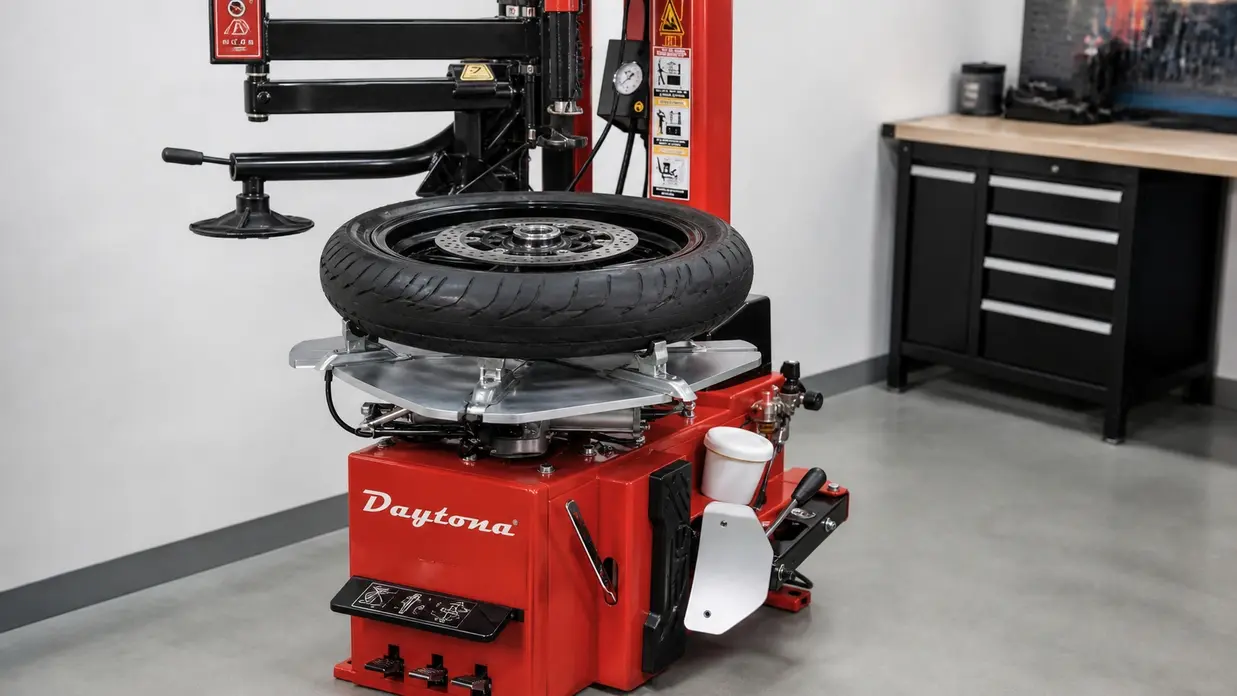
Car tire machines and motorcycle machines are not the same. A car changer's jaws are built for car rims and can crush or scratch a narrow bike rim. That's why a dedicated motorcycle tire changer matters if you service bikes.
A motorcycle machine has clamping made for narrow rims, usually in the 3 to 12 inch rim-width range, and a smaller, gentler bead breaker. Daytona's TC-806M motorcycle tire changer clamps wheels from 6 to 24 inches and handles tires up to 37 inches, with dedicated motorcycle clamping that protects the rim.
A pneumatic motorcycle tire changer uses shop air to power the bead breaker and clamping, which speeds up the job and saves your tech's back. If you do any real volume of bike tires, a powered motorcycle tire machine pays off fast compared to fighting tires by hand with spoons.
Why a Car Machine Will Not Do
It's tempting to think you can just run bike wheels on the car changer you already own. Don't. The risks are real and expensive.
Bike rims are narrow and often soft alloy, so car jaws can dent or scratch them. Motorcycle tires also have stiff sidewalls and tight beads that a car machine's geometry fights against. And many bike wheels have brake rotors and pulleys mounted close to the rim that a car changer can bend.
A dedicated bike machine solves all three. It's built around the narrow rim, the gentle bead break, and the clearance those wheels need. If bikes are even a small part of your business, the right machine protects your customers' wheels and your reputation.
What to Look for in a Motorcycle Tire Machine
When you shop for a bike changer, focus on the rim-width range, the clamping style made for spoked and cast wheels, and whether it's powered by air or done by hand. A powered, pneumatic machine is the clear pick for a shop; hand tools are fine only for the occasional home job.
Motorcycle Wheel Balancers Explained
Bike wheels need balancing too, and they have their own rules. A motorcycle wheel balancer is built for lighter, narrower wheels and usually uses static balancing rather than the dynamic spin a car gets.
Here's the key debate: static vs dynamic balancing motorcycle wheels. Static balancing uses one set of weights in the center plane of the wheel. Dynamic balancing uses two sets, inside and outside. For most street bikes, many riders and shops prefer static balancing, and a number of dealers favor it for motorcycle wheels.
A simple, well-built bike wheel balancer gets the job done for most powersports work. Daytona's BL-630M motorcycle wheel balancer handles rims from 1 to 25 inches and wheels up to 31 inches, sized specifically for bikes rather than cars.

Static vs Dynamic for Bikes: Which Should You Use?
For the vast majority of street motorcycles, static balancing is the standard and works beautifully. The wheels are light and narrow, so the side-to-side imbalance that dynamic balancing corrects is usually tiny on a bike.
Dynamic balancing can matter on wider rear tires found on big touring bikes and some sport bikes, where there's enough width for a true two-plane imbalance. But even then, plenty of experienced shops get excellent results with careful static work.
Quick Tip for Bike Shops
Don't try to balance motorcycle wheels on a car balancer's standard cone setup. Use a balancer made for bikes, or the right motorcycle adapter, so the wheel sits true on the shaft. A wheel that sits crooked on the shaft will never read right, no matter how good the machine is.
What Causes Brake Pulsation?
You might wonder why a tire equipment guide talks about brakes. Simple: brake pulsation often shows up right after tire service, and good shop habits during a tire job help prevent it. So let's clear up what causes brake pulsation, because a lot of common advice is wrong.
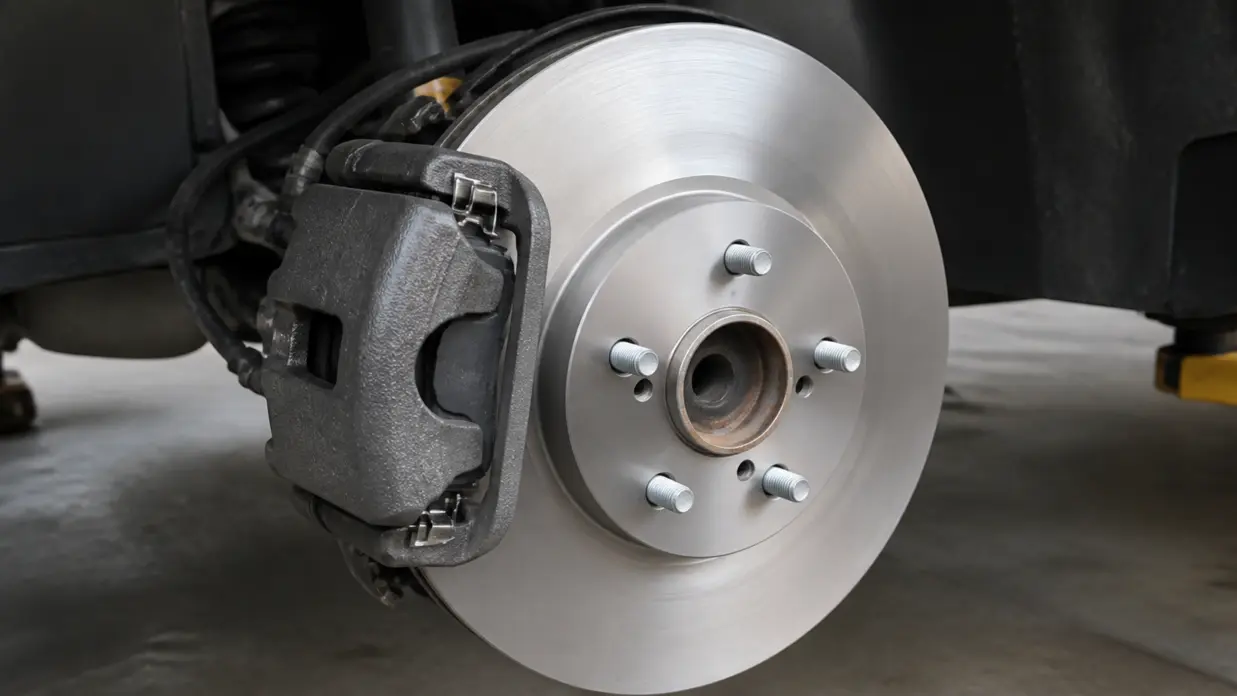
Most people blame "warped rotors." But brake engineers say rotors rarely actually warp. The real cause of that pulse you feel in the pedal is usually disc thickness variation, which means the rotor has high and low spots so it's slightly thicker in some places than others.
As the brake pads squeeze a rotor with uneven thickness, the pedal pushes back at you in a rhythm. That's the pulsation. According to Wagner Brake's technical team, disc thickness variation is commonly the result of excessive lateral runout, which is side-to-side wobble in how the rotor spins.
The Contrarian Truth About "Warped Rotors"
Rotors almost never warp from heat the way people assume. The pulsing pedal is nearly always disc thickness variation caused by lateral runout or uneven brake pad deposits. Knowing this saves you from replacing rotors that didn't need it.
How Tire Service Ties Into Brake Pulsation
Here's the link most guides miss. When you remount a wheel during tire service, how you torque the lug nuts matters. Tighten them unevenly or too tight with an impact gun, and you can introduce lateral runout that leads to that thickness variation over time.
The other culprit is brake pad deposits. When pad material transfers onto the rotor and builds up in patches, you get uneven brake pad deposits on rotors. Those patches change the rotor's effective thickness and feel just like a warped rotor, even though the metal is fine.
The fix at the tire bay is boring but powerful: always finish a wheel job with a calibrated torque wrench, in the right star pattern, to the carmaker's spec. It costs nothing and prevents a comeback. This is the kind of small habit that separates a professional tire shop from a sloppy one, and it's tied directly to the quality of your tire service equipment and process.
How to Prevent Pulsation Comebacks
A few simple steps at the wheel keep brake pulsation from landing back in your bay.
- Clean the hub face before mounting the wheel, since rust and grit cause runout.
- Snug the lug nuts by hand in a star pattern first, never all the way around in order.
- Final-torque with a calibrated torque wrench to the carmaker's exact spec.
- Never zip lug nuts tight with an impact gun alone, which over-torques unevenly.
- Tell the customer to recheck torque after the first 50 to 100 miles on new wheels.
None of this is glamorous, but it's the difference between a clean job and a callback. Note that this section is general guidance; brake diagnosis on a specific vehicle should follow that vehicle's service manual and a qualified technician's judgment.
Matching Tire Equipment to Shop Volume
Not every shop needs the same machines. The smartest way to buy is to match your gear to how many tires you actually change. We call this the Shop Volume Match, and it's the framework we walk customers through.
Think in three tiers. A low-volume bay does a handful of tire jobs a day. A mid-volume shop runs a steady stream. A high-volume operation is mounting and balancing tires nearly nonstop.

| Shop Volume | Typical Daily Tires | Recommended Changer | Recommended Balancer |
|---|---|---|---|
| Small / Low Volume | A few sets a day | Swing-arm (TC-880) | Base (BL-917) |
| Mid-Volume | Steady all-day flow | Mid / low-profile (TC-890) | Mid-size (BL-950) |
| High Volume | Near-constant tire work | Tilt-back heavy duty (TC-890T) | Heavy duty (BL-956) |
Tire Shop Equipment for a Small Shop
If you're choosing tire shop equipment for small shop setups, don't overbuy. A reliable swing-arm changer and a base computer balancer will handle most passenger and light-truck work without tying up cash you need elsewhere. You can always step up later as volume grows.
The mistake we see most often with new shops is spending on a top-tier machine before the volume justifies it. That money is usually better spent on a second bay, more inventory, or marketing in your first year. Buy solid, not flashy, and grow into the bigger machines.
Mid-Volume Shops
A mid-volume tire changer should be faster and better at low-profile tires, since you'll see more variety and more wheels per day. Step up to a machine that protects pricey rims and speeds the cycle, because at this stage every saved minute is a car you can fit in.
On the balancer side, a mid-size machine with a quicker spin keeps the changer and balancer in step, so neither becomes the bottleneck. This is the tier where pairing your two machines correctly really starts to pay off.
High-Volume Shops
For high volume tire shop equipment, speed and durability win. A tilt-back changer and a fast heavy-duty balancer keep cars moving and reduce tech fatigue, which matters when the bay never slows down. The faster cycle time on each machine adds up to real money over a year.
At this volume, also think about uptime. A machine that's built tough and backed by a real warranty keeps you from losing a whole day to a breakdown. That's part of why we back every Daytona tire machine with our 5-2-1 warranty, with freight included on warranty parts in the US and Canada.
Key Takeaway
Buy for the volume you have now, with a little room to grow. Overbuying ties up cash; underbuying slows your bay and frustrates techs. Match the machine tier to your real daily tire count, and you'll get the best return on every dollar.
Want a hand sizing your bay? Daytona is a Canadian-owned manufacturer of tire changers and wheel balancers serving shops across the US and Canada since 1999, and we're glad to spec a setup for your space and volume. Tell us about your shop and we'll point you to the right tier.
Frequently Asked Questions
What equipment do you need to start a tire shop?
At minimum you need a tire changer and a wheel balancer, plus an air compressor, a calibrated torque wrench, a bead seater, and small tools like valve stem and TPMS tools. The changer and balancer are the two machines that decide how fast and professional your tire service feels, so invest there first.
What's the difference between a tire changer and a balancer?
A tire changer removes the old tire from the metal rim and mounts the new one. A wheel balancer spins the finished wheel to find heavy spots and tells you where to add small weights so the wheel rides smooth. You need both, because a mounted tire that isn't balanced will still shake the steering wheel at speed.
Should I buy a tire changer and balancer combo?
For most new or growing shops, yes. Buying both machines together saves space in your bay layout, keeps the two machines working as a daily pair, and means one warranty and one parts source. Daytona offers both under one 5-2-1 warranty, which keeps service simple.
What is the best tire changer for a small shop?
A small or low-volume shop is usually well served by a swing-arm tire changer, which is affordable and handles standard passenger and light-truck tires. You can step up to a tilt-back or leverless machine later if your volume grows or you start servicing more low-profile and alloy wheels.
What's the difference between swing-arm, tilt-back, and leverless tire changers?
A swing-arm changer is the most affordable and great for steady, lower-volume work. A tilt-back changer tilts its column back for more room and faster work on bigger tires. A leverless changer uses bead lifters instead of a pry bar, making it the gentlest and fastest on run-flats and alloy wheels, but it costs the most and needs training.
How do you use a wheel balancer?
Mount the wheel on the balancer's shaft and lock it, enter or measure the wheel size, then spin it. The machine finds the heavy spots and tells you exactly where to clip on weights and how heavy each one should be. Add the weights and spin again to confirm the wheel reads balanced.
What is road force balancing and is it worth it?
Road force balancing presses a load roller against the spinning tire to copy the weight of the road, measuring how stiff and round the tire and wheel really are. It catches problems standard balancing cannot, like a slightly egg-shaped tire. It's worth it for stubborn vibrations and high-end vehicles, but most everyday wheels balance fine on a standard computer balancer.
Do motorcycle tires need a special tire changer?
Yes. A car changer's jaws can crush or scratch a narrow bike rim, so you need a dedicated motorcycle tire changer with clamping made for narrow rims and a gentler bead breaker. Daytona's TC-806M is built specifically for motorcycle wheels and protects the rim during the job.
Should motorcycle wheels be balanced static or dynamic?
Most street motorcycle wheels are balanced statically, using one set of weights in the center plane of the wheel. Many shops and riders prefer static balancing for bikes because of how light and narrow the wheels are. A balancer made for motorcycles, like the BL-630M, keeps the wheel sitting true for an accurate read.
What causes brake pulsation?
Brake pulsation is usually caused by disc thickness variation, meaning the rotor has high and low spots so it's thicker in some places than others, not by rotors actually warping. This often comes from excessive lateral runout or uneven brake pad deposits on the rotor. Finishing every wheel job with a calibrated torque wrench in the correct pattern helps prevent it.
How much does tire shop equipment cost?
Cost depends on the tier of changer and balancer you choose and whether you buy a combo. A small-shop setup is far more affordable than a high-volume tilt-back and heavy-duty balancer pair. Daytona uses quote-based pricing, so contact our team with your shop's volume and wheel sizes for a tailored quote.
Build Out Your Tire Bay
Tell us your busiest day's tire count, your biggest wheel size, and whether you service bikes, and we'll help you choose the right changer and balancer and connect you with a distributor near you.
- Full tire equipment ecosystem: changers, balancers, and accessories from one source
- 5-2-1 Limited Warranty (5 years structural, 2 years power, 1 year parts)
- Canadian-owned manufacturer since 1999
- Freight included on warranty parts in the US and Canada
- Active distributor network across North America