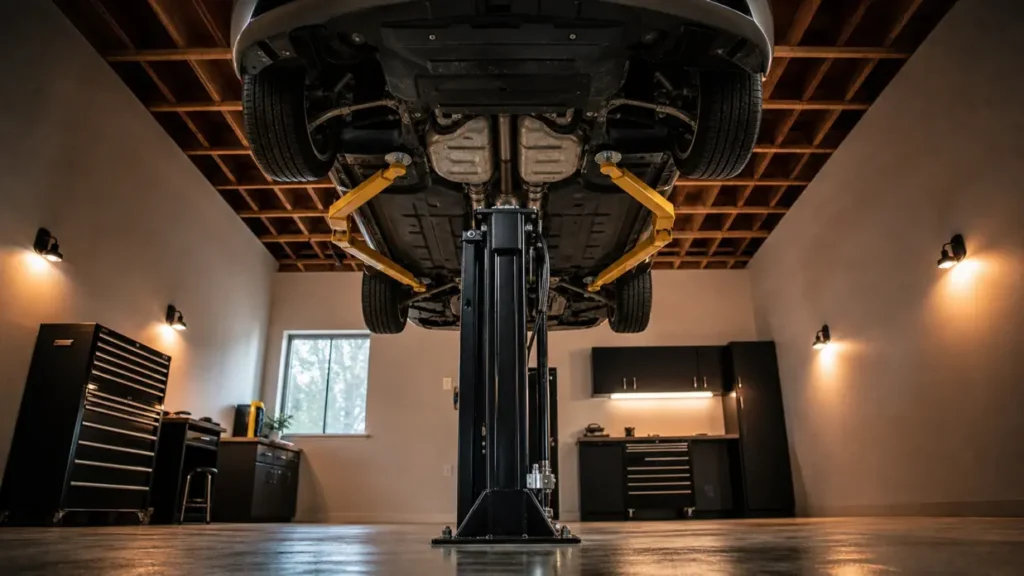
You've picked out the vehicles you want to service, you've measured your bay, and you're finally ready to buy a 2 post lift. Then you hit the fork in the road: floorplate or overhead? The salesperson tells you one is for low ceilings and the other has a "cleaner" floor, and that's usually where the useful advice ends.
Here's the honest version. The choice between a floorplate 2 post lift and an overhead 2 post lift comes down to three things: how much vertical space you actually have, how you move tools and jacks under a raised vehicle, and how tall the vehicles you service typically are. Get those three right and the decision makes itself. This guide walks through each one, with real numbers, so you can pick with confidence.
The Short Answer
A floorplate 2 post lift routes hydraulic hoses and equalizer cables under a low steel plate between the two columns, keeping the top open for tall vehicles. An overhead 2 post lift routes the same hoses and cables through a bar at the top, keeping the floor clear for creepers and jacks. Choose floorplate for ceilings under about 11 feet or for tall vans and cube trucks. Choose overhead if you have the height and want an unobstructed working floor.
What Is the Difference Between a Floorplate and Overhead 2 post Lift?
A floorplate 2 post lift is a design that transfers hydraulic power and cable tension between its two columns through a steel plate mounted at floor level, while an overhead 2 post lift transfers the same systems through a crossbar at the top of the two columns. Both lift a vehicle exactly the same way; the difference is only in where the plumbing runs.
That single design choice cascades into every other trade-off you're about to read about: ceiling requirements, workflow under the vehicle, the vehicles you can service, and even the arm configurations available to you.
How Each Design Routes Power
Both lift types use a hydraulic power unit mounted on one column, called the power side. That unit pumps fluid to cylinders in both columns, which then raise the carriages and arms. A pair of aircraft-quality equalizer cables keeps both sides rising at the same rate. The cables don't lift; the hydraulics do. The cables just synchronize.
The question is how you get the hoses and cables from column A to column B. On a floorplate lift, they run across the floor and sit under a low steel cover roughly two inches tall and eight inches wide. On an overhead lift, they run up one column, across a crossbar at the top, and down the other side. That crossbar also holds a shut-off switch that stops the lift if a tall vehicle contacts it. Same job. Different route.
Why the Terminology Matters
You'll see a few different names for these two designs, and they all mean the same thing:
- Floorplate is also called baseplate, open top, or a 2 post lift no overhead bar.
- Overhead is also called clear floor, clearfloor, or closed top.
When you're shopping, don't assume "clear floor" is safer or "baseplate" is cheaper just because of the name. They describe the physical layout, nothing more. Focus on the specs.
When to Choose a Floorplate 2 post Lift
A floorplate 2 post lift is the right choice when your ceiling is under about 11 feet, when you regularly service tall vehicles that would hit an overhead crossbar, or when you want a simpler install with fewer overhead components.
In our experience, most floorplate buyers land in one of three groups. Home garage owners with 8 to 10 foot ceilings. Independent shops that service work vans, cube trucks, or lifted pickups. And commercial fleet bays where the overhead crossbar would conflict with tall service vehicles rolling through.
Low Ceilings (8 to 10 Feet)
This is the classic case. A typical overhead 2 post lift needs 11 to 12 feet of clear ceiling because you have to stack the column height, the overhead assembly, and a safety gap. A floorplate lift drops that requirement significantly by removing the overhead assembly from the equation. Daytona's LTPF9 9,000 lb floorplate lift has an overall height of 110 inches, and the LTPF12 12,000 lb floorplate lift comes in at 114 inches. Both fit under a standard 10-foot residential ceiling with clearance to spare.
If you're specifically working in an 8-foot ceiling garage, the math gets tighter. Read our dedicated guide on the 2 post car lift for 8-foot ceiling options before committing.
Tall Service Vehicles and Vans
Here's where the floorplate stops being a compromise and starts being the right tool. If you regularly service delivery vans, cube trucks, high-roof cargo vehicles, or lifted trucks with roof racks, an overhead crossbar is a problem, not a solution. Even with the ceiling height, the crossbar itself sits about 10 to 12 inches below the top of the columns and will hit tall vehicles before the ceiling does.
A floorplate lift removes that obstruction entirely. You can raise a work van with roof racks loaded, as long as your ceiling accommodates it. That's a legitimate operational advantage, not a workaround.
Contrarian Take: The Floorplate Isn't Always the Compromise
Most articles treat the floorplate lift as the "settle for" option when you can't fit an overhead. That's outdated thinking. For any shop that services vehicles over about 78 inches tall on a regular basis, the floorplate is the correct primary choice. The overhead assembly becomes the limitation, not the feature.
Simpler Installs and Tight Bays
Floorplate lifts are typically easier to install because there's no overhead crossbar to hoist and bolt into place at the top of two columns. That saves time, saves a second set of hands during install, and reduces the risk of dropping a heavy assembly. It's also more forgiving in older buildings where ceiling structure or roof trusses would make anchoring an overhead unit awkward.
When to Choose an Overhead 2 post Lift
An overhead 2 post lift is the right choice when you have at least 11 to 12 feet of ceiling clearance, when you value an unobstructed floor between the columns for jacks and creepers, and when you need access to asymmetric arm configurations for passenger cars.
Standard Ceilings (11 Feet or More)
Most commercial shop bays are built with 12 to 14 foot ceilings, and that's the sweet spot for overhead lifts. Daytona's LTPO15 15,000 lb overhead lift ships with a 2-foot height extension kit included, which is standard for shops that regularly service pickup trucks and SUVs. If code compliance is on your radar, the ALI Certified BR10-2OH-33 10,000 lb overhead lift is Daytona's only ALI-certified model and is the straightforward choice when a permit inspector is involved.
Daily Shop Workflow with Jacks, Creepers, and Oil Drains
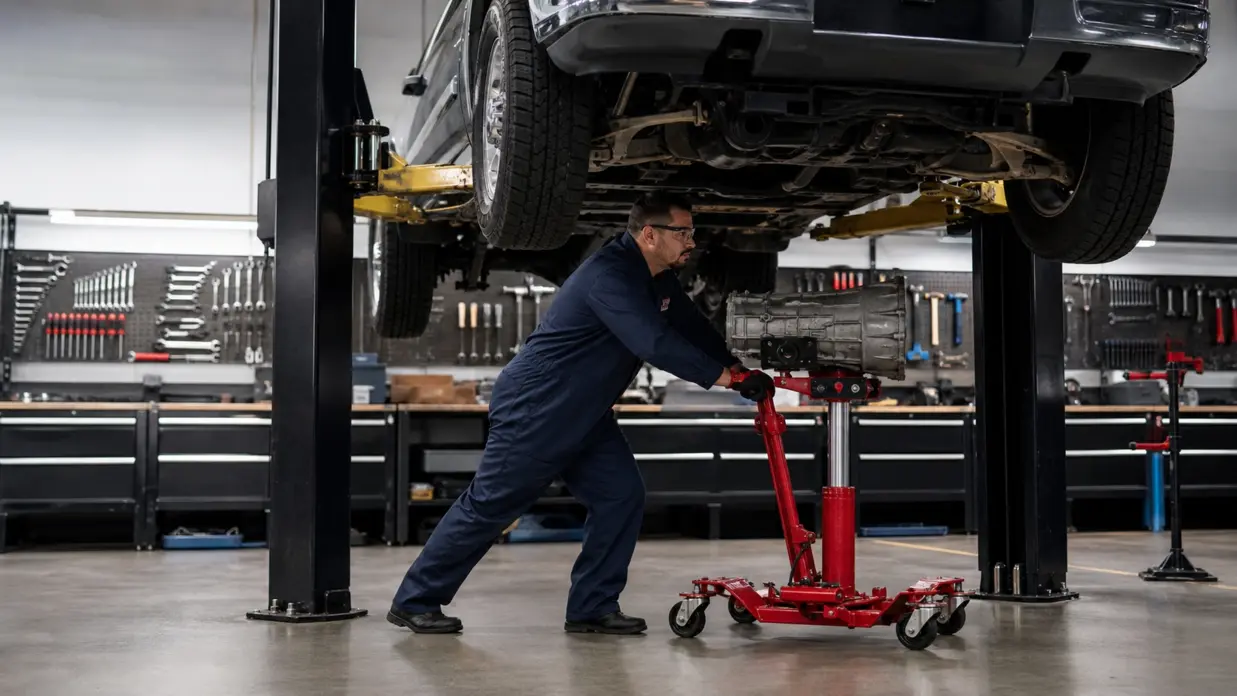
This is where the overhead earns its keep. Nothing on the floor means a transmission jack rolls freely from front to back of the vehicle. Oil drains slide underneath without lifting over a plate. Creepers move without catching. A shop tech doing 15 to 20 vehicles a day feels the friction of a floorplate every time they hit the bar with a wheel or a boot.
It's not a dealbreaker. Plenty of high-volume shops run floorplate lifts happily. But if you're doing brake and suspension work all day, and you already have the ceiling, the overhead pays for itself in small moments of workflow that add up over months.
Access to Asymmetric Arm Configurations
Here's a detail most buyers miss until it bites them. Floorplate lifts, by design, only support symmetric arm configurations. The columns face each other directly and the arms are equal length front and back. Overhead lifts can be configured symmetric or asymmetric, meaning the columns rotate slightly and the front arms are shorter than the rear. Asymmetric is what lets you open a car door fully without it hitting the column.
For a shop that mostly services passenger cars, that's a real quality-of-life advantage. Daytona's overhead lineup, including the LTPA10 and LTPA12 adjustable models, gives you multiple width settings to fine-tune the arm geometry for the vehicles you see most.
How to Calculate the Ceiling Height You Actually Need
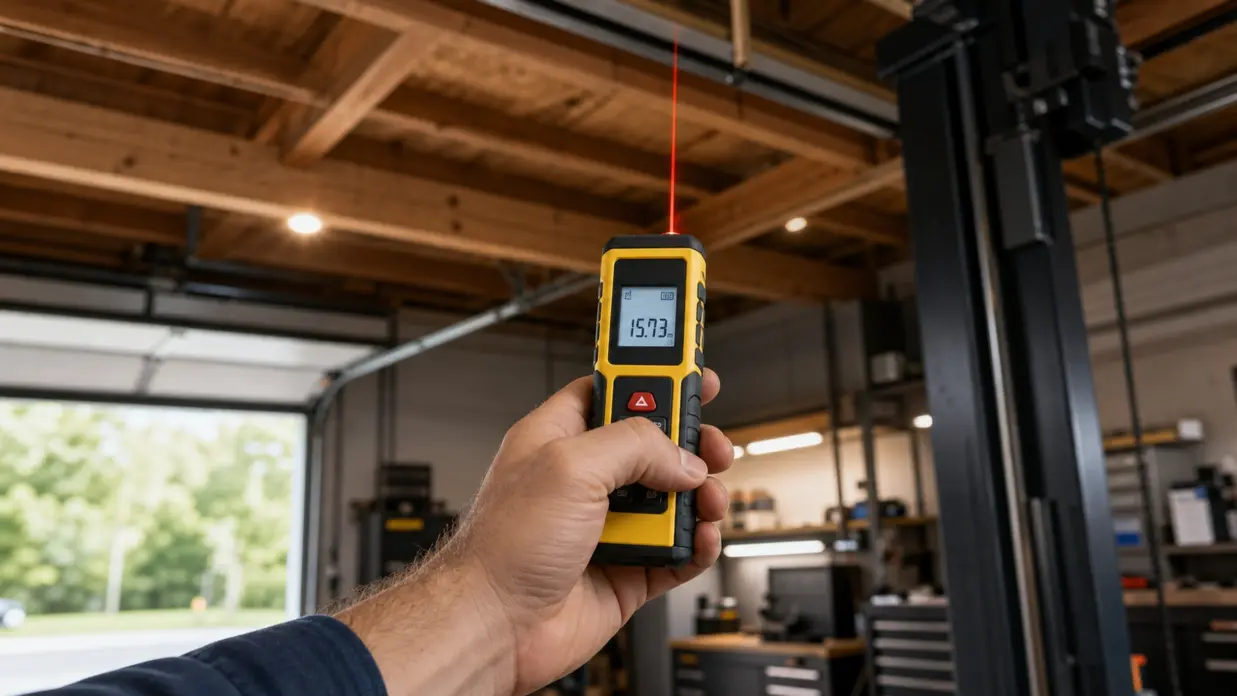
To calculate the ceiling height you need for a 2 post lift, add the lift's overall column height plus the overhead assembly clearance if applicable, plus at least one inch of safety gap between the lift and the ceiling. For an overhead lift with a 12-foot column and a 12-inch overhead assembly, you need about 13 feet of clear ceiling. For a floorplate lift with a 110-inch column, you need about 111 inches, or roughly 9 feet 3 inches.
Overhead Lift Ceiling Math
Overhead lifts have three vertical components you have to account for: the column, the overhead crossbar assembly, and a safety gap. The crossbar is not just a decorative housing. It sits above the top of the columns and adds real inches to the total footprint.
| Component | Typical Range |
|---|---|
| Column height | 135 to 155 inches on standard 10K to 15K models |
| Overhead assembly clearance | 10 to 12 inches above the column top |
| Safety gap to ceiling | At least 1 inch (more is better) |
| Total ceiling needed | 146 to 168 inches (12 ft 2 in to 14 ft) |
The number that actually matters for daily use is different: the distance from the floor to the underside of the overhead cutoff switch. That's how tall a vehicle can be before it triggers the switch and stops the lift. Confirm that dimension in your model's spec sheet, not the total column height.
Floorplate Lift Ceiling Math
Floorplate lifts are simpler because there's no overhead assembly to add. You need the column height plus a safety gap to the ceiling. That's it.
| Lift Model | Overall Height | Minimum Ceiling |
|---|---|---|
| Daytona LTPF9 (9,000 lb) | 110 inches | about 9 ft 3 in |
| Daytona LTPF12 (12,000 lb) | 114 inches | about 9 ft 7 in |
| Typical overhead 10K | 145 to 155 inches (with assembly) | about 12 ft to 13 ft |
The gap between a floorplate and an overhead is real. Three feet of ceiling, in some cases. That's the entire reason the floorplate design exists.
Are There Any Downsides to a Floorplate Lift?
A floorplate 2 post lift has three notable trade-offs compared to an overhead: it supports only symmetric arm configurations, the low steel plate creates minor workflow friction under the raised vehicle, and it can concentrate slightly more load on the rear anchor bolts of each column. None of these are dealbreakers, but they matter more in some shops than others.
Symmetric-Only Arm Configuration
As noted earlier, a floorplate lift's columns face each other directly, which means the arms have to be equal length front and back. That's fine for trucks, vans, and evenly balanced vehicles. It's less ideal for passenger cars where an asymmetric configuration would let the driver open the door fully. In our experience, home garage owners rarely care about this. Shops doing high-volume passenger car work notice it every single day.
Under-Vehicle Workflow Impact
The floorplate itself is about two inches tall and eight inches wide, with angled ramps on both approaches so vehicles drive over it easily. But when a tech is working under the raised vehicle with a transmission jack or a creeper, that bar is in the way. It's not a huge obstacle. Just a small one, encountered many times per day. If your shop does mostly under-vehicle work like transmission drops or exhaust jobs, the overhead's clear floor is worth the extra ceiling requirement.
Anchor and Concrete Considerations
Because a floorplate lift lacks the top crossbar that helps counteract the forward lean of both columns under load, more of the lifting force transfers to the rear anchor bolts at the base of each column. In practice this means you should be extra diligent about anchor depth, concrete quality, and torque. Any Daytona lift install requires a minimum of 4 to 4.25 inches of 3,000 PSI concrete cured at least 28 days; for heavier floorplate models it's worth confirming your slab meets or exceeds that. Read our full guide on how thick of concrete for a 2 post lift before you drill your first hole.
Are Floorplate Lifts Safe?
Yes. Both designs are safe when installed to the manufacturer's spec on qualifying concrete. The overhead design does provide slightly more stability under maximum load because the top bar counteracts column lean, but this is a marginal engineering difference, not a real-world safety gap. Every Daytona lift ships with automatic safety locks with single-point release, height limit switches, and aircraft-quality lifting cables. The Automotive Lift Institute certifies lifts to ANSI/ALI ALCTV standards regardless of whether they're floorplate or overhead design.
Side-by-Side Comparison Table
| Feature | Floorplate (Baseplate) | Overhead (Clear Floor) |
|---|---|---|
| Minimum ceiling height | About 9 to 10 ft | About 12 to 14 ft |
| Vehicle height limit | Ceiling only | Ceiling minus overhead assembly |
| Under-vehicle floor | Plate between columns | Completely clear |
| Arm configuration | Symmetric only | Symmetric or asymmetric |
| Install complexity | Simpler | Requires overhead assembly hoist |
| Best for | Tall vehicles, low ceilings, tight bays | Passenger cars, high-volume shops, standard ceilings |
| ALI certification available (Daytona) | No | Yes on BR10-2OH-33 |
Daytona's Floorplate and Overhead Options
Daytona has been building 2 post lifts for the US and Canadian markets since 1999, and the current lineup covers both designs across a range of capacities. On the floorplate side, the LTPF9 handles 9,000 lb at a 110-inch overall height and the LTPF12 handles 12,000 lb at 114 inches. Both fit under a standard 10-foot residential ceiling and both use chain-over hydraulic cylinders with automatic safety locks.
On the overhead side, the lineup runs from the ALI Certified BR10-2OH-33 at 10,000 lb, through the LTPA10 and LTPA12 adjustable-width models, up to the LTPO15 15,000 lb overhead lift with a 2-foot height extension kit included. Every lift ships backed by Daytona's 5-2-1 warranty: five years on structural components, two on power units, one on parts, with freight covered in both the US and Canada.
If you want to see all the 2 post options side by side, browse the full 2 post lift category, or step up a level to the automotive lifts hub to compare across lift types. For a broader buying framework, our best 2 post car lift buyer's guide walks through capacity, arm style, and power requirements in more depth.
Frequently Asked Questions
What is the minimum ceiling height for a 2 post lift?
A floorplate 2 post lift typically needs about 9 feet 3 inches of ceiling for a 9,000 to 10,000 lb model, while an overhead 2 post lift usually needs 12 to 13 feet. Always confirm the exact overall height in your specific model's spec sheet and add at least a 1-inch safety gap to the ceiling.
Can you install a 2 post lift in an 8-foot ceiling garage?
Fitting a true 2 post lift under an 8-foot ceiling is tight and often not possible with a full-rise unit. Most floorplate 2 post lifts need at least 9 to 10 feet. If you're limited to an 8-foot ceiling, a mid-rise scissor lift or a lower-capacity floorplate model is usually the better fit. See our dedicated 8-foot ceiling guide for the specifics.
Are baseplate lifts as safe as overhead lifts?
Yes, both designs are safe when installed to spec on qualifying concrete. The overhead design provides slightly more stability under maximum load because the top bar counteracts column lean, but that's a marginal engineering difference, not a real-world safety gap. Both use automatic mechanical locks and aircraft-quality cables.
Do floorplate lifts require more concrete than overhead lifts?
Not necessarily more, but the load distribution is different. Because there's no top crossbar to help resist column lean, more lifting force transfers to the rear anchor bolts. The minimum spec is the same (typically 4 to 4.25 inches of 3,000 PSI concrete cured 28 days), but be extra diligent with anchor depth, torque, and slab quality on a floorplate install.
Can you get an asymmetric floorplate 2 post lift?
No. Floorplate 2 post lifts are symmetric-only by design because the columns face each other directly across a fixed-length base plate. If you need an asymmetric configuration for door-opening clearance on passenger cars, you'll need an overhead 2 post lift.
Can a floorplate lift handle trucks and vans?
Yes, and it's often the better choice for them. Because there's no overhead crossbar, a floorplate lift can raise tall work vans, cube trucks, and lifted pickups higher than an overhead lift with the same ceiling clearance. For fleet shops that regularly service tall vehicles, floorplate is frequently the primary recommendation, not a compromise.
Which is cheaper to install, floorplate or overhead?
Floorplate lifts are usually slightly easier and faster to install because there's no overhead crossbar assembly to hoist and bolt into place at the top of both columns. Total installed cost varies by model and market, but the labour side of the equation typically favours the floorplate design.
Do I need a permit to install a 2 post lift in my home garage?
It depends on your jurisdiction. The 2024 IRC and IBC now require residential and commercial lifts to be ALI certified, and any new electrical circuit usually needs permitted, inspected work. Check with your local building department before installing, and confirm the 2024 IRC lift requirements apply in your area.
Does using a floorplate lift affect the warranty?
No, both floorplate and overhead lifts carry Daytona's full 5-2-1 warranty (5 years structural, 2 years power units, 1 year parts) when installed indoors on qualifying concrete by a properly qualified installer. Outdoor installation voids the warranty regardless of lift type.

Still Choosing Between Floorplate and Overhead?
Send us your ceiling height, the vehicles you lift most, and your slab details. We'll spec the right Daytona 2 post lift and connect you with a distributor or installer in your area.
- 5-2-1 Limited Warranty (5 years structural, 2 years power, 1 year parts)
- ALI Certified option available on the BR10-2OH-33
- Canadian-owned manufacturer since 1999
- Freight included on warranty parts in the US and Canada
- Active distributor network across North America